Table of Contents
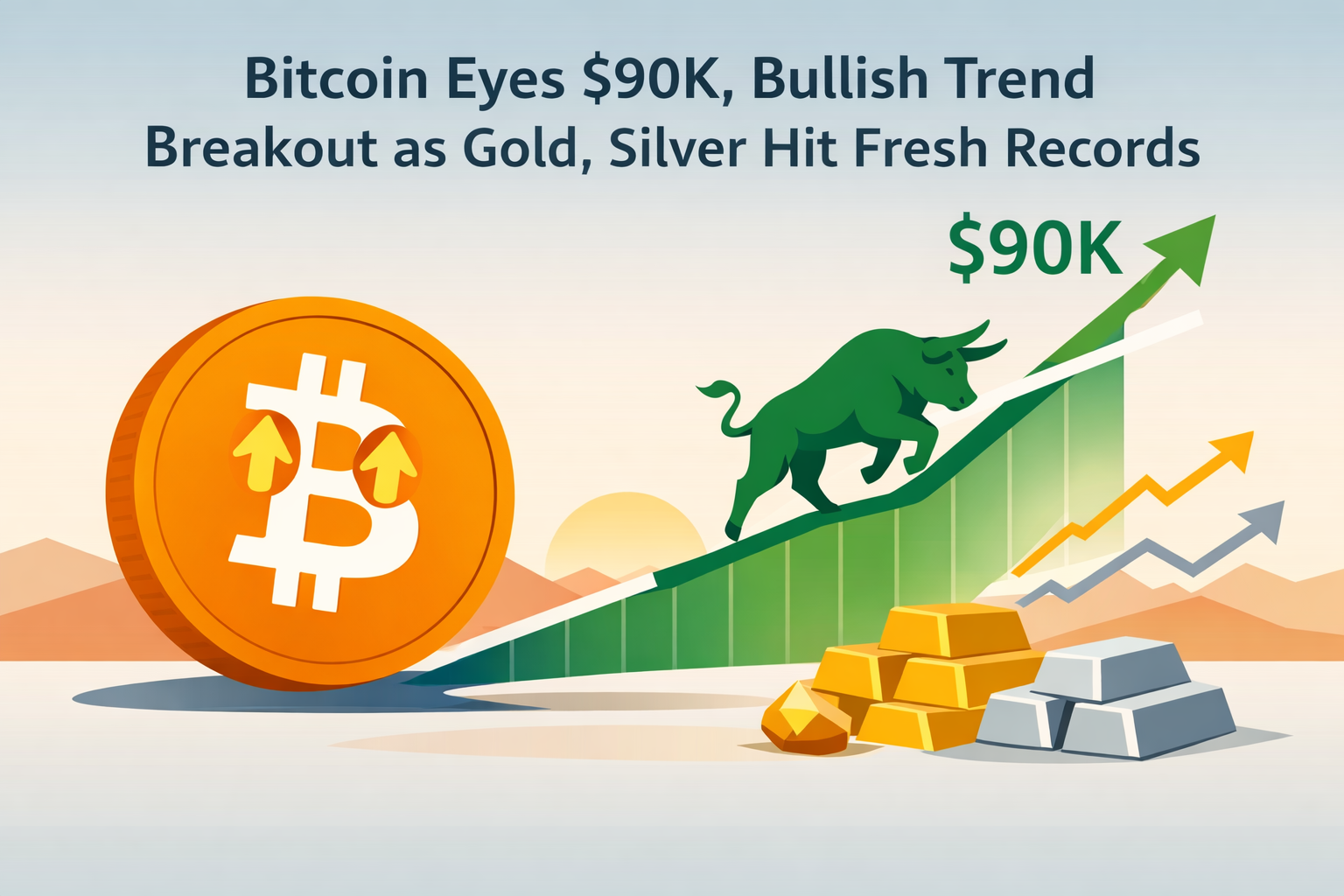
While traditional financial markets bask in record-setting highs for gold and silver, the truly forward-thinking investor is casting an eye beyond the glitter of precious metals—toward the digital frontier of Bitcoin and its potential trajectory past $90,000. Amidst a backdrop of inflationary pressures, mounting sovereign debt, and eroding confidence in fiat currencies, Bitcoin stands poised to assert itself not just as a speculative asset, but as a serious contender for the title of supreme store-of-value in the modern era.
Contrarians and macro-minded investors would be wise to examine the current divergence among major asset classes. In recent months, gold soared beyond $2,400, while silver finally broke the $30 threshold—levels unseen since the early 2010s. This rush into hard assets reflects widespread fear around the health of fiat economies. However, conspicuously under the radar, Bitcoin (BTC) has been consolidating in bullish fashion. Historically, Bitcoin tends to follow late behind gold during market shifts into safe havens, but when it catches momentum, it tends to leave every other asset behind, often delivering exponential gains in compressed timeframes.
The Macro Landscape: Inflation, Currency Debasement, and Institutional Awakening
The macroeconomic climate globally is under considerable strain. Central banks across advanced economies have spent over a decade engaging in quantitative easing (QE), balance sheet expansion, and near-zero interest rate policy (ZIRP). These interventions, while effective in the short term, have created long-term distortions. Trillions in printed currency have led to asset price inflation, deteriorating real wages, and rising costs of living—all symptomatic of a creeping fiat devaluation.
Although recent Consumer Price Index (CPI) numbers may suggest several months of cooling inflation, core components like rent, energy, and food reveal persistent cost pressures. Investors have taken notice. The result has been strong inflows into hard assets. Gold's impressive 8% climb in April reinforced its traditional role as a hedge, while silver’s 12% surge reminded skeptics of its industrial and monetary use-case. Yet, amid these moves, Bitcoin quietly reclaimed ground after a March pullback, floating just under the psychologically significant $72,000 level.
All eyes now turn to historical precedent. If prior post-halving cycles are any indication—2013, 2017, and 2021—Bitcoin appears to be entering the launching pad phase of the cycle. In each previous cycle, the greatest gains occurred six to twelve months after halving. Given the 2024 halving, a surge toward (or beyond) $90,000 before year’s end is increasingly looking plausible, if not probable.
Why Following the Crowd May Be a Mistake This Time
Mass media and legacy financial institutions, though starting to acknowledge digital assets, are still largely inclined toward the familiar gold and silver narratives. These are assets that have served as monetary hedges for millennia. However, financial history is littered with examples of paradigm shifts. Bitcoin is not the same asset it was five or even three years ago. What began as an experimental peer-to-peer cash system has evolved into a trillion-dollar, borderless store-of-value with unmatched programmable utility.
Institutional adoption is no longer a matter of speculation—it’s an observable fact. Leading hedge funds, public companies, family offices, and sovereign wealth funds have begun adding BTC to their balance sheets. Moreover, the approval of Bitcoin-focused ETFs in major jurisdictions like the U.S. and Europe has opened floodgates of capital. Assets under management (AUM) in these ETFs have exploded in recent months, and that’s just the beginning.
Contrast this with physical gold or silver. The barriers to entry are significant—custody, transport, valuation, and liquidity are all challenges. Bitcoin offers frictionless access, 24/7 tradeability, and near-instant settlement—qualities that appeal especially to the next generation of investors. With its capped supply of 21 million coins, algorithmic issuance schedule, and transparent ledger, Bitcoin may be the only digitally native asset that satisfies the requirements of a modern hard money standard.
Technical Outlook: The Path to $90,000 (and Beyond)
From a technical perspective, Bitcoin’s current price action reveals a bullish structure. On the weekly chart, BTC broke out of a multi-week descending wedge—a traditional bullish reversal pattern. After finding strong support at the $60,000-$62,000 range, the digital asset has built a solid base for a potential vertical move.
Immediate resistance lies at $75,000, the prior local high, followed by psychological resistance zones at $80,000 and then the round number of $90,000. Technical indicators such as the Relative Strength Index (RSI) remain in neutral territory, implying that a move higher does not necessitate extreme overbought conditions. Additionally, Fibonacci extension levels from the last major retracement point suggest a price target between $89,000 and $92,000 if symmetric historical fractals play out.
Risk management remains paramount at these levels. While Bitcoin’s long-term trend is bullish, it remains notoriously volatile. Smart exposure recommendations suggest dollar-cost averaging (DCA) for initial entry, and adding positions strategically on dips. For more active investors, employing stop-losses just below support levels can offer downside protection. Others may use protective puts or call options to manage risk or leverage entries via futures while maintaining tight controls. In an environment where fiat currency routinely loses purchasing power, Bitcoin may offer asymmetric upside—but only to those who navigate its volatility with discipline.
Valuation Frameworks: Comparing Bitcoin to Gold
If we use gold’s market capitalization as a benchmark, the Bitcoin narrative becomes even more compelling. Gold's estimated market cap hovers around $14 trillion. In contrast, Bitcoin's is still under $1.5 trillion—just over 10% of gold’s. If Bitcoin were to achieve a similar level of trust and adoption, even partially, the implied price per coin could range between $200,000 to $500,000, depending on assumptions around total supply and distribution.
This comparison highlights the massive asymmetry of opportunity. While gold may offer 10%-15% upside from current levels in a best-case inflation hedge scenario, Bitcoin could potentially double, triple, or even quintuple in value over the next market cycle. This does not mean Bitcoin is without risks—it is younger, more volatile, and still misunderstood by regulators and institutions alike. However, for those with a long-term horizon and tolerance for volatility, the potential reward may more than compensate.
Final Thoughts: The Quiet Revolution Is Already Underway
Legacy financial commentary continues to celebrate gold and silver as the ultimate safe-haven assets. There is nothing inherently wrong with that view. But in a digital-first, decentralized economy, it is becoming increasingly evident that Bitcoin is carving out its place not merely as a speculative tool, but as the native digital store-of-value for the 21st century.
The crowd continues to sleep on Bitcoin’s transformative potential, preferring physical metals grounded in centuries of tradition. But financial revolutions are rarely announced. They happen incrementally, then suddenly. Bitcoin’s adoption is quietly penetrating insurance companies, pension funds, governments, and fintech applications around the world. As this trend accelerates, so too will its price—likely catching the majority of market participants off guard.
Gold and silver will always have their place, but in a world increasingly defined by decentralization, programmability, and digital connectivity, Bitcoin stands primed to become the asymmetric bet of the decade. Accumulating quietly now, while mainstream attention remains elsewhere, could prove a generation-defining decision.