Table of Contents
The Move and the Numbers
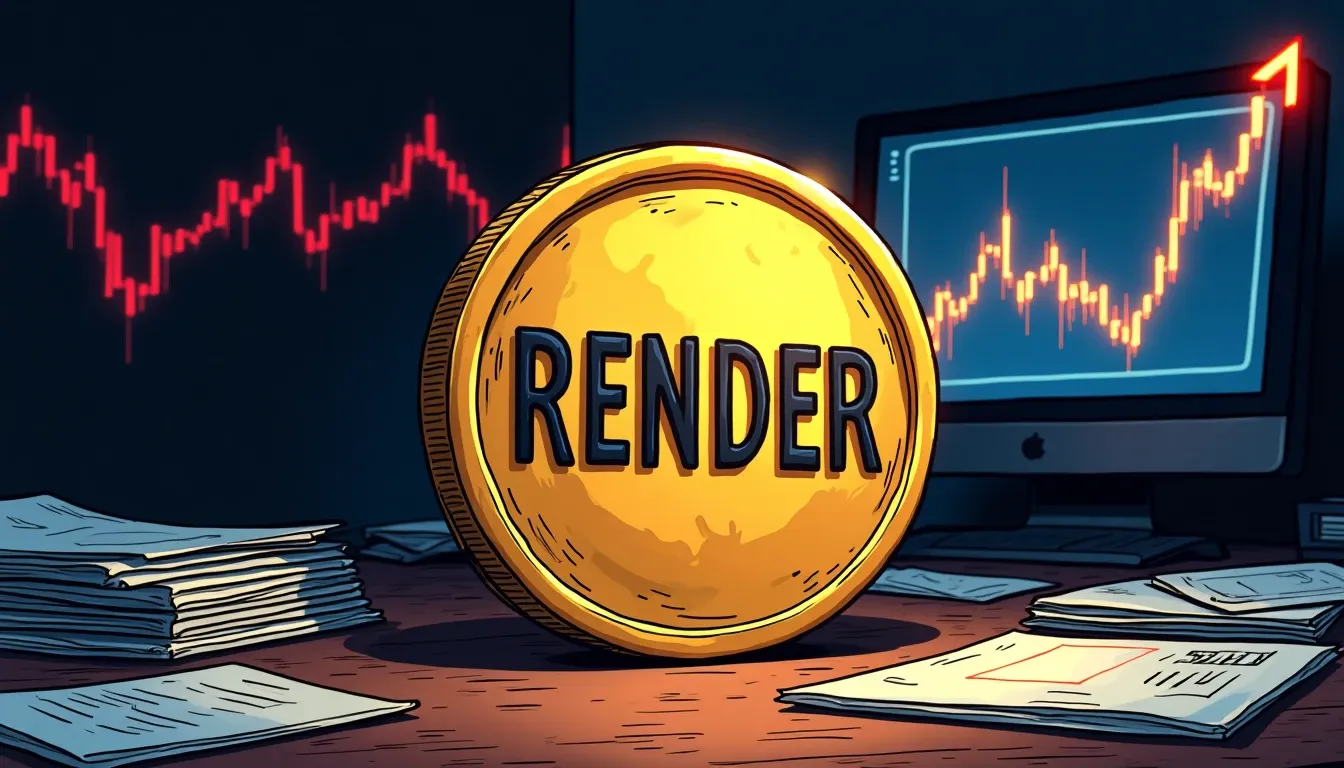
Render (RENDER) climbed 40.8% over the past 30 days to $1.95 as of September 30, 2026, per CoinGecko. The token added 10.4% in the past seven days and dropped 0.8% in the past 24 hours. Market capitalization stands at $1,008,912,598, ranking the token 80th among all crypto assets. Render remains 85.6% below its March 17, 2024 all-time high of $13.53.
The rally unfolded in stages across August and September, not from a single announcement. The move reflects a combination of network upgrades completed in July, sustained AI infrastructure narrative strength, and sector rotation into decentralized physical infrastructure network (DePIN) tokens during the third quarter of 2026.
What Drove the Rally
The most concrete catalyst preceded the 30-day window. RNP-023 was implemented in production on July 9, 2026, integrating Salad's decentralized GPU subnet as an exclusive provider and significantly boosting network capacity for AI and rendering workloads. Payments and node rewards now use RENDER, directing more on-chain revenue into the token's burn-and-mint equilibrium. The upgrade added tens of thousands of consumer-grade GPUs to the network and was designed to create deflationary pressure by ensuring burns exceed new token minting from day one.
The rally itself intensified in mid-September as AI-linked tokens rallied as a group. RENDER's price rose 10.2% in 24 hours as AI-linked crypto tokens surged 9.4% collectively. Render was explicitly cited in sector coverage as gaining around 10% alongside NEAR, TAO, and FET, coinciding with a high-profile AI safety summit and ongoing enthusiasm for AI and GPU infrastructure. No new Render-specific fundamental catalyst stood out in this window, so the move appeared to be largely narrative and flow-driven within a broader AI token rotation rather than triggered by a unique project event.
Network activity provided supporting data. Daily active addresses reportedly climbed to 394, while 118 new wallets were created in a single day, both reaching their highest levels in 12 weeks, supporting the view that the latest rally was not only speculative but also backed by stronger network participation. Grayscale rebalanced its Decentralized AI Fund for Q2 2026 with RENDER making up approximately 21.7 to 22 percent of holdings. Institutional allocation signals legitimacy but does not by itself create upward price pressure.
The timing matters. The July upgrade provided fundamental support, but the price action accelerated two months later when capital rotated into AI infrastructure tokens. That sequence suggests the market priced in the upgrade slowly, then amplified the move when broader sector sentiment turned positive. The rally followed rather than led the catalyst.
What Holds It and What Breaks It

For the move to hold, network usage must grow faster than token emissions. From January to September 2025, the network burned 530,171 RENDER tokens, compared to 139,924 during the same period in 2024, a 278.9% year-over-year increase demonstrating accelerating network utilization. If that trajectory continues, the deflationary mechanism supports price. If usage stalls, new token minting dilutes holders and the rally reverses.
The second variable is AI narrative strength. Render Network's core value proposition, decentralized GPU compute for rendering and increasingly for AI workloads, keeps pulling it into the broader AI token narrative whenever compute demand becomes a talking point across markets, but it also means the token tends to move on sentiment tied to companies like Nvidia rather than purely on its own network metrics. When Nvidia earnings disappoint or AI infrastructure spending forecasts weaken, tokens like RENDER typically give back gains faster than the sector averages because their valuations embed multiple layers of speculation.
Whale concentration adds fragility. Whale-tier addresses control the large majority of tracked value, meaning large holder movements have the potential to influence price more than they might for a more evenly distributed token. A 40.8% rally in 30 days signals crowded positioning. If early buyers begin taking profit or if a few large wallets rotate into other assets, the bid can disappear quickly. Reversals from momentum-driven rallies typically move as fast as the initial climb.
The move may reflect renewed interest in artificial-intelligence infrastructure, decentralized physical infrastructure networks, GPU scarcity and the broader recovery of crypto risk appetite, but Render's valuation remains sensitive to whether network usage, token burns and creator demand grow quickly enough to justify a higher market capitalization, and competition from centralized GPU providers and decentralized alternatives such as Akash Network and io.net remains a constraint.
What the Rally Does Not Mean for Holders
A 40.8% move does not validate the investment thesis. It validates that other buyers were willing to pay more over the past month. Those are not the same thing. The token remains 85.6% below its all-time high, meaning earlier rallies were followed by deeper drawdowns. Fast moves create the illusion of momentum, but momentum is a lagging signal that tells you what already happened, not what comes next.
For holders evaluating whether this changes anything about the position, the relevant question is whether the network is generating enough revenue to support current or higher valuations through token burns. Throughout August 2026, the Render Network continued to build on its 2025 momentum, which saw the launch of Dispersed, a customer-facing platform that aggregates the network's globally distributed GPU supply for AI and general-purpose compute workloads, and the network has been onboarding enterprise-grade GPUs, including NVIDIA H100/H200 models, to meet growing AI compute demand. That infrastructure expansion is necessary but not sufficient. The network must convert capacity into paid jobs at a rate that exceeds token dilution.
If you hold RENDER for its yield or staking mechanics, this rally changes nothing about those fundamentals unless burn rates accelerate materially. If you hold it for exposure to decentralized AI infrastructure, the rally reflects broader sector interest but not a breakthrough in Render's competitive position. Centralized cloud providers still control the vast majority of GPU compute, and decentralized alternatives are adding capacity faster than they are adding differentiated demand.
The move also does not signal an entry point. Tokens that rally 40% in 30 days either continue on the strength of sustained catalysts or correct when early buyers take profit. Both outcomes are possible, which means the recent move provides no directional information for someone considering a new position. The decision to add exposure should rest on whether the network's usage growth, tokenomics, and competitive positioning justify the current market capitalization, not on whether the chart moved up recently.
What matters for income-focused holders is whether the network can sustain or grow its burn rate relative to emissions. If usage continues to accelerate and the burn-and-mint equilibrium tips further toward deflation, holding makes sense. If usage flattens or if competing networks capture the incremental demand for decentralized GPU compute, the recent rally becomes a high-water mark rather than a foundation.
What Comes Next
The token's next major test will be whether network activity continues to grow through the fourth quarter of 2026. On September 16, 2026, the Render Network community voted on the Mainnet Adapter and Protocol 28 Upgrade, a governance decision that will determine the network's next protocol iteration, and this upgrade vote is significant because it signals the network's ongoing commitment to protocol evolution and technical refinement. Governance votes do not move prices, but successful upgrades that increase capacity or reduce friction for enterprise users create the conditions for sustained usage growth.
The broader AI infrastructure narrative will remain a driver, but it cuts both ways. If centralized providers like AWS, Google Cloud, or Microsoft Azure continue to dominate enterprise GPU contracts, decentralized networks will struggle to capture meaningful market share regardless of how much capacity they add. Render's advantage lies in cost and censorship resistance, but most enterprises optimize for reliability and integration ease, not decentralization.
For now, the 40.8% rally reflects a combination of real network development, sector rotation, and narrative strength. It does not reflect a fundamental revaluation or a shift in competitive positioning. The move holds if usage accelerates and burns increase. It breaks if AI sentiment weakens, whales rotate out, or competing networks capture the next wave of decentralized compute demand.
You have just examined a 40.8% rally built on network upgrades, sector rotation, and whale-driven flows. Those catalysts shift every cycle, and next month the composition will be different.
Every Thursday: where crypto yield actually is - stablecoins, liquid staking and DeFi lending, with the risk named next to the rate and what changed since last week.
Get it free every ThursdayFree. No trade calls, no allocations, no hype. Unsubscribe in one click.