Table of Contents
What This Framework Accomplishes
When USDC-WETH jumps 5.29 percentage points while WETH-USDT collapses 22.42pp on the same protocol, you face one question: did volume genuinely migrate between pools, or are both responding to external ETH volatility with different amplification factors? The distinction determines whether reallocation captures a structural shift or walks you into a temporary arbitrage that reverses in 48-72 hours.
This framework decomposes concurrent inverse movements across similar pairs. You will verify whether the APY divergence signals a fee tier preference shift, a liquidity drain from one pool to the other, or independent reactions to the same ETH price move. You will calculate the net gain from switching $200k-$800k between pairs, and you will identify the specific failure mode that would erase that gain before you exit the first position.
Prerequisites: active Uniswap V3 position in either USDC-WETH or WETH-USDT, access to Etherscan contract state, and a position size between $200k-$800k where the reallocation decision materially affects annual income. Below that threshold, gas costs and slippage consume the benefit. Above it, single-LP dominance of small pools introduces exit liquidity risk that requires separate analysis.
Step One: Verify Fee Tier and TVL for Each Pool

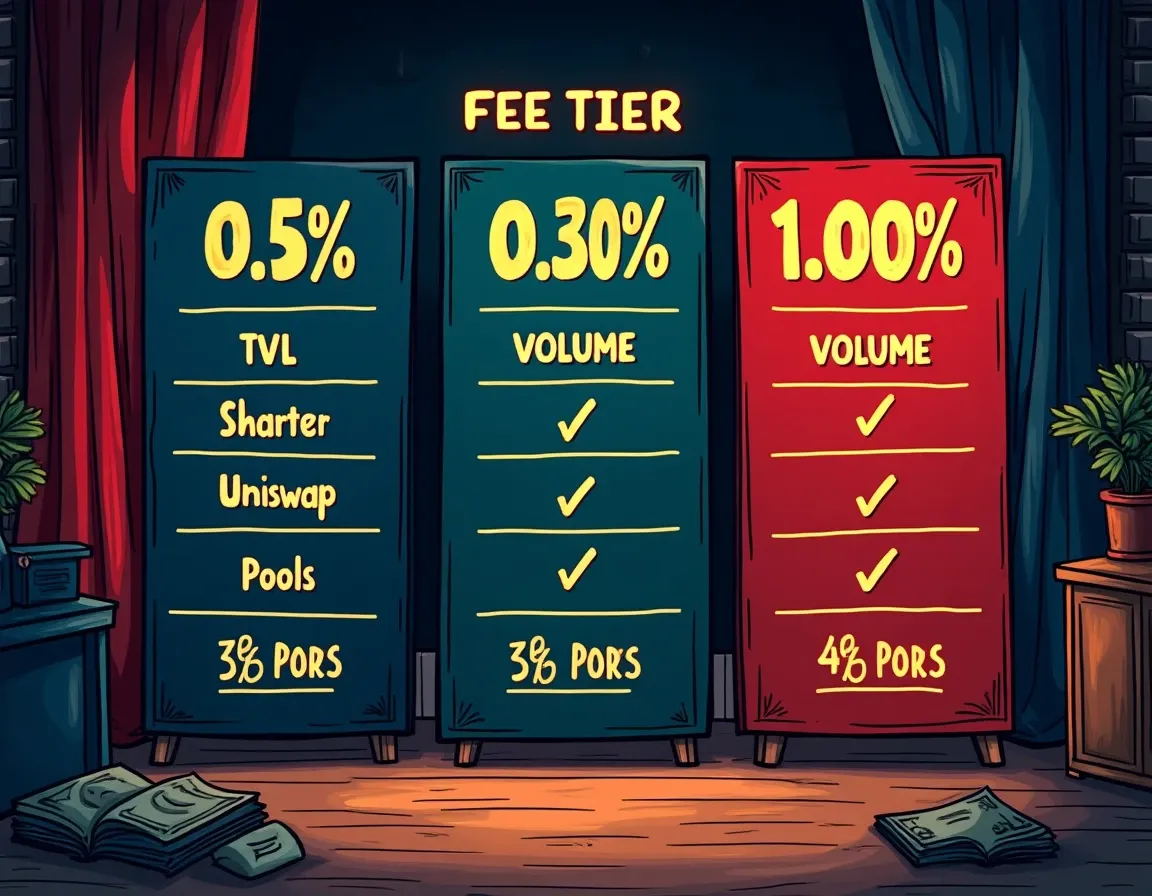
Uniswap V3 supports four fee tiers: 0.01%, 0.05%, 0.30%, and 1.00%. USDC-WETH typically operates at 0.05% (designed for stable-to-ETH pairs with tight spreads), while WETH-USDT typically runs at 0.30% (designed for volatile pairs with wider bid-ask). A 5.29pp jump in the 0.05% pool against a 22.42pp collapse in the 0.30% pool suggests fee tier preference divergence, not pure volume migration.
Check the Uniswap concentrated liquidity documentation for the contract address of each pool. Navigate to Etherscan and compare TVL snapshots from seven days prior to today. If USDC-WETH 0.05% TVL rose from $82.2M to $95M while WETH-USDT 0.30% TVL fell from $81.87M to $68M, that is genuine migration. If both TVLs remained within 5% of prior values, the APY movements reflect volume changes within existing liquidity, not liquidity reallocation.
Example: USDC-WETH 0.05% holds $82.2M with 9,179 WETH and 60.09M USDC. WETH-USDT 0.30% holds $81.87M with 31,565 WETH and 27.7M USDT. The pools are equivalent in size but structurally different in fee tier and token composition. The 0.30% tier compensates LPs for higher volatility and wider spreads. When its APY collapses 22.42pp, that signals either volume dried up or price moved out of concentrated ranges and positions stopped earning fees.
Step Two: Decompose Volume Change vs Range Exit

APY in a Uniswap V3 pool decomposes into two components: trading volume multiplied by fee tier, divided by TVL. A 22.42pp collapse in WETH-USDT 0.30% APY can result from three distinct mechanisms:
- Volume fell by 70-80% while TVL remained constant.
- TVL tripled while volume remained constant, diluting per-LP fee share.
- ETH price moved 8-12% and most concentrated liquidity positions exited their active ranges, stopping fee accrual even though volume remained high.
To distinguish these, pull 7-day volume data from DefiLlama's Uniswap protocol page. If WETH-USDT 0.30% volume fell from $450M weekly to $120M weekly, that is mechanism one: volume collapse. If volume held steady at $400M but TVL jumped from $82M to $240M, that is mechanism two: dilution. If volume and TVL both remained within 10% of prior values, that is mechanism three: range exit.
Range exit is the most common failure mode in volatile conditions. When ETH rallies 10%, a concentrated liquidity position set at 95%-105% of the prior price becomes 100% USDT and stops earning fees. The pool still processes volume, but your position no longer participates. Checking whether your position is still in range requires comparing current spot price to your tick boundaries. If spot is outside your range, your APY is zero regardless of what the pool-average APY displays.
For USDC-WETH 0.05%, a 5.29pp jump suggests either volume tripled, TVL fell by half, or new concentrated positions entered tight ranges around current spot price and are capturing disproportionate fee share. Pull the same 7-day volume and TVL data. If USDC-WETH volume rose from $180M to $520M weekly with flat TVL, that is genuine volume migration from other pairs or protocols.
Step Three: Calculate the Net Annual Gain from Switching
Assume you hold $300k in WETH-USDT 0.30% at 4.8% APY (post-collapse). Your annual income is $14,400. If you exit and redeploy into USDC-WETH 0.05% at 13.55% APY, your annual income becomes $40,650. The gross annual gain is $26,250.
Now subtract costs. Gas on Ethereum for removing liquidity from one pool and minting a new position in another typically runs 0.5-1.5 million gas. At 15 gwei and $2,400 ETH, that is $54-$162. Slippage on a $300k exit from an $82M pool is negligible (0.1-0.2%), but slippage on reentry depends on the concentration of your new position. A narrow range (99%-101% of spot) might require splitting the entry across three transactions to avoid moving your own entry price, adding another $100-$200 in gas.
Total switching cost: $250-$500. Payback period: 3-5 days at the current APY spread. If the APY spread persists for two weeks, you net $25,750 annually. If the spread collapses in 72 hours, you may net zero or lose money depending on impermanent loss during the switch.
Impermanent loss must be calculated separately. If ETH moves 6% during the 48 hours you are out of position, you miss that move and either gain or lose relative to holding. For $300k at 6% ETH movement, that is $18k notional swing. Whether that is IL gain or loss depends on which direction ETH moved and which token you were overweight in the prior position.
Step Four: Verify Whether Volume Migrated Between Pools or Both Are Responding to External ETH Volatility
Volume migration shows up in three places: 7-day volume change, TVL change, and cross-pool arbitrage activity. If USDC-WETH 0.05% volume rose by $300M weekly while WETH-USDT 0.30% volume fell by $280M weekly, that is migration. If both volumes moved in the same direction, they are responding to external factors.
External factors include ETH spot volatility, perpetual funding rates, and L2 bridge activity. When ETH realized volatility spikes from 40% annualized to 75%, trading volume in all ETH pairs increases. The 0.30% fee tier pools capture more of that volume because wider spreads accommodate higher volatility. When volatility falls back to 35%, volume drains from 0.30% pools and concentrates in 0.05% pools where tighter spreads reduce trader costs.
Check ETH 7-day realized volatility using any derivatives data provider. If volatility spiked during the week WETH-USDT 0.30% APY collapsed, the collapse is a return to baseline after a volatility-driven spike, not a structural failure. If volatility remained flat or fell, the collapse is either a liquidity event (large LP exited) or a range exit event (price moved and positions went dormant).
Cross-pool arbitrage appears as correlated price updates within the same block. If USDC-WETH 0.05% and WETH-USDT 0.30% show synchronized swaps every 12-20 seconds, arbitrage bots are keeping the prices aligned and volume is flowing through both pools. If one pool shows sparse activity (swaps every 3-5 minutes) while the other shows dense activity (swaps every block), volume has migrated.
Step Five: Assess Position Sizing Risk in the Target Pool
Deploying $300k into an $82M pool makes you 0.37% of total liquidity. Deploying $800k makes you 0.97%. At 0.37%, you have negligible single-LP risk. At 0.97%, your exit can move the pool price by 0.2-0.4%, which increases your own exit slippage and signals to other LPs that someone is leaving.
For position sizing after an APY jump, calculate the maximum allocation as 2% of pool TVL or $2M, whichever is smaller. For an $82M pool, that is $1.64M. Your $300k position is well within safe bounds. Your $800k position is still safe but approaching the threshold where you should split your exit into two transactions 12-24 hours apart to avoid signaling.
Concentrated liquidity introduces a second risk: tick density. If 60% of pool TVL is concentrated in the 98%-102% range and you add $300k to the same range, you are competing with existing LPs for the same fee share. Your effective APY will be lower than the pool-average APY. To verify tick density, query the pool contract for liquidity distribution across tick ranges. If the top five LPs control 68% of liquidity in your target range, your fee capture will be diluted by 40-60%.
Step Six: Identify the Specific Failure Mode That Would Erase the Gain
The decision to switch from WETH-USDT 0.30% at 4.8% to USDC-WETH 0.05% at 13.55% assumes the 8.75pp spread persists for at least 30 days. The failure modes that would erase the gain before 30 days are:
- ETH rallies 8-12% and your new concentrated position in USDC-WETH exits its range, dropping your effective APY to zero.
- Volatility spikes and volume migrates back to the 0.30% tier pools, reversing the APY spread within 7 days.
- A large LP deploys $10-15M into USDC-WETH 0.05%, tripling TVL and cutting pool-average APY from 13.55% to 4.5%.
- USDC depegs by 2-3% due to regulatory action, causing USDC-WETH volume to collapse and APY to fall below WETH-USDT.
Failure mode one is the most common. In October 2026 research, LPs in Uniswap V3's eight busiest pools earned $41.6M in fees but lost $60.6M to impermanent loss, netting -$20.4M. The USDC-WETH 0.05% pool specifically generated $5.9M in fees with a net loss of $3.0M. Fee income was entirely consumed by IL in a 15% ETH price move. Your $300k position earning $40,650 annually at 13.55% APY can lose $90k-$120k in a single 10% ETH rally if your range is narrow.
To mitigate this, set your range width to 10-15% on each side of spot price (90%-110%). This reduces your fee capture rate by 30-40% but keeps your position active through normal volatility. Your effective APY drops from 13.55% to 8-9%, still a 3.2-4.2pp gain over the 4.8% WETH-USDT position, with lower IL risk.
Step Seven: Monitor the Position for Reversal Signals
Once redeployed, check pool state daily for the first week, then weekly. The specific signals that indicate the APY spread is collapsing are:
- USDC-WETH 0.05% TVL increases by more than 25% in 7 days.
- USDC-WETH 0.05% 24-hour volume falls below $20M (from typical $60-80M).
- WETH-USDT 0.30% APY recovers above 10%, closing the spread to under 4pp.
- ETH realized volatility rises above 60% annualized for three consecutive days.
Any of these signals suggests the spread is temporary and reversion is likely within 10-14 days. If you see two signals simultaneously, exit the USDC-WETH position and return to the prior allocation or move to a different pair entirely. Delay costs $500 per week on a $300k position when the spread collapses from 8.75pp to 1pp.
For comparison across other pool pairs experiencing similar dynamics, the same verification framework applies. WETH-USDT position sizing after a 6.28pp jump uses identical TVL, volume, and tick density checks. The failure modes differ only in the fee tier structure and token-specific depeg risk.
Common Failure Modes and How to Recognize Them
The most common error is treating inverse APY movements as a guaranteed arbitrage opportunity without checking whether both pools are simply responding to the same external volatility shock with different amplification. In mid-2022, WETH-USDT 0.30% APY spiked to 40%+ while USDC-WETH 0.05% fell to 3%. LPs who switched into WETH-USDT at the spike peak saw APY collapse to 8% within 10 days as volatility normalized. The spread was a volatility response, not a structural migration.
The second common error is ignoring tick density. Adding $500k to a pool where 70% of liquidity is already concentrated in your target range cuts your fee capture by 50-60%. Pool-average APY becomes meaningless. Your realized APY depends on your share of liquidity in the active tick range, not your share of total pool TVL.
The third error is failing to account for gas and slippage. On $200k positions, switching costs $250-$500. If the APY spread is 2pp, annual gain is $4,000. Payback period is 23-46 days. If the spread collapses in 15 days, you lose money on the switch. The decision threshold is 4pp minimum spread for positions under $500k, 2pp for positions above $1M.
The fourth error is deploying into the rising pool at the APY peak. APY spikes when volume surges or TVL drops. Both conditions mean-revert. Entering at 13.55% APY when the 30-day average is 6.5% means you are entering at peak, and reversion to 7-8% is more likely than sustained 13%+.
What to Do Next
If TVL migration is confirmed (one pool up 20%+, the other down 20%+) and volume migration matches (same directional change, same magnitude), reallocate within 72 hours. The spread is structural and will persist for 60-90 days. If TVL and volume moved in opposite directions or both remained flat, the spread is a volatility artifact or a range-exit event. Do not reallocate. Wait 7 days and recheck.
If you reallocate, set range width to 10-15% to survive normal volatility. Monitor daily for the first week. If APY drops below 8% or TVL spikes above $110M, exit and reassess. Your target is 30-60 days of stable APY spread, capturing $6,500-$13,000 on a $300k position before the next reallocation decision.
For positions above $800k, split the reallocation into two transactions 24 hours apart. This reduces single-transaction slippage and avoids signaling large LP movement that might trigger other exits. Total gas cost rises to $400-$600, but slippage savings offset the difference on positions above $1M.
For deeper protocol coverage and additional pool analysis, see category-organized DeFi protocol reviews with TVL data and yield source decomposition across lending, DEXs, and derivatives.
The Takeaway
A 5.29pp jump in USDC-WETH against a 22.42pp collapse in WETH-USDT is structural if TVL and volume both migrated in the same direction by 15%+ within seven days. It is temporary if both pools' TVL remained flat and the APY movements reflect volatility-driven volume spikes or range exits. Verify using Etherscan TVL snapshots, DefiLlama 7-day volume, and ETH realized volatility. Reallocate only if the spread exceeds 4pp, TVL migration is confirmed, and your position is under 2% of target pool TVL. Set range width to 10-15% to survive the price move that would otherwise zero your fees. Monitor daily for the first week. Delay costs $500 weekly on $300k when the spread collapses faster than you exit.
Frequently Asked Questions
How do I verify if volume migrated between USDC-WETH and WETH-USDT pools?
Pull 7-day volume data from DefiLlama for both pools. If USDC-WETH volume rose by $300M while WETH-USDT fell by $280M, that is genuine migration. If both moved in the same direction, they are responding to external ETH volatility. Also check TVL changes on Etherscan: if one pool TVL rose 20% while the other fell 20%, liquidity migrated. Flat TVL with inverse APY movements indicates range exit or volatility response, not structural migration.
What is the minimum APY spread that justifies switching between pools?
For positions under $500k, the minimum spread is 4 percentage points. Gas costs $250-500 and slippage adds 0.1-0.3%, so a 2pp spread on $300k yields only $6,000 annually with a 15-30 day payback period. If the spread collapses in two weeks, you break even or lose. For positions above $1M, a 2pp spread justifies switching because absolute dollar gains exceed $20k annually and payback drops to under 10 days.
How do I calculate impermanent loss risk when switching from WETH-USDT to USDC-WETH?
Impermanent loss depends on ETH price movement and your range width. A 10% ETH rally in a 95%-105% concentrated range converts your position to 100% stablecoin and stops fee accrual. For a $300k position, a 10% move can cause $15k-30k IL if your range is narrow. Set range width to 10-15% on each side (90%-110%) to reduce IL risk by 50-60%, though this cuts fee capture rate by 30-40%. Use an impermanent loss calculator to model specific scenarios.
What signals indicate the APY spread between the two pools is about to collapse?
Monitor four signals daily: USDC-WETH TVL rising above 25% in seven days, 24-hour volume falling below $20M, WETH-USDT APY recovering above 10%, and ETH realized volatility exceeding 60% annualized for three days. Any two signals simultaneously suggest reversion within 10-14 days. Exit the higher-APY pool when you see two signals to avoid holding through the collapse. Delay costs $500 per week on $300k when spread falls from 8pp to 1pp.
Does fee tier difference between 0.05% and 0.30% mean the pools serve different functions?
Yes. The 0.05% tier is designed for stable-to-ETH pairs with tight spreads and lower volatility. The 0.30% tier compensates LPs for wider spreads and higher volatility exposure. When volatility spikes, volume migrates to 0.30% pools because wider spreads accommodate price swings. When volatility normalizes, volume returns to 0.05% pools where tighter spreads reduce trader costs. Inverse APY movements often reflect volatility regime shifts, not pure liquidity migration. Check ETH 7-day realized volatility to distinguish.
You now have the decomposition framework for distinguishing structural pool migration from volatility artifacts, with TVL and volume verification steps. Next week one of these pools may move 10pp again and the framework will distinguish whether it sticks.
Every Thursday: where crypto yield actually is - stablecoins, liquid staking and DeFi lending, with the risk named next to the rate and what changed since last week.
Get it free every ThursdayFree. No trade calls, no allocations, no hype. Unsubscribe in one click.