Table of Contents
The Decision: Where to Put ETH to Work

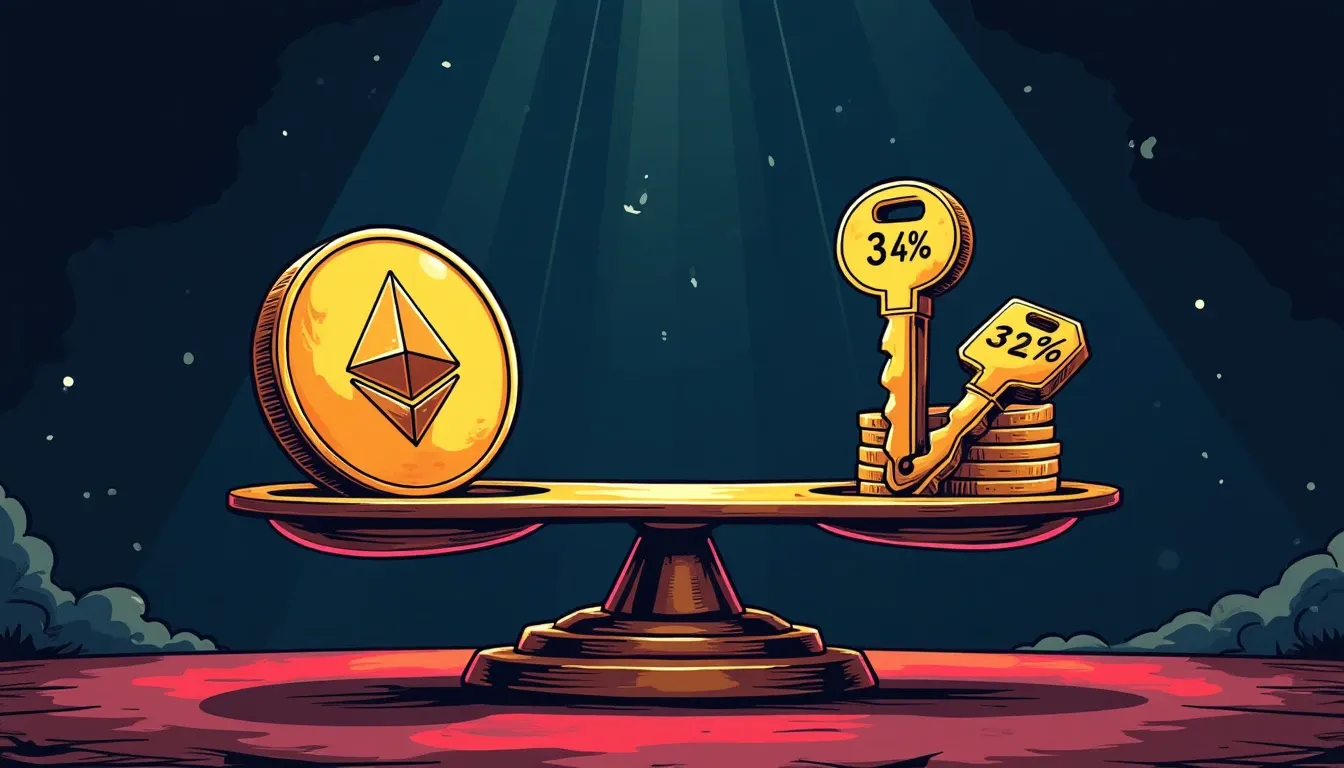
Aave V3 WETH currently pays 1.42% APR. Spark Protocol WETH pays 1.44%. Direct ETH staking through liquid staking tokens yields roughly 2.22% net after fees, while solo staking captures 3.3-3.8% all-in with MEV rewards. The spread between the bottom and top is 2.38 percentage points.
On a $500,000 ETH allocation, that difference is $11,900 annually. But headline APY is the wrong decision input. Rate volatility, smart contract risk, liquidity depth, and secondary yield opportunities determine what you actually keep. The optimal choice depends on position size, rebalancing tolerance, and whether you can afford to lock capital for 45 days.
Aave WETH rates spiked to 4.61% in May 2024, then collapsed back to 1.3% within weeks. Spark rates track stETH staking yield minus a fixed spread, moving as a block with Ethereum consensus yield. Direct staking yields compress gradually as more validators join. This is a comparison of three structural mechanisms, not three static numbers.
Rate Stability: Why Aave Spikes and Spark Doesn't

Aave V3 sets WETH lending rates algorithmically based on pool utilization. When borrowing demand surges, rates climb sharply. In May 2024, Aave WETH borrow rates hit 4.61%, with supply rates peaking near 3.88% on a 7-day average. By September, rates had settled back to 1.29-1.31%. The spike lasted less than 30 days.
This volatility is structural, not anomalous. Aave WETH holds $4.65 billion in supply at current rates, but WETH represents 43% of borrow activity on the platform. When leveraged traders or DeFi protocols need WETH collateral, utilization spikes and rates follow. You cannot predict when the next spike occurs or how long it lasts.
Spark Protocol takes a different approach. Spark deliberately pegs WETH borrow rates to stETH staking yield minus a fixed spread, currently setting borrowing costs at approximately 1.81%. This external peg mechanism makes Spark rates move with Ethereum network yield, not market demand. Over $725 million in WETH is borrowed at this stable rate, enabling profitable leveraged staking strategies.
Direct staking yields are also structurally stable. Ethereum staking yield sits at roughly 2.78% base APR, with MEV rewards adding another 0.5-1% for validators running MEV-Boost. The network staking rate dropped from about 2.8% to 2.6% over nine months as participation increased, a gradual compression driven by protocol economics, not borrowing demand. Lido stETH currently pays 2.22% after the protocol's 10% fee on gross rewards.
The trade-off is clear. Aave offers occasional rate spikes that can deliver 3-4% for brief windows. Spark and direct staking offer predictable yields that move slowly. If you chase Aave rate spikes, you pay gas twice: once to enter, once to exit when rates collapse. On $500,000 ETH, moving from Spark to Aave and back costs $200-500 in gas at 20 gwei, wiping out weeks of incremental yield.
Smart Contract and Concentration Risk

Aave V3 is the largest DeFi lending protocol by total value locked, holding $14.5 billion on Ethereum alone. The codebase is battle-tested across multiple chains and versions. Smart contract risk exists, but it is lower than most DeFi protocols. The real risk is liquidation cascade: if ETH drops sharply and leveraged positions get liquidated simultaneously, the protocol could experience temporary insolvency before liquidations clear.
Spark Protocol uses a fork of Aave V3, inheriting the same core smart contract architecture. But Spark adds an additional governance layer. The protocol operates as Sky's dedicated lending arm, and Spark's Liquidity Layer deploys USDS (Sky's stablecoin) into on-chain lending pools. If the broader Sky ecosystem experiences distress, Spark could face contagion risk through the USDS/SSR peg or treasury depletion.
Lido stETH introduces different risks. The protocol holds approximately 8.9 million ETH, representing roughly 23% of all staked ETH. Smart contract bugs, validator slashing penalties shared across holders, and secondary market liquidity risk all exist. The June 2022 stETH depegging event, when stETH traded below 1:1 parity during market stress, provides a concrete case study of mark-to-market volatility even when the underlying protocol remains solvent.
Solo staking eliminates smart contract risk entirely. You run your own validator node with 32 ETH, capturing full protocol rewards and MEV. But you assume operational risk: node infrastructure, uptime monitoring, and the slashing penalty if your validator misbehaves. Withdrawals work, but exits wait in a queue that has stretched beyond 45 days during periods of high validator exit demand.
For allocations above $1 million, concentration risk matters. Splitting capital across Aave, Spark, and direct staking reduces single-protocol exposure. For allocations below $100,000, the incremental complexity of managing three positions outweighs the diversification benefit.
Liquidity Depth and Rebalancing Costs
Aave WETH offers the deepest instant liquidity. The WETH pool holds $829 million in supplied capital according to recent data. Deposits and withdrawals execute immediately, though withdrawals during periods of very high utilization (above 90%) may face temporarily reduced liquidity. Gas costs are the only friction: typically $30-80 per deposit or withdrawal at 20 gwei.
Spark WETH liquidity is smaller but stable. The protocol holds $6.8 billion in total value locked across Ethereum, Gnosis, and Base, with utilization sitting at 70.7% on the Ethereum WETH pool. That means roughly seven out of every ten dollars deposited are actively lent out. The 70% utilization rate is by design, maintained through the stETH-pegged borrow rate. Deposits and withdrawals are instant, but the smaller pool size means allocations above $10 million may move utilization noticeably.
Lido stETH provides instant secondary market liquidity through DEX pools, but you face slippage and potential peg volatility. Withdrawals through Lido's native protocol take 1-5 days and carry no slippage, but you must wait in the withdrawal queue. For allocations below $1 million, secondary market liquidity is sufficient. For larger allocations, you should assume 3-5 days to exit without market impact.
Solo staking has the longest exit friction. Ethereum's validator exit queue has stretched beyond 45 days during busy periods. This is protocol-level queue management, not economic friction. You cannot pay to exit faster. If you need liquidity within 30 days, solo staking is unsuitable regardless of yield advantage.
Rebalancing costs matter more than most allocators assume. Moving $500,000 from Aave to direct staking costs $150-300 in gas, plus 3-5 days of missed yield during the transition. That's roughly $200-400 in total friction. If Aave rates spike 2 percentage points for 20 days, you earn an extra $547 on that allocation. After deducting rebalancing costs, you net $147-397. The smaller the allocation and the shorter the spike, the less profitable the chase.
Secondary Yield Opportunities
Aave WETH enables leveraged looping strategies. You deposit WETH, borrow WETH against it, re-deposit the borrowed WETH, and repeat. This amplifies both yield and liquidation risk. Aave Base WETH looping recently carried 7.38% APY but showed extreme 30-day volatility, ranging from 0.28% to 31.43% with a mean of 7.09%. Looping on Ethereum mainnet is less volatile but still introduces liquidation risk if ETH price drops and your loan-to-value ratio exceeds safe thresholds.
Spark offers different secondary yield. You can borrow USDS or DAI against WETH collateral and deposit the borrowed stablecoins into Sky Savings Rate, which paid 3.75% in May 2024. If SSR exceeds your borrow cost, you earn positive carry on leveraged capital. This works until Sky governance changes the SSR or Spark adjusts borrow rates. The spread has historically been positive, but it is governance-dependent and can close without warning.
Lido stETH can be deposited into other DeFi protocols as collateral, enabling recursive stacking of yield and risk. You can deposit stETH into Aave, borrow against it, and loop. Or deposit stETH into Curve or Uniswap V3 liquidity pools to earn trading fees plus staking yield. Each layer adds smart contract risk and potential liquidation exposure. The all-in yield can reach 8-12% during favorable conditions, but you are now exposed to Lido, Aave, and Curve simultaneously.
Restaking layers like EigenLayer offer additional yield in exchange for additional slashing risk. You stake ETH, receive a liquid staking token, then restake that LST to secure other protocols. Gross yields can reach 5-7%, but restaking penalties are not yet fully understood because the infrastructure is new. For allocations above $1 million, restaking represents meaningful incremental yield. For allocations below $100,000, the operational complexity and emerging risk profile make restaking premature.
Position Size and the Right Choice
For allocations under 10 ETH (roughly $30,000 at recent prices), use Lido stETH or Aave WETH. Both offer instant liquidity, no minimum deposit, and simple UX. Lido pays 2.22% with one-click deposits. Aave pays 1.42% but lets you exit within minutes if you need capital. The yield difference on $30,000 is $240 annually. That does not justify solo staking's operational overhead.
For allocations between 10 and 32 ETH, Lido stETH remains optimal unless you have strong views on rate volatility. Aave's rate spikes are unpredictable and short-lived. Chasing them costs gas and attention. On $100,000 ETH, the difference between Lido (2.22%) and Aave (1.42%) is $800 annually. Spark's 1.44% is functionally identical to Aave at this allocation size.
For allocations at or above 32 ETH, solo staking becomes viable if you can tolerate 45-day exit queues and operate validator infrastructure. Solo staking captures 3.3-3.8% all-in, roughly 1-1.5 percentage points above Lido. On 32 ETH ($96,000), that's $960-1,440 annually. If you already run nodes for other protocols or have technical operations capability, the incremental cost is low. If you would need to hire help or learn from scratch, the operational risk outweighs the yield pickup for allocations below 100 ETH.
For allocations above $500,000, diversify across Aave, Spark, and direct staking. Allocate 40% to direct staking (solo or Lido depending on operational tolerance), 30% to Spark for stable yield, and 30% to Aave for optionality during rate spikes. Rebalance only when Aave rates exceed Spark by 150 basis points for more than 10 days, and only shift the Aave allocation, leaving the staking allocation untouched.
If you need liquidity within 30 days, do not use solo staking. If you need liquidity within 7 days, use Aave or secondary market stETH. If you can lock capital for 90 days or longer, prioritize direct staking and ignore short-term rate noise.
The Takeaway
Aave WETH's 4.6% rate spike lasted 22 days in May and has not recurred. Spark's rate has stayed within 20 basis points of its peg for six months. Direct staking compressed 20 basis points over nine months. If you have less than $100,000 allocated, chasing rate spikes costs more in gas and missed yield than it earns. If you have more than $500,000 allocated, split the capital and rebalance only when spreads exceed 150 basis points for two weeks. The decision input is not current APY. It is how long you can lock capital, how much you will pay to rebalance, and whether you can operate a validator node. Everything else is noise.
You just compared three ETH yield products paying between 1.42% and 3.8%. Those numbers will shift next month, and the risk-adjusted ranking may invert if Aave rates spike or Ethereum changes issuance policy.
Frequently Asked Questions
Why does Aave WETH pay lower rates than direct staking?
Aave WETH rates are determined by borrowing demand, not network staking yield. When utilization is low, lenders earn less because fewer borrowers are paying interest. Direct staking earns protocol issuance plus MEV rewards regardless of lending market conditions. Aave rates spike above staking yields only during brief periods of high leverage demand, typically lasting under 30 days before reverting to 1-2% as utilization normalizes.
Is Spark Protocol safer than Aave for ETH lending?
Spark uses a fork of Aave V3 code, so core smart contract risk is similar. Spark adds governance risk through its connection to the Sky ecosystem and USDS stablecoin peg. Aave has larger TVL and longer operational history, reducing uncertainty. For allocations under $500,000, the risk difference is negligible. For larger allocations, Aave's deeper liquidity and broader auditing history offer modest advantages, though Spark's rate stability mechanism reduces yield volatility risk.
Can I withdraw staked ETH immediately from Lido?
Lido offers two withdrawal paths. Native protocol withdrawals take 1-5 days with no slippage or fees beyond gas. Secondary market sales via DEX provide instant liquidity but introduce slippage and potential peg risk if stETH trades below 1:1 during market stress. For allocations under $1 million, secondary market depth is typically sufficient. The June 2022 depeg event saw stETH trade as low as 0.93 ETH during peak stress, recovering to parity within weeks.
What allocation size justifies solo staking over Lido?
Solo staking requires 32 ETH minimum and captures 3.3-3.8% yield versus Lido's 2.22%, a difference of roughly 1-1.5 percentage points. On 32 ETH, that is $960-1,440 annually. If you already operate validator infrastructure or have technical capability, solo staking is optimal at 32 ETH. If you must hire help or learn from scratch, operational risk outweighs yield benefit below 100 ETH. Solo staking also introduces 45-day exit queues, making it unsuitable for capital you may need within 30 days.
How long do Aave WETH rate spikes typically last?
The May 2024 Aave WETH rate spike reached 4.61% borrow and 3.88% supply on a 7-day average, then reverted to 1.3-1.5% within four weeks. Historical data shows Aave rate spikes above 3% last less than 30 days as arbitrageurs deposit more capital and utilization normalizes. Chasing these spikes costs gas to enter and exit. On $500,000 ETH, a 20-day spike at 2 percentage points above baseline earns $547, but rebalancing costs $200-400, netting only $147-397 after friction.
You have just compared three ETH yield products paying between 1.42% and 3.8%. Those numbers will shift next month, and the risk-adjusted ranking may invert if Aave rates spike or Ethereum changes issuance policy.
Every Thursday: where crypto yield actually is - stablecoins, liquid staking and DeFi lending, with the risk named next to the rate and what changed since last week.
Get it free every ThursdayFree. No trade calls, no allocations, no hype. Unsubscribe in one click.