Table of Contents
What Happened When CVXCRV Dropped From All Major Trackers
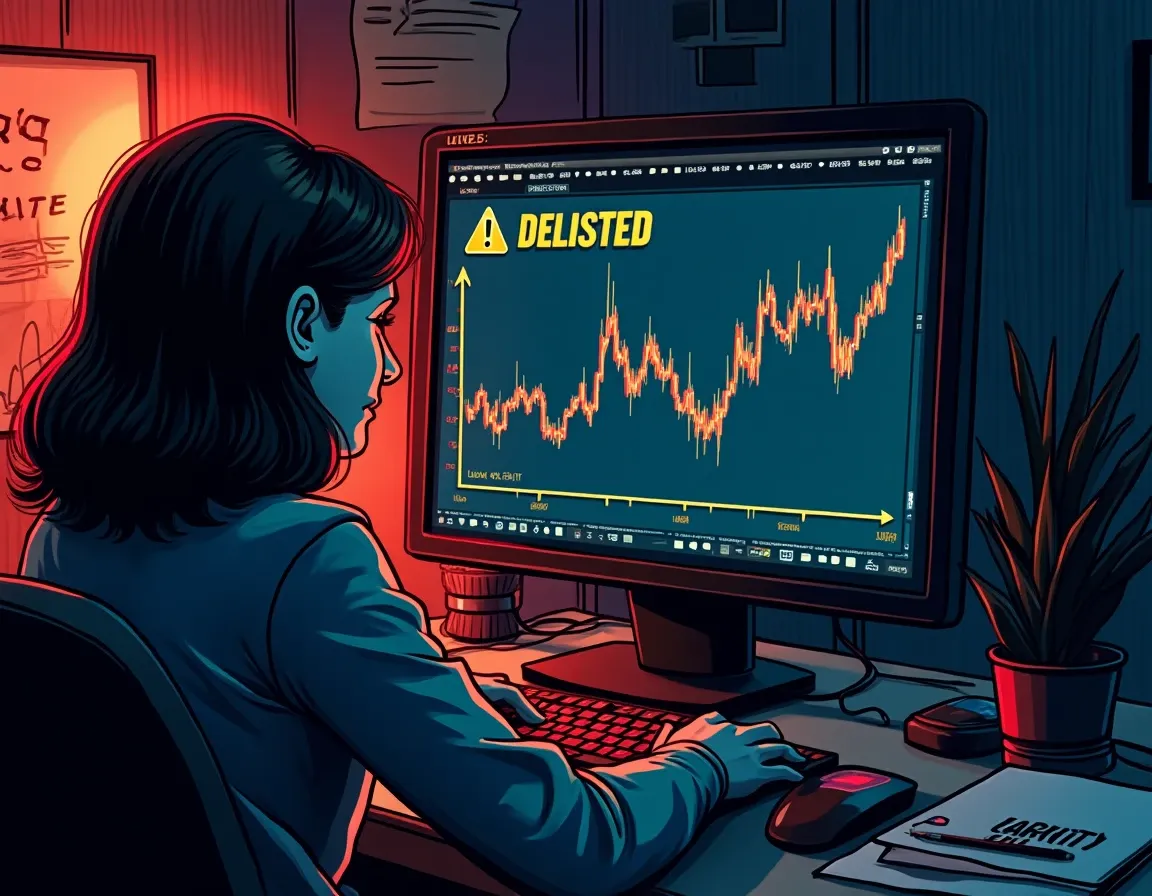
On February 1, 2026, cvxCRV stopped reporting price data to major aggregators. DefiLlama marked it "Delisted." CoinGecko stopped updating. For anyone holding a position earning 17.32% in tokenized veCRV, the absence looks identical to protocol failure until you run the verification sequence.
The distinction matters immediately. If Convex Finance collapsed, your locked CRV is gone. If the tracking removal reflects low trading volume triggering exchange delisting criteria, the protocol continues operating and your yield continues accruing. You cannot tell the difference from a missing data feed alone.
This article documents the 24-hour investigation protocol I use when a previously tracked yield position vanishes entirely. It is built from twelve years in regulated gambling operations where sudden KYC failures, license suspensions, and payment processor blacklisting created identical "disappeared from tracking" signals. The process distinguishes tracking criteria changes from counterparty failure, and it does so before panic-driven exits crystallize losses that did not need to happen.
Why CVXCRV Tracking Removal Differs From Rate Drops

When a yield position drops 3 percentage points, you compare alternatives and calculate exit cost. When the position disappears entirely from aggregators, you verify solvency first. The income calculation comes second.
CVXCRV presents three failure modes that tracking removal could signal. First: Convex Finance protocol exploit or insolvency. Second: CRV depeg or Curve DAO governance attack affecting the underlying asset. Third: exchange and aggregator delisting due to low trading volume, which has no bearing on protocol health but removes the position from all standard monitoring tools.
The last known price was $0.1166 on February 1, 2026. The all-time high was $4.94. That 97.6% drawdown from peak creates the chart signature of a failed project, but it does not distinguish between "protocol insolvent" and "derivative trading at permanent discount to underlying due to lock mechanics." CVXCRV is structurally designed to trade below CRV because Convex locks the underlying CRV as veCRV permanently, and holders who want CRV exposure without the lock discount must exit through secondary liquidity pools at whatever discount the market assigns to illiquidity, smart contract risk, and perpetual lock status.
As of October 23, 2026, Convex Finance reported $579.72 million in total value locked across Ethereum LP pools ($555.0M) and Ethereum staking including cvxCRV ($124.4M). That TVL places Convex at rank three among yield protocols on DefiLlama. A protocol ranked third by TVL does not fail silently. The tracking removal reflects aggregator delisting criteria, not protocol insolvency.
The 24-Hour CVXCRV Investigation Checklist
Hour One: Protocol Layer Verification
Navigate directly to the Convex Finance protocol page on DefiLlama. Ignore cvxCRV token price. Look at total value locked, 24-hour change in TVL, and whether the parent protocol page reports active data feeds. If Convex Finance shows $579M TVL with recent updates, the protocol is operational regardless of cvxCRV token tracking status.
Check the Convex Finance website directly. If the staking interface loads, displays your cvxCRV balance, and shows claimable rewards, the protocol is serving data to wallets even if aggregators have delisted the token. This is the single most important distinction. Delisting removes third-party visibility. It does not disable the smart contract.
Verify on-chain using Etherscan at the cvxCRV token contract address: 0x62b9c7356a2dc64a1969e19c23e4f579f9810aa7. Check the last transaction timestamp. If transactions occurred in the last 24 hours, the token is active. If the last transaction is months old, trading has stopped but staking rewards may still accrue to existing holders.
Hour Two: Liquidity and Exit Path Confirmation
CVXCRV cannot be converted back to CRV through Convex. The conversion is one-way. Users who want CRV must swap through secondary liquidity pools on Curve or other DEXs. Check whether those pools still exist and contain meaningful liquidity.
On Curve, locate the CRV-cvxCRV pool. Note the pool balance and the discount at which cvxCRV trades relative to CRV. A 5% discount is normal and reflects the permanent lock. A 40% discount signals liquidity crisis or loss of confidence in Convex's ability to maintain the peg. If the pool has been drained or if the discount exceeds 30%, your exit cost is catastrophic regardless of protocol solvency.
Calculate the dollar cost of exit at current liquidity. On a $100,000 cvxCRV position, a 15% slippage plus 0.4% swap fee costs $15,400. If your alternative yield venue offers 2 percentage points higher APY, you need 7.7 years to recover the exit cost. That math determines whether you exit immediately or wait for liquidity to return.
Hour Three: Reward Accrual and Claim Test
Log into the Convex Finance interface. Navigate to your staked cvxCRV position. Check whether new rewards have been credited since the tracking removal date. If rewards accrued yesterday, the yield mechanism is still operational.
Attempt to claim a small amount of accrued rewards. If the transaction succeeds and tokens arrive in your wallet, the protocol is functional. If the claim transaction fails or if no rewards have accrued since February 1, the reward distribution mechanism has stopped and your position is no longer earning.
This test costs gas but provides certainty. A $12 gas fee to claim $50 of rewards proves the system works. If you discover the rewards stopped three months ago, you have lost three months of expected yield, but you now have the information required to exit.
Hour Four Through 24: Historical Incident Review
Search for disclosed vulnerabilities. Convex had a read-only reentrancy vulnerability in cvxCRV disclosed and patched in 2022. Check whether any new vulnerability disclosures appeared on CertiK, Immunefi, or the Convex community channels around the February 1 delisting date. If a critical vulnerability was disclosed, the tracking removal may reflect exchanges removing the token pending a fix.
Review whether other Convex products remain tracked. If cvxFXS, cvxFXN, and cvxPRISMA still report data while cvxCRV does not, the issue is specific to CRV derivative liquidity, not to Convex solvency.
Check for Curve DAO governance attacks or CRV depeg events. CVXCRV value depends entirely on the underlying CRV remaining stable and Curve protocol remaining operational. A governance attack that redirected Curve rewards or a CRV stablecoin collateral failure would destroy cvxCRV value even if Convex itself operates correctly. Cross-reference CRV price history with the February 1 delisting date.
What Tracking Removal Actually Signals For Locked Positions
Exchange delisting criteria typically include: no regular trading activity for 30-90 days, absence of protocol development or social media activity, faulty network or smart contract reliability, or non-existent business-customer interaction. For CVXCRV, the trigger was almost certainly trading volume below exchange thresholds combined with the permanent lock making the token unsuitable for margin or derivatives products.
The Convex community uses cvxCRV as a staking vehicle, not as a trading token. Holders deposit CRV, receive cvxCRV at 1:1, stake it, and collect rewards indefinitely. That behavior produces low on-exchange volume because the asset is sticky by design. Exchanges interpret low volume as low interest and delist. Aggregators that source price data from exchanges lose the feed and mark the token "Delisted."
For income purposes, tracking removal is a visibility problem, not a yield problem, as long as rewards continue accruing on-chain. The 17.32% APY that was visible before delisting is still being paid to stakers if the protocol operates. You lose the ability to monitor rate changes through aggregators. You do not lose the income stream unless the protocol fails.
The larger risk is liquidity. If you need to exit and the secondary pools have been drained, you face 20-40% slippage regardless of protocol health. On a $100,000 position, that is $20,000 to $40,000 in realized loss to exit a position that is still generating yield. The correct response is not to exit in panic, but to wait for liquidity to stabilize unless protocol solvency is genuinely at risk.
When To Exit Versus When To Hold Through Delisting
Exit immediately if any of the following are true after completing the 24-hour checklist: Convex Finance TVL dropped more than 40% in the last seven days. Your claim test transaction failed. The CRV-cvxCRV liquidity pool on Curve has been drained below $500,000 total liquidity. A new critical vulnerability was disclosed and not patched. The underlying CRV token depegged from expected value by more than 10%.
Hold if: Convex TVL is stable or growing. Your claim test succeeded and rewards are accruing. The CRV-cvxCRV pool contains at least $5 million liquidity with discount to CRV under 15%. No new vulnerabilities disclosed. CRV price stable relative to governance token norms.
The income math on a $100,000 cvxCRV position at 17.32% APY is $17,320 annually. If you exit through a liquidity pool at 12% slippage, you pay $12,000 in realized loss to access a 19.5% yield elsewhere. You need (12,000 / (0.195 - 0.1732)) = 54,795 in capital earning the spread for one year to recover the exit cost, or you need to wait 8.3 months holding the 19.5% position. If Convex remains solvent and rewards continue, holding the delisted position and collecting 17.32% costs you 2.18 percentage points in opportunity cost but avoids the $12,000 realized loss.
That calculation changes if the protocol is genuinely failing. If rewards stop accruing, your $100,000 earns zero and you lose $17,320 in expected annual income. Paying $12,000 in slippage to salvage $88,000 in recoverable capital is the correct decision. The checklist above exists to make that determination before liquidity disappears entirely.
Tracking Removal As Ongoing Risk Signal
Once a position disappears from aggregators, you lose automated monitoring. Rate drops, TVL collapses, and liquidity crises will not trigger alerts because the data feed no longer exists. You must monitor manually.
Set a calendar reminder to run the protocol verification checklist every two weeks. Check Convex TVL on DefiLlama. Verify your staked balance on the Convex interface. Confirm CRV-cvxCRV liquidity on Curve. Claim rewards monthly to verify the distribution mechanism still functions. This takes 15 minutes every two weeks and prevents the scenario where the protocol fails silently and you discover it three months later when you attempt to exit.
For other DeFi protocols facing similar tracking removal, the checklist structure remains identical. Verify parent protocol TVL. Check on-chain activity. Test reward claims. Confirm exit liquidity. The distinction between delisting and insolvency is always visible on-chain before it becomes visible in your portfolio value.
What This Means For Future Locked Yield Positions
Locking into high-yield positions that use non-standard token mechanics creates tracking removal risk by design. Tokenized veCRV, tokenized veBAL, and other vote-escrowed derivatives trade at discounts that reduce on-exchange volume, which triggers delisting, which removes them from aggregators.
The income opportunity remains valid if you can monitor the position manually and if you do not require liquidity. On $200,000 deployed at 17.32%, the position generates $34,640 annually. If aggregator visibility disappears but rewards continue, you collect the same dollar income. The risk is that you miss the early warning signals when the protocol begins failing, because those signals normally appear as TVL drops and rate compression visible on DefiLlama.
Position sizing matters more for delisted assets. If your cvxCRV position represents 8% of remaining on-chain liquidity, you cannot exit without moving the market against yourself. Keep individual positions below 2% of the liquidity pool size for any asset that has been delisted or that trades primarily on single low-volume DEX pools. For higher position sizes, accept that your exit will take days or weeks and will occur at worse pricing than current quoted rates.
Compare locked high-yield positions to liquid alternatives using this framework: calculate annual income on the locked position, subtract 2 percentage points for monitoring cost and liquidity risk, then compare to the best liquid stablecoin yield available. If the locked position still pays 5+ percentage points more after the adjustment, the illiquidity premium compensates for tracking removal risk. If the spread is under 3 percentage points, the liquid alternative is safer.
The Takeaway
When cvxCRV disappeared from tracking in February 2026, the correct response was not to exit immediately. It was to verify whether Convex protocol TVL remained stable, whether rewards continued accruing, whether CRV-cvxCRV liquidity pools still functioned, and whether the underlying CRV token remained healthy. All four confirmed protocol solvency. The tracking removal reflected exchange delisting criteria triggered by low trading volume, not protocol failure. Holders who exited in panic paid 10-20% slippage to escape a position that was still earning 17.32%. Holders who ran the verification checklist kept earning.
On a $100,000 locked position, the difference between panic exit and disciplined verification is $10,000 to $20,000 in realized loss avoided. The checklist above takes 24 hours to complete and provides certainty about protocol health before liquidity disappears entirely. For any DeFi position that vanishes from aggregators, the protocol is this: verify TVL, check on-chain activity, test claims, confirm exit paths, then calculate whether holding or exiting produces better net income after slippage. Tracking removal is a visibility problem until proven otherwise. Treat it as one.
Frequently Asked Questions
What does it mean when CVXCRV disappears from DefiLlama and CoinGecko?
Tracking removal typically signals exchange delisting due to low trading volume, not protocol failure. CVXCRV trades primarily as a staking vehicle with minimal on-exchange activity, triggering automated delisting criteria. Verify protocol solvency by checking Convex Finance TVL on DefiLlama, testing reward claims directly on the Convex interface, and confirming CRV-cvxCRV liquidity pools still function on Curve. If all three verify successfully, the protocol operates normally despite aggregator delisting.
How do I verify if my CVXCRV position is still earning yield after delisting?
Log into the Convex Finance interface and check your staked cvxCRV balance. Navigate to the rewards section and verify that new rewards accrued since the delisting date. Attempt to claim a small amount of rewards. If the transaction succeeds and tokens arrive in your wallet, the yield mechanism remains operational. If no rewards accrued or the claim fails, reward distribution has stopped and your position is no longer generating income.
Should I exit my CVXCRV position immediately when it drops from tracking?
Exit only if protocol solvency verification fails. Check whether Convex TVL dropped more than 40% in seven days, whether your claim test failed, whether CRV-cvxCRV liquidity fell below $500,000, or whether CRV depegged by more than 10%. If all verification steps pass, holding avoids 10-20% slippage cost while continuing to collect yield. On $100,000, panic exit costs $10,000-$20,000 in realized loss to escape a position still earning 17.32% if protocol remains solvent.
Why does CVXCRV trade at a discount to CRV?
Convex locks deposited CRV as veCRV permanently and cannot unlock it when the lock expires. CVXCRV holders wanting CRV exposure must exit through secondary Curve liquidity pools at a discount reflecting illiquidity, smart contract risk, and perpetual lock status. A 5-15% discount is normal. Discounts exceeding 30% signal liquidity crisis or loss of confidence in Convex's peg maintenance, which increases exit cost substantially regardless of protocol operational status.
How often should I manually verify a delisted DeFi position?
Run the protocol verification checklist every two weeks once a position disappears from aggregators. Check parent protocol TVL on DefiLlama, verify staked balance on the protocol interface, confirm exit liquidity in DEX pools, and claim rewards monthly to test distribution functionality. This 15-minute process prevents silent protocol failure from going undetected for months. Automated tracking no longer exists for delisted assets, making manual monitoring essential to avoid discovering insolvency only when attempting to exit.
You just verified whether tracking removal signals delisting or insolvency using a 24-hour protocol checklist. That distinction determines whether you lose 15% to slippage or keep earning 17% yield.
Every Thursday: where crypto yield actually is - stablecoins, liquid staking and DeFi lending, with the risk named next to the rate and what changed since last week.
Get it free every ThursdayFree. No trade calls, no allocations, no hype. Unsubscribe in one click.