Table of Contents
What You Are Vetting And Why 72 Hours Matters
The Curve BOLD-USDC pool appears with rates between 22.26% and 30.75% APY across data sources. The TVL sits at $11.31 million. Before you allocate six figures to a pool paying 7-10x the typical reward-driven Curve stable baseline, you need a 72-hour verification protocol. This article shows you how to distinguish sustainable incentive allocation from pools that collapse or depeg within 30 days.
The core question: is 22% compensation for real liquidity provision risk, or is it a temporary spike that will compress the moment you deploy capital? Curve pool APYs are not interest rates. They are compensation within a particular pool structure. High advertised rates reflect either organic fee capture or vote-dependent gauge incentives. Most pools above 20% are the latter. That means your yield depends on weekly veCRV voting cycles, and those cycles lag market conditions by 7-14 days.
The income mechanism: 22.26% on $100,000 is $22,260 annually. But if BOLD depegs 5% or exit liquidity is insufficient when you need to withdraw, losses exceed one year of yield. You need to vet the pool before you deploy, not after the collapse. Here is the 72-hour checklist.
Step 1: Separate Base APY From Reward APY

Open the Curve pool page on DefiLlama and identify the yield composition. For BOLD-USDC, recent data shows 1.96% base APY composed of 1.52% fees and 0.44% rewards. The 22-30% advertised rate is not reflected in this snapshot, which suggests either a data lag or a sharp recent incentive allocation spike.
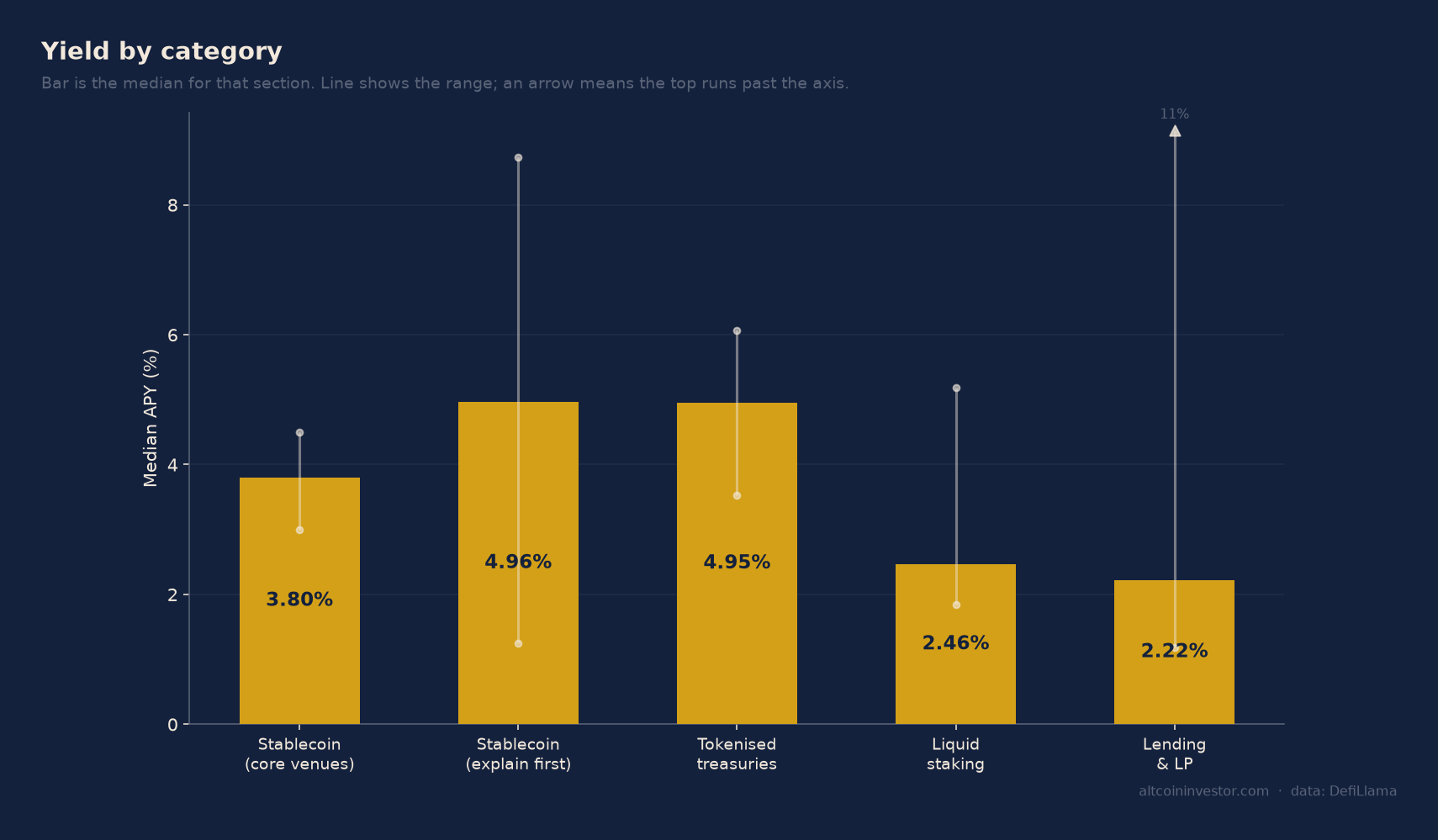
Compare this to historical Curve stable pool patterns. On November 10, 2026, the largest reward-driven Curve stable pools paid 2.9% to 4.9% on a 30-day average. Curve 3pool paid close to 0%. A 22-30% rate is an outlier by an order of magnitude. That flags one of two scenarios: either the pool is capturing exceptional organic fee volume, or it is receiving a concentrated gauge incentive allocation that may not persist.
Look at the MUSD/USDC/USDT pool as a reference case. That pool generated 0.27 percentage points from base fees and 22.57 points from incentives. The advertised rate was almost entirely vote-dependent. If BOLD-USDC follows the same pattern, your yield evaporates the moment veCRV holders reallocate votes or bribe campaigns shift.
Check 24-hour volume relative to TVL. The pool holds $11.31M TVL and generates $574,980 in daily volume. That is a 5.08% daily volume-to-TVL ratio, which translates to roughly 1.85x annual turnover. Organic fee capture at 0.04% per swap would yield approximately 0.74% APY. The gap between 0.74% and 22-30% is incentive subsidy. You are farming gauge rewards, not trading fees.
What to verify: open Curve.fi and navigate to the BOLD-USDC pool page. Scroll to the yield breakdown. If base APY is below 2%, the high advertised rate is reward-driven and subject to weekly vote volatility. If you cannot find a yield breakdown, that is a red flag. Do not deploy until you have transparent incentive composition data.
Step 2: Assess BOLD Token Stability And Collateral Backing

BOLD is the stablecoin issued by Liquity V2. It relaunched in January 2025 and reached 30 million supply by late 2026. The largest liquidity pools by TVL are Liquity V2 ($18.0M), Curve DEX ($11.8M), Yearn Finance ($6.1M), Uniswap V4 ($2.9M), and Uniswap V3 ($1.4M). The Curve pool is the second-largest venue for BOLD liquidity. That introduces single-point failure risk. If the BOLD-USDC pool becomes the primary exit venue and demand collapses, you will face slippage regardless of the advertised TVL.
Look at the stablecoin's backing mechanism. BOLD is overcollateralized by ETH and other approved assets in Liquity V2. The protocol incentivizes liquidity using 25% of total interest collected from borrowers. That is a second-order lever. Your yield depends on collateral demand in the Liquity system. If borrowing activity declines, the protocol has less interest revenue to allocate to liquidity incentives. The 22-30% rate may compress even if BOLD does not depeg.
Compare BOLD's maturity to stablecoins that failed at similar pool sizes. UST maintained 20% APY on Anchor Protocol when approximately 75% of circulating supply was deposited for yield. The system had virtually no organic demand. Most holders were yield-farming, not transacting. If BOLD shows similar concentration, the pool is a reflexive yield trap. When the incentive rate compresses, LPs withdraw, liquidity collapses, and slippage spikes.
What to verify: open Liquity V2's dashboard and check the protocol's total collateral and total BOLD issued. Calculate the collateralization ratio. If the ratio is below 150%, depeg risk is elevated. Check the number of active borrowers. If fewer than 500 unique addresses are minting BOLD, the stablecoin lacks organic demand. Cross-reference BOLD supply distribution using Etherscan. If more than 60% of supply is locked in liquidity pools, the token is over-financialized. Those are the conditions that preceded UST's collapse.
Step 3: Check Liquidity Exit Risk At $11.31M TVL
The institutional liquidity benchmark for Curve pools is $50 million TVL. Below that threshold, slippage risk becomes material for position sizes above $500,000. The BOLD-USDC pool at $11.31M sits 78% below the benchmark. That does not disqualify the pool, but it limits your position size.
Calculate your slippage exposure using the 5% rule. Slippage stays negligible while your trade is small against pool depth and steepens sharply above roughly 5% of pool size. For an $11.31M pool, that is $565,500. If you are deploying more than $500,000, you will move the pool balance materially when you exit. During a depeg event, that slippage compounds. During the March 2023 USDC depeg, Curve's 3pool saw slippage spike from 0.025% to 3.7%, and LPs absorbed $38 million in impermanent loss.
Look at the pool's composition. The Curve Stableswap BOLD-USDC pool holds $8.8M in liquidity with $5.6M in BOLD and the remainder in USDC. That is a 63.6% BOLD concentration. If BOLD depegs, the pool becomes imbalanced. LPs withdraw USDC, leaving BOLD behind. The remaining LPs are left holding a depreciating asset with no exit liquidity. The pattern is identical to what happened during the UST depeg. Pools became imbalanced within hours because LPs withdrew USDC, leaving UST stranded.
What to verify: open the Curve pool page and check the token balances. If one side of the pool exceeds 60% of total liquidity, the pool is already imbalanced. That increases depeg risk. Check the pool's 7-day volume trend. If volume is declining while TVL remains flat, liquidity is sticky but not active. That suggests LPs are farming yield without hedging. When incentives compress, those LPs will exit simultaneously, collapsing available liquidity. Run a test trade on Curve's interface. Input a $100,000 swap from BOLD to USDC and observe the quoted slippage. If slippage exceeds 0.5%, the pool cannot support six-figure exits without material losses.
Step 4: Monitor Gauge Weight Volatility And Voting Lag Risk
Curve's gauge system distributes CRV emissions through weekly veCRV voting. Users lock CRV tokens for up to four years to receive veCRV, a non-transferable governance token. Each week, veCRV holders vote to allocate CRV emissions across Curve's liquidity pools. Higher-weighted gauges receive more CRV rewards, which translate to higher advertised APYs for LPs.
Individual pool weights can swing 20-50% week-to-week if major voters change allocation or new bribe campaigns launch. That introduces two risks. First, your yield is variable. A 22% rate this week may become 11% next week if veCRV holders reallocate votes. Second, gauge voting is a lagging indicator. During the UST-LUNA collapse, UST pools maintained high gauge weights for weeks after the depeg began because weekly voting cycles do not respond in real-time. LPs who relied on high advertised APYs as a signal of pool health suffered catastrophic losses.
The BOLD-USDC pool's high rate suggests it is receiving concentrated veCRV allocation. That could reflect genuine confidence in BOLD's stability, or it could reflect a short-term bribe campaign designed to bootstrap liquidity. If the latter, the rate will compress sharply once the campaign ends. You need to distinguish between structural incentive support and temporary vote manipulation.
What to verify: navigate to Curve's governance portal and search for the BOLD-USDC gauge. Check the gauge's current weight relative to total veCRV votes. If the gauge weight exceeds 2% of total Curve emissions, the pool is receiving outsized support. That is not inherently negative, but it increases the risk of sharp rate compression if votes shift. Check the gauge's 30-day weight history. If the weight spiked in the past two weeks, the high rate is temporary. Compare the BOLD-USDC gauge weight to other stable pools. If BOLD-USDC is weighted 5-10x higher than USDC-DAI or USDC-USDT, the allocation is anomalous. Monitor for bribe activity on platforms like Votium or Convex. If BOLD's protocol or affiliated addresses are paying bribes to secure veCRV votes, the incentive is artificial and will not persist beyond the bribe budget.
Step 5: Set Position Sizing Limits And Exit Triggers
Given the pool's $11.31M TVL, gauge weight volatility of 20-50%, and BOLD's relative immaturity, the recommended maximum allocation is 5-10% of your DeFi portfolio. Never put more than 20% of your portfolio into one pool, and treat pools below $50M TVL with additional caution. For a $1 million portfolio, that is a $50,000-$100,000 maximum position.
Calculate your breakeven timeline. At 22.26% APY on $100,000, you earn $61.00 per day. If the rate compresses to 11% after 30 days, you have earned $1,830. If BOLD depegs 2% during that window and you exit with 0.5% slippage, your loss is $2,500. You are underwater. The position only makes sense if you believe the rate will hold for at least 90 days and BOLD will not depeg during that period.
Set automated exit triggers. If BOLD's peg drops below $0.98 for more than four hours, exit the position immediately. Do not wait for recovery. The pattern in every stablecoin depeg is that the first 24 hours determine survival. If the peg does not recover within 24 hours, the stablecoin collapses. During the UST depeg, early exits at $0.95 saved LPs 80% losses compared to those who waited.
What to verify: open your wallet's transaction history and document your entry date, entry APY, and entry pool balance. Set a calendar reminder for seven days, 30 days, and 90 days. At each checkpoint, compare the current APY to your entry APY. If the rate has compressed more than 50%, exit the position. Check BOLD's peg daily using CoinGecko or Coingecko's stablecoin dashboard. If the peg drops below $0.98, exit within four hours. Monitor the pool's TVL trend. If TVL drops more than 30% in seven days, liquidity is exiting. Exit before slippage becomes material. For detailed context on vetting similar pools, see How To Vet New Curve USDC-RLUSD Pool At 4.33% In 72 Hours.
Step 6: Compare To Historical 20%+ APY Pool Patterns
Pools above 20% APY have specific failure patterns. The most common is incentive exhaustion. A protocol bootstraps liquidity by allocating outsized rewards for 30-90 days. LPs rush in, TVL spikes, and the advertised rate remains elevated as long as the incentive budget lasts. When the budget depletes, the rate collapses, LPs withdraw, and TVL crashes. The pool becomes illiquid and unusable.
The second failure mode is depeg during high-incentive periods. High yields attract liquidity, but they also attract extractive LPs who have no confidence in the underlying asset. When the first sign of depeg risk appears, those LPs exit immediately, collapsing the pool. The UST-LUNA collapse is the canonical example. Anchor Protocol paid 20% on UST deposits. When UST lost its peg, withdrawals overwhelmed the system, and the stablecoin collapsed to near-zero within 48 hours.
The third failure mode is oracle delay. Curve pools rely on price oracles to maintain balance. If an oracle lags by more than 10 seconds during a depeg event, LPs withdraw the stronger asset, leaving the pool imbalanced. During the March 2023 USDC depeg, oracle delays caused impermanent loss spikes of 2-5% in pools that held USDC. LPs who did not exit immediately absorbed losses that exceeded months of yield.
What to verify: search for other stablecoin pools on Curve that have paid 20%+ APY in the past 12 months. Cross-reference those pools on Best DeFi Protocols By Category to identify which protocols survived and which collapsed. Check whether those pools maintained their rates for more than 90 days. If most high-rate pools compress within 30-60 days, the BOLD-USDC pool will likely follow the same pattern. Look for governance proposals or forum discussions about BOLD incentive budgets. If the protocol has allocated a fixed incentive pool for a limited duration, the rate will compress when the budget depletes. For parallel vetting frameworks, review How To Vet Curve USDC-RLUSD 12.16pp Jump To 17.97% On $38M TVL.
Step 7: Establish A 30-Day Monitoring Cadence
Passive Curve positions require monthly check-ins unless you are monitoring for depeg events. For pools above 20% APY, weekly monitoring is mandatory. Set a calendar alert for every Thursday at 10:00 AM UTC. Curve gauge weights update on Thursdays. That is when you will see rate changes reflected in your position.
At each weekly checkpoint, verify three metrics. First, check the pool's current APY on Curve.fi or DefiLlama. If the rate has compressed more than 20% from your entry rate, calculate whether the position still justifies the liquidity lock. Second, check the pool's TVL. If TVL is declining while the rate remains stable, that is a warning signal. It suggests incentives are propping up the rate while LPs are quietly exiting. Third, check BOLD's peg. If the peg has dropped below $0.99, increase your monitoring frequency to daily.
Monitor the pool's 7-day volume-to-TVL ratio. For the BOLD-USDC pool, baseline volume is approximately $574,980 daily on $11.31M TVL, or 5.08% daily turnover. If volume drops below 3% daily turnover for more than three consecutive days, the pool is losing activity. That increases exit risk because lower volume means higher slippage when you need to withdraw.
What to verify: open a spreadsheet and log the following data weekly: date, pool APY, pool TVL, BOLD price, 24-hour volume, and gauge weight (if available). After four weeks, calculate the standard deviation of APY and TVL. If APY standard deviation exceeds 30% of the mean, the pool is volatile and unsuitable for passive yield. If TVL standard deviation exceeds 20%, liquidity is unstable. For additional monitoring frameworks, see How To Vet Uniswap V3 USDC-WETH 16.28% For New Pool Risk.
Common Failure Modes And How To Recognize Them Early
The first failure mode is the reflexive yield trap. High advertised rates attract liquidity. Rising TVL compresses the per-LP yield because the same incentive pool is divided among more participants. As yields compress, marginal LPs exit, reducing TVL. Lower TVL increases slippage, which accelerates exits. The pool enters a death spiral. You can recognize this pattern by monitoring TVL and APY trends simultaneously. If TVL is rising while APY is falling faster than TVL growth would predict, the incentive pool is finite and depleting.
The second failure mode is governance capture. A single entity or cartel controls enough veCRV votes to manipulate gauge weights. They direct outsized rewards to their own pools, farm the yield, and exit before the rate compresses. You can recognize this by checking gauge vote concentration. If more than 30% of votes for the BOLD-USDC gauge come from a single address or cluster of related addresses, the incentive is not decentralized. When that voter exits, the rate collapses.
The third failure mode is liquidity migration. A new pool launches with better incentives, and LPs migrate en masse. The old pool's TVL collapses, slippage spikes, and remaining LPs cannot exit without losses. You can recognize this by monitoring competing pools. If a new BOLD-USDC pool launches on Uniswap V3 or Balancer with higher rates, Curve TVL will bleed. Set alerts for new BOLD pools on aggregators like DefiLlama.
The fourth failure mode is protocol-level risk. If Liquity V2 suffers an exploit, BOLD's collateral backing evaporates, and the stablecoin depegs. You can recognize this by monitoring Liquity V2's total value locked and collateral health. If Liquity's TVL drops more than 20% in 48 hours, exit the BOLD-USDC pool immediately. For comparative analysis of lending venue risk, review How To Vet New Lending Venues With Six-Figure TVL Risk.
What To Do Next: Deploy, Monitor, Or Wait
If you have completed the 72-hour vetting checklist and all signals are green, deploy a maximum of 5-10% of your DeFi portfolio. Enter the position with the understanding that the rate is temporary and will compress. Plan for a 30-90 day holding period. Set automated exit triggers at $0.98 BOLD peg and 50% APY compression from entry.
If any of the following conditions are true, do not deploy: gauge weight is concentrated in fewer than three voters, BOLD's collateralization ratio is below 150%, pool TVL has declined more than 10% in the past seven days, or you cannot find transparent yield composition data. Wait 30 days and re-evaluate. The opportunity cost of waiting is lower than the capital loss from deploying into a collapsing pool.
If you deploy, monitor weekly. Set alerts for BOLD depeg, gauge weight changes, and TVL declines. Use the monitoring cadence outlined in Step 7. The goal is to exit before the rate collapses or the pool becomes illiquid. Passive Curve LPs who do not monitor lose money during volatility. Active LPs who monitor and exit early capture yield and avoid losses. For tools to track impermanent loss, see the Impermanent Loss Calculator.
The Takeaway: 22% Is Compensation For Risk, Not A Free Rate
The Curve BOLD-USDC pool at 22-30% APY is paying you to provide liquidity in a sub-$12M pool for a stablecoin that relaunched 11 months ago. The rate is 7-10x the Curve stable pool baseline. That is not a free interest rate. It is compensation for liquidity exit risk, gauge weight volatility, and BOLD depeg risk. If you deploy six figures without vetting the pool, you are gambling, not providing liquidity.
The 72-hour checklist distinguishes sustainable pools from collapse candidates. Separate base APY from reward APY. Verify BOLD's collateral backing and supply distribution. Calculate exit liquidity at your position size. Monitor gauge weight volatility and voting lag risk. Set position sizing limits and exit triggers. Compare the pool to historical 20%+ APY failures. Establish a weekly monitoring cadence. If the pool passes all checks, deploy 5-10% of your portfolio and monitor weekly. If any check fails, wait 30 days.
The pattern is predictable. High-rate pools either sustain their rates and become core liquidity venues, or they collapse within 30-90 days when incentives deplete or the underlying asset depegs. The 72-hour vetting protocol tells you which outcome is more likely. The blockchain shows you the gauge weights, the pool balances, and the wallet flows. The signal is there before the collapse. You just have to look.
Frequently Asked Questions
Why is the Curve BOLD-USDC pool paying 22-30% APY?
The high rate is driven by gauge incentives, not organic trading fees. The pool receives concentrated veCRV vote allocation, likely from Liquity V2's protocol incentive program that allocates 25% of borrower interest to liquidity support. Base fee APY is approximately 1.52%, meaning 20+ percentage points come from vote-dependent CRV rewards. This rate will compress when gauge weights shift or incentive budgets deplete, typically within 30-90 days for pools above 20% APY.
What is the maximum safe position size for the BOLD-USDC pool?
At $11.31M TVL, the pool sits 78% below the $50M institutional liquidity benchmark. Slippage becomes material above 5% of pool size, or approximately $565,000. For six-figure allocations, recommended maximum is 5-10% of your DeFi portfolio. During depeg events, slippage compounds and exit liquidity collapses. The March 2023 USDC depeg saw Curve 3pool slippage spike from 0.025% to 3.7%, with LPs absorbing $38M in impermanent loss.
How often should I monitor a 22% APY Curve pool?
Weekly monitoring is mandatory for pools above 20% APY. Set calendar alerts for Thursdays at 10:00 AM UTC when Curve gauge weights update. Verify three metrics weekly: current APY (exit if compressed >50% from entry), pool TVL (warning if declining while rate stays flat), and BOLD peg (increase to daily monitoring if below $0.99). Passive positions require monthly check-ins; high-rate pools require weekly check-ins unless monitoring for depeg events.
What are the exit triggers for the BOLD-USDC pool?
Exit immediately if BOLD's peg drops below $0.98 for more than four hours. The first 24 hours determine stablecoin survival; depegs that do not recover within 24 hours typically collapse to near-zero. Exit if APY compresses more than 50% from your entry rate, if pool TVL drops more than 30% in seven days, or if Liquity V2's total value locked drops more than 20% in 48 hours. Early exits at $0.95 during UST's depeg saved LPs 80% losses versus those who waited.
What is gauge weight voting lag risk in Curve pools?
Curve distributes CRV emissions through weekly veCRV voting. Pool weights can swing 20-50% week-to-week when voters reallocate. Gauge voting is a lagging indicator that does not respond in real-time to market conditions. During the UST-LUNA collapse, UST pools maintained high gauge weights for weeks after depeg began because weekly voting cycles lag market events. LPs who relied on high advertised APYs as pool health signals suffered catastrophic losses when UST depegged despite continued high gauge weights.
You just reviewed the 72-hour vetting protocol for a 22% Curve pool using gauge weight analysis, liquidity depth testing, and exit trigger frameworks. That rate will change. Those gauge weights will shift. Next week the pool may pay 11%. Or BOLD may trade at $0.96. Monitor weekly or lose more than a year of yield in 48 hours.
Every Thursday: where crypto yield actually is - stablecoins, liquid staking and DeFi lending, with the risk named next to the rate and what changed since last week.
Get it free every ThursdayFree. No trade calls, no allocations, no hype. Unsubscribe in one click.