Table of Contents
What You Will Accomplish
In April 2025, RLUSD appeared on Aave V3 at 4.98% APY with a $50 million supply cap and zero initial utilization. By May 2026, the stablecoin had grown to $1.78 billion in circulation and became a fixture of Ethereum mainnet DeFi.
That trajectory, from new listing to established asset, contains risk signals at every step.
This article provides a repeatable 30-day risk framework for evaluating newly listed stablecoins on Aave V3. You will learn how to verify reserve quality in the first 72 hours, measure liquidity depth before scaling deposits, confirm oracle configuration against manipulation risk, and interpret early borrow demand as a sustainability signal.
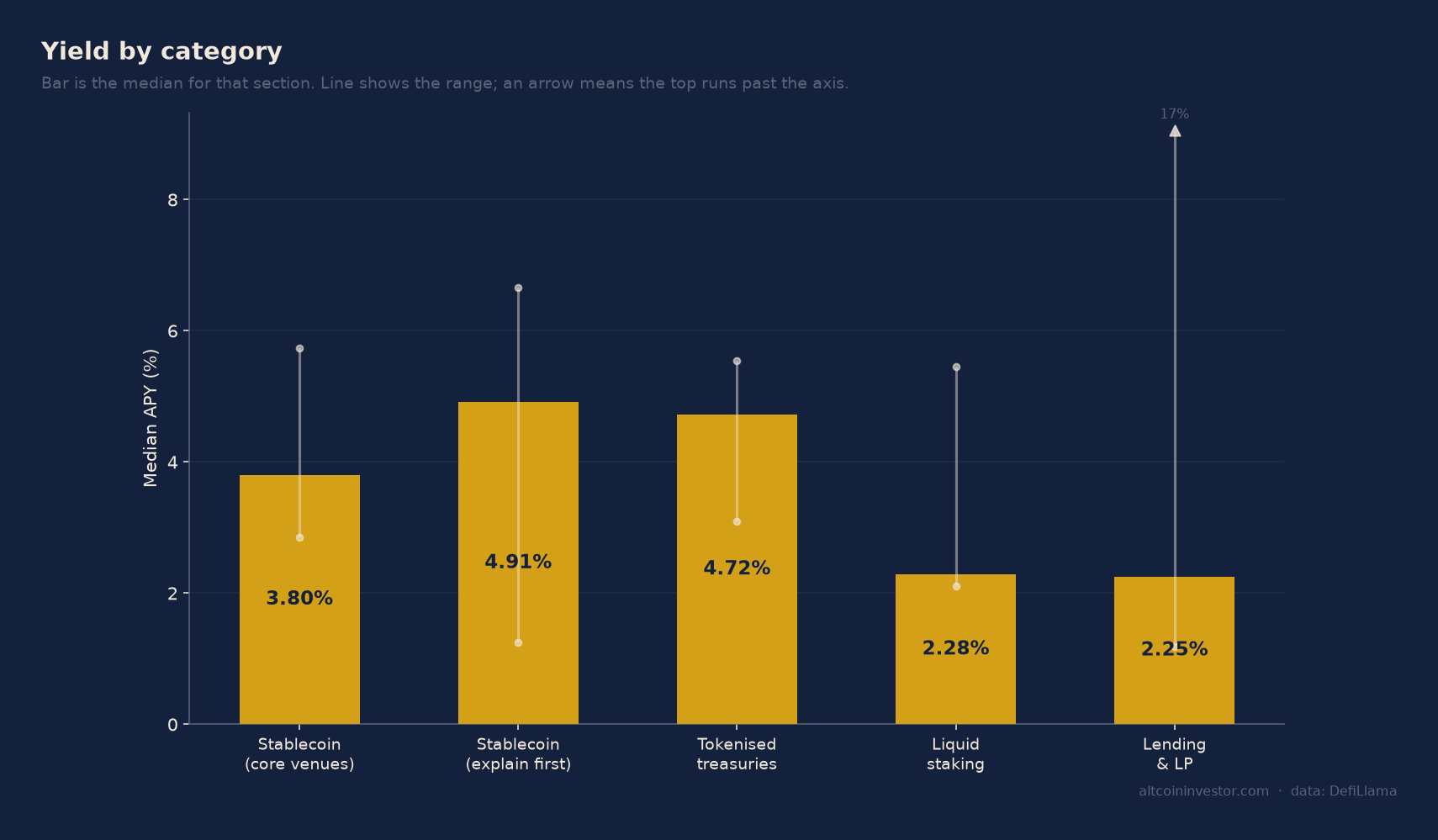
The income mechanism here is straightforward. Early entry into a new listing can capture 4-5% yields before rates normalize to the 2-3% baseline most established stablecoins offer. But poor due diligence risks depeg exposure on six-figure positions. Your objective is to separate conservative launches from systemic failures before you deploy meaningful capital.
Prerequisites: You should already understand how stablecoin lending generates yield and have used Aave V3 at least once. You need enough capital to justify the time spent on this evaluation process. If you are testing with $500, skip to established stablecoins. If you are deploying $50,000 or more, this framework prevents costly mistakes.
Step 1: Verify Reserve Composition Within 72 Hours
The first question is not whether the stablecoin is listed on Aave. The first question is whether the reserves backing the stablecoin are what the issuer claims they are, and whether those reserves can withstand a redemption run.
RLUSD is backed by USD deposits, cash equivalents, and short-term U.S. Treasuries, with custody held by The Bank of New York Mellon under monthly independent attestations. That structure places it at the conservative end of the stablecoin risk spectrum. But "monthly attestation" introduces a 30-day lag between what the issuer publishes and what the current reserve composition actually is.
Your 72-hour checklist:
- Cross-reference the latest published attestation at ripple.com/legal against the on-chain TVL visible on Aave V3's DefiLlama page.
- Confirm the attestation is dated within the past 45 days. If the most recent report is older than that, the issuer has missed a scheduled disclosure.
- Check the reserve breakdown. Stablecoins backed entirely by short-duration Treasuries are safer than those holding corporate debt or repo agreements.
- Verify the custodian is a regulated institution. BNY Mellon custody is institutional-grade. A custodian you have not heard of requires additional research.
If the attestation is missing, outdated, or vague about asset composition, do not proceed. The 4.98% APY is not worth exposure to undisclosed reserve risk.
Redemption Mechanism Test
A stablecoin's ability to maintain its peg depends on whether users can redeem tokens for dollars at a 1:1 ratio on demand. If the issuer cannot meet redemption requests due to illiquidity or insolvency, the perceived value of the token declines, and the on-chain price depegs.
Simulate a redemption request within the first week. This does not mean redeeming your entire position. It means initiating a small redemption through the issuer's official channels and documenting the confirmation time and workflow.
For RLUSD, redemption happens through Ripple's institutional interface, not through a retail-facing app. That structure is appropriate for a NYDFS-regulated stablecoin, but it also means retail users have less visibility into redemption speed. If you cannot easily determine how long a redemption takes or what the minimum threshold is, that opacity is a red flag.
Step 2: Measure Liquidity Depth On Secondary Markets

A stablecoin can have perfect reserves and still depeg if secondary market liquidity is insufficient to absorb sell pressure. RLUSD is smaller than USDT and USDC, so liquidity can be thinner in some markets and trading pairs.
Liquidity measurement is not subjective. You are checking whether the stablecoin can handle your position size without material slippage.
Open Uniswap V3 and simulate a $100,000 swap from RLUSD to USDC. Note the slippage percentage. If slippage exceeds 0.5%, the liquidity pool is too shallow to support a six-figure exit without moving the price. That does not mean the stablecoin is unsafe. It means your position size exceeds the liquidity available, and you will face exit friction if you need to redeem quickly.
Compare that figure to the Aave V3 supply cap. If the supply cap is $50 million but Uniswap V3 liquidity for RLUSD/USDC is only $2 million, a mass exit from Aave would overwhelm the secondary market and create temporary depeg risk.
This is not a theoretical concern. On March 12, 2026, Aave V3 experienced an oracle manipulation incident involving $862,000. The root cause was not reserve failure but price feed distortion in a low-liquidity environment. When secondary market depth is thin, oracle manipulation becomes easier and liquidation cascades become more severe.
What Liquidity Depth Tells You About Maturity
Low liquidity in the first 30 days is not inherently bad. It signals a conservative launch. But liquidity should grow as TVL grows. If Aave TVL increases by 50% over 30 days but Uniswap liquidity remains flat, borrow demand is outpacing market-making incentives. That imbalance creates depeg risk.
Check liquidity depth on day 7, day 14, and day 30. If liquidity is not scaling with TVL, governance has misjudged demand, and you are exposed to exit friction that more established stablecoins do not have.
Step 3: Confirm Oracle Configuration And Manipulation Resistance
Aave V3 relies on Chainlink Price Feeds to determine the value of collateral and trigger liquidations. For stablecoins, the oracle's job is to confirm that $1.00 of RLUSD equals $1.00 of value. That sounds simple. It is not.
Oracle configuration determines how quickly Aave reacts to price deviations and how much tolerance exists before liquidations trigger. If the oracle is too slow to update, Aave may accept depegged collateral as if it were still worth $1.00. If the oracle is too sensitive, minor liquidity fluctuations can trigger mass liquidations.
Ripple chose Chainlink Price Feeds for RLUSD to provide tamper-proof, reliable asset prices directly on-chain. That choice is sound, but implementation details matter.
Your oracle checklist:
- Verify the Chainlink feed for RLUSD on Ethereum mainnet at data.chain.link. Check the update frequency and deviation threshold.
- Confirm that the feed updates at least once per hour or whenever the price deviates by more than 0.5% from the last reported value.
- Check the staleness threshold. If the oracle allows a price that is more than 24 hours old to be used in liquidation logic, that lag creates manipulation risk.
- Identify whether Aave uses a single Chainlink feed or multiple price sources. Single-source oracles are more vulnerable to manipulation than multi-source aggregators.
If you cannot find this information in Aave's asset listing documentation, the listing is not mature enough for large deposits.
Isolation Mode vs. Core Market Exposure
Aave V3 introduced isolation mode to limit systemic risk when listing riskier assets. In isolation mode, a stablecoin can only be borrowed against isolated collateral, and it cannot be used as collateral for other assets.
RLUSD's listing parameters determine whether it was launched in isolation mode or added directly to the core market. If RLUSD is in the core market, Aave governance has determined that it meets the same risk standards as USDC and DAI. That is a strong endorsement. If RLUSD is in isolation mode, Aave considers it higher-risk, and your exposure should be calibrated accordingly.
Check governance.aave.com for the Technical Asset Listing Framework adopted in May 2026. This framework standardizes the review process for new assets and makes isolation vs. core market decisions transparent. If RLUSD passed the technical review gates without isolation restrictions, that outcome signals lower risk.
Step 4: Interpret Early Borrow Demand As A Sustainability Signal
RLUSD launched on Aave with zero initial utilization. That is normal. A conservative launch means supply enters the market before borrow demand, and rates remain low until arbitrage opportunities develop.
But if utilization remains at 0% after 30 days, that signal is concerning. It means no one is borrowing RLUSD, which means there is no organic demand for the asset outside of passive lending. Yield on Aave comes from borrowers paying interest. If no one borrows, your APY will stay near 0% regardless of what the supply cap allows.
Your borrow demand checklist:
- Monitor utilization on Aave V3 weekly. Healthy early-stage utilization is 5-15% by day 30.
- Compare RLUSD borrow APY to USDC and USDT borrow APY on the same platform. If USDC borrow rates are rising and RLUSD borrow rates remain flat, arbitrageurs are not using RLUSD because liquidity or redemption friction makes it less efficient.
- Check whether Aave or Ripple has activated any liquidity mining incentives for RLUSD borrowers. If incentives are live and utilization is still 0%, demand is structurally weak.
Low utilization in the first week is fine. Low utilization at day 30 means the market does not need this stablecoin yet, and you are better off deploying capital into USDC or DAI, where borrow demand is established and yields are predictable.
Funding Rate Arbitrage As A Demand Proxy
Stablecoin borrow demand on Aave often comes from traders executing funding rate arbitrage on perpetual futures exchanges. When funding rates on ETH-PERP or BTC-PERP are positive, traders borrow stablecoins on Aave, open short positions on the perp, and collect funding payments while hedging their exposure.
If funding rates are positive and USDC borrow demand is high but RLUSD borrow demand is absent, the issue is not a lack of arbitrage opportunity. The issue is that RLUSD is not yet integrated into the trading workflows arbitrageurs use. That integration lag can persist for months, and during that period, your RLUSD deposits will earn minimal yield.
Step 5: Assess Governance Control Risk And Admin Keys
Stablecoins are not immutable. Most stablecoin contracts include admin functions that allow the issuer to freeze accounts, pause transfers, or upgrade the contract. Those functions are necessary for regulatory compliance, but they also introduce governance risk.
For RLUSD, governance control sits with Ripple. The company operates under NYDFS regulation, which limits the discretion Ripple has to change contract behavior without regulatory approval. That structure is safer than a stablecoin governed by a multisig with no regulatory oversight.
But you still need to verify the governance setup:
- Check the RLUSD contract on Etherscan for admin functions. Identify whether Ripple can freeze individual accounts or pause the entire contract.
- Verify whether Ripple's admin controls have timelock delays. A timelock prevents the issuer from executing changes instantly and gives users time to exit if they disagree with a governance decision.
- Assess whether Ripple uses a multisig for admin control. Single-key control is riskier than a multisig requiring 3-of-5 signatures.
If admin keys are held by a single wallet with no timelock, that structure is higher-risk than a multisig with a 48-hour delay. Governance risk does not mean the stablecoin will fail. It means that your funds are subject to decisions you cannot influence, and you need to size your position accordingly.
Multi-Chain Bridge Risk
RLUSD operates on Ethereum mainnet and the XRP Ledger, with expansions to Layer-2 networks including Base, Optimism, Unichain, and Ink through a partnership with Wormhole. Multi-chain deployment increases utility but also increases attack surface.
Bridge exploits are one of the largest sources of loss in DeFi. If RLUSD is bridged to Layer-2 and the bridge contract is exploited, tokens minted on the Layer-2 may not resolve to mainnet custody. That discrepancy creates temporary depeg risk until the issuer intervenes.
During the first 30 days, confirm that Aave's RLUSD integration is using native Ethereum mainnet RLUSD, not bridged tokens. If Aave lists bridged RLUSD, you are exposed to both stablecoin reserve risk and bridge exploit risk.
Step 6: Monitor Supply Cap Dynamics And Governance Response
RLUSD launched on Aave with a $50 million supply cap and a $5 million borrow cap. Those caps are conservative by design, but they also create a governance bottleneck if demand exceeds expectations.
If supply reaches 90% of the cap within 30 days, that outcome signals strong demand. But it also means new deposits are blocked until governance votes to raise the cap. Governance votes on Aave take 5-7 days from proposal to execution. During that window, you cannot add to your position, and yield may compress as existing suppliers compete for limited borrow demand.
Your supply cap checklist:
- Check Aave V3 supply metrics weekly. If supply exceeds 80% of the cap, governance is behind demand.
- Monitor governance.aave.com for RLUSD cap increase proposals. If no proposal appears after supply reaches 90%, governance is unresponsive, and the listing is not scaling as planned.
- Verify that the borrow cap is scaling proportionally with the supply cap. A $50 million supply cap with a $5 million borrow cap means maximum utilization is 10%. If the borrow cap does not increase, yields will remain compressed regardless of how much capital enters the pool.
If governance is slow to raise caps, that delay is not necessarily a red flag. It may reflect caution. But it does mean the opportunity to capture early-stage yield is closing faster than you expected, and you should adjust your allocation timeline.
Common Failure Modes And How To Spot Them
Most newly listed stablecoins do not fail catastrophically. They fail quietly by underperforming expectations. Here are the specific failure modes you are screening for.
Reserve Opacity
If the issuer publishes attestations irregularly or provides vague descriptions of reserve composition, that opacity is a leading indicator of reserve quality problems. Established stablecoins like USDC publish reserve breakdowns monthly with specific percentages allocated to each asset class. New stablecoins that avoid that level of disclosure are hiding something.
Liquidity Stagnation
If Uniswap liquidity for the stablecoin does not grow as Aave TVL grows, market makers are not incentivized to provide liquidity. That imbalance creates depeg risk during periods of high withdrawal demand.
Oracle Lag
If the Chainlink feed for the stablecoin updates less frequently than once per hour, or if the staleness threshold is set above 24 hours, the oracle is too slow to react to depeg events. That lag exposes Aave to accepting depegged collateral as if it were still worth $1.00.
Persistent Zero Utilization
If utilization remains at 0% for 30 days, no one is borrowing the stablecoin. That outcome means your deposits will earn minimal yield, and the listing has not achieved product-market fit.
Governance Unresponsiveness
If supply reaches the cap and governance does not propose a cap increase within 10 days, Aave governance is either unaware of demand or unwilling to expand exposure. Either scenario is a negative signal.
What To Do Next
If RLUSD or any newly listed stablecoin passes the 30-day checklist, your next step is to scale your position gradually. Do not deploy your full allocation on day 31. Deploy 25% of your intended allocation and monitor for another 30 days. If utilization remains healthy, liquidity continues to grow, and governance responds promptly to supply cap constraints, scale to 50%, then 75%, then 100%.
If the stablecoin fails any of the checklist items, do not deploy additional capital. Move to an established stablecoin with a longer track record and accept the lower yield. The 1-2% yield premium on a new listing is not worth the risk of a 5-10% depeg if reserves, liquidity, or governance fail.
For readers deploying six-figure positions, this framework is not optional. The difference between a 4.98% yield and a 3.5% yield is $1,480 per year on $100,000. The cost of a 5% depeg is $5,000. One failure erases three years of outperformance. The math favors caution, and caution requires process.
The Takeaway
RLUSD's launch on Aave V3 at 4.98% APY looked attractive. It still might be. But "attractive" is not the same as "safe," and yield is not the same as return. Return is yield minus losses, and losses come from skipping the steps outlined here.
The most common mistake retail DeFi users make is treating all stablecoins as equivalent because they all claim to be worth $1.00. They are not equivalent. Reserve composition, liquidity depth, oracle configuration, borrow demand sustainability, and governance responsiveness all vary, and those variables determine whether a newly listed stablecoin will hold its peg under stress.
The next time a stablecoin launches on Aave V3 at an elevated yield, run this checklist before you deposit. You are not looking for perfection. You are looking for evidence that the issuer, governance, and market infrastructure are prepared for the scale the listing will reach. If that evidence is missing, wait. The opportunity to earn 4-5% today is not worth the risk of explaining to yourself later why you ignored the signals that were visible from the beginning.
Frequently Asked Questions
Is RLUSD safe to deposit on Aave V3?
RLUSD is backed by USD deposits, cash equivalents, and short-term U.S. Treasuries with BNY Mellon custody and NYDFS regulation. Those fundamentals place it at the conservative end of stablecoin risk. However, newly listed stablecoins require 30 days of monitoring to verify liquidity depth, oracle configuration, and borrow demand sustainability before deploying large positions. Start with 25% of your intended allocation and scale gradually after confirming reserve attestations are current, secondary market liquidity supports your position size, and utilization is growing.
How long should I wait before depositing into a newly listed Aave stablecoin?
Wait at least 7 days to verify reserve composition and redemption mechanisms, then monitor for 30 days to assess liquidity growth, borrow demand, and governance responsiveness. Deploy capital in stages: 25% after day 7 if reserves and oracles check out, another 25% after day 30 if utilization reaches 5-15%, and scale to full allocation only after 60 days if liquidity depth and governance response remain healthy. Rushing into a new listing to capture early yield risks depeg exposure that erases months of outperformance.
What is a safe utilization rate for a new stablecoin on Aave?
Healthy early-stage utilization is 5-15% by day 30. Zero utilization after 30 days signals weak borrow demand and means yields will remain near zero regardless of supply cap. Utilization above 80% in the first 30 days signals strong demand but also creates liquidation risk if borrowers are concentrated in leveraged positions. Target 10-20% utilization for the first 90 days as a sign of organic growth without excess leverage risk.
How do I check if a stablecoin oracle on Aave is vulnerable to manipulation?
Verify the Chainlink feed at data.chain.link for update frequency, deviation threshold, and staleness limit. The feed should update at least once per hour or whenever price deviates by more than 0.5%. Staleness thresholds above 24 hours create manipulation risk because Aave may accept outdated prices during depeg events. Check Aave's asset listing documentation for whether the protocol uses a single Chainlink feed or multiple price sources. Single-source oracles are more vulnerable than multi-source aggregators.
What reserve composition is safest for a new stablecoin?
The safest reserve structure is 100% short-duration U.S. Treasuries and cash held by a regulated custodian like BNY Mellon, with monthly third-party attestations published within 30 days. Avoid stablecoins backed by corporate debt, repo agreements, or reserves described vaguely as 'cash equivalents' without specific percentages. If the most recent attestation is older than 45 days or does not break down reserve composition by asset class, the issuer is not meeting transparency standards established by USDC and should be treated as higher-risk.
You have just reviewed a 30-day checklist for RLUSD and other newly listed stablecoins. Those risk parameters change with every new listing and every governance vote.
Every Thursday: where crypto yield actually is - stablecoins, liquid staking and DeFi lending, with the risk named next to the rate and what changed since last week.
Get it free every ThursdayFree. No trade calls, no allocations, no hype. Unsubscribe in one click.