Table of Contents
Have you ever been so focused on finding the right trade that you forgot to think about what happens if it goes wrong?
Most traders do. And that is exactly where forex risk management becomes critical. In a market as fast-moving as forex, protecting your capital is just as important as growing it. In this blog, we will cover the key techniques and approaches every modern trader should have in place.
What is Forex Risk Management?
Forex risk management is the process of identifying, assessing, and controlling potential losses when trading currency pairs. It is not about avoiding losses entirely, as they are part of trading. It is about ensuring those losses remain within a range you can manage and recover from.
For modern traders, forex risk management is not optional. It is the foundation on which every other part of your trading is built. Without it, even the most promising trade can result in an unplanned loss.
What Are the Types of Forex Risks?
Before you can manage risk effectively, you need to understand where it comes from. Here are some of the types of risk every forex trader faces:
Market Risk
Market risk is the most common type of forex risk. It refers to the possibility that the market moves against your position. Currency prices are influenced by economic data, geopolitical events, central bank decisions, and market sentiment. Any of these can cause sudden and sharp price movements that work against an open trade.
Leverage Risk
Forex trading involves leverage, which lets you control large positions with a small deposit. But it comes with a significant downside. Leverage amplifies both your gains and your losses in equal measure. Which means even a small move against your position can result in a loss much larger than what you initially put in. That is why carefully managing leverage is an important part of forex risk management.
Liquidity Risk
Liquidity risk occurs when you cannot exit a trade at the price you want to. It happens when there are not enough buyers or sellers in the market at that moment. This is common in exotic currency pairs or during periods of low market activity. It can therefore result in your trade closing at a worse price than expected.
Emotional Risk
Emotional risk is often overlooked but is one of the most damaging factors. Fear, greed, and impatience can all lead traders to make decisions that go against their plan. Entering trades too early, holding losing positions too long, or increasing position sizes after a loss are all examples of emotional risk in action.
What is a Stop Loss Order in Trading?
A stop loss order is one of the most fundamental tools in forex risk management. So, what exactly is a stop-loss order in trading?
A stop loss is an instruction you set on your trade that automatically closes your position if the price moves against you by a certain amount. It removes the need to make a decision under pressure. When the price hits your stop-loss level, the trade closes automatically, and your loss is limited to what you planned before you entered.
For example, if you buy EUR/USD at 1.1000 and set a stop loss at 1.0950, your trade will automatically close if the price falls to 1.0950. That means your maximum loss on that trade is 50 pips, regardless of how far the price falls after that point.
Stop loss orders become even more important when markets are volatile and prices shift quickly. Traders using a range trading strategy, for instance, place stop loss orders just outside their defined support and resistance levels. So if the price breaks out of the expected range, the trade closes automatically before the losses go any further.
What Are the Key Forex Risk Management Techniques?
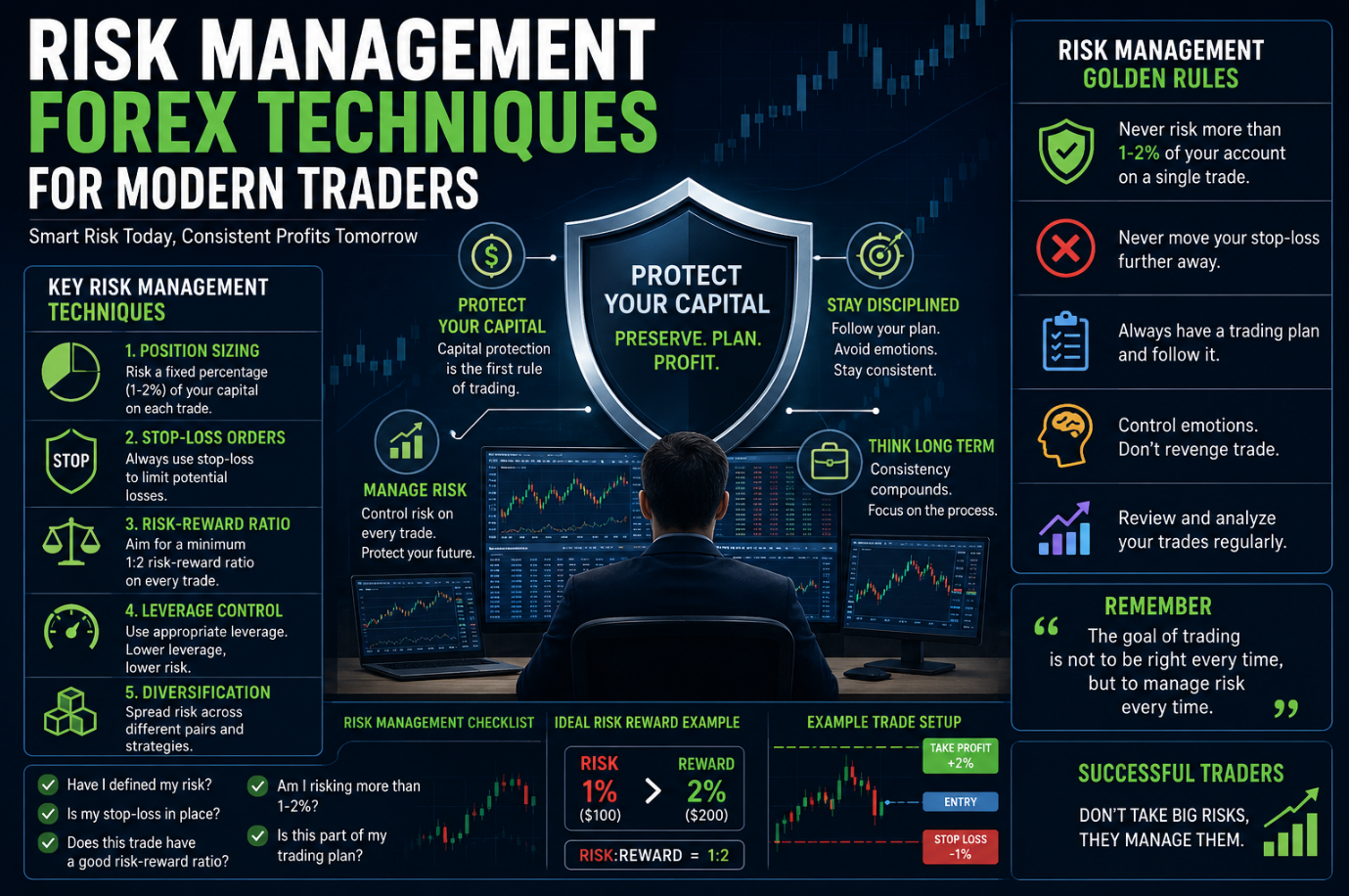
Now that we understand what forex risk management is and the risks involved, here are the key techniques every modern trader should apply consistently.
Position Sizing
Position sizing refers to how much of your capital you commit to a single trade. Most experienced traders risk no more than one to two per cent of their account on any single trade. This means that even a series of losing trades will not wipe out your account.
For example, if your account balance is £10,000 and you risk one per cent per trade, your maximum loss on any single trade is £100. This keeps losses manageable and allows you to stay in the market for a long period to improve and grow.
Risk to Reward Ratio
The risk-to-reward ratio compares how much you are willing to risk on a trade against how much you aim to gain. A ratio of 1:2 means you are risking one unit to potentially gain two. This matters because it means you can be wrong on more trades than you are right and still come out ahead over time.
Managing Leverage
Leverage gives you access to positions larger than your capital would normally allow. But it works both ways. It can increase your potential gains and your losses in equal measure. Using lower leverage, especially when you are still developing as a trader, gives your positions more room to move without being stopped out by normal market fluctuations.
Diversification
Rather than focusing on one currency pair, diversification means trading across several pairs. This way, if one position moves against you, your other trades are not affected in the same way. Moreover, it does not remove risk from the equation. But it does help spread it more evenly across your trading activity.
What Mistakes Should Every Forex Trader Avoid?
Even with the right techniques in place, certain mistakes can undermine your forex risk management approach. Here are the most common ones to watch out for:
Trading Without a Plan
Entering a trade without a clear entry point, stop loss, and target is one of the most common mistakes traders make. Without a plan, decisions are made on impulse rather than logic. And impulsive decisions in forex trading almost always lead to avoidable losses.
Overleveraging
Using too much leverage is one of the fastest ways to damage a trading account. Many traders, particularly beginners, are drawn to high leverage because of the potential for large gains. But the same leverage that creates those gains can wipe out an account just as quickly when the market moves against you.
Moving Your Stop Loss
Once a stop loss is set, moving it further away to avoid a loss is a dangerous habit. It turns a planned and manageable loss into a potentially much larger one. Your stop loss exists for a reason. Trusting is an important part of disciplined forex risk management.
Increasing Risk After a Loss
After a losing trade, it can be tempting to increase your position size on the next trade to recover losses quickly. This is known as revenge trading, and it almost always makes things worse. Stick to your planned risk per trade regardless of what happened on the previous one.
Conclusion
Forex risk management is not the most exciting part of trading. But it is the most important. Without it, even the best strategy in the world will eventually lead to significant losses.
Understanding the types of risk you face, applying the right techniques, and avoiding common mistakes give modern traders the foundation to trade consistently and responsibly.