Table of Contents
What Staking Actually Means
Staking is how proof-of-stake blockchains pay you to help secure the network. You lock cryptocurrency in a wallet that runs validator software. That software proposes new blocks and verifies transactions. In exchange, the network pays you a percentage of your stake annually, usually between 3% and 7%.
The rewards come from two sources: new tokens minted by the network (inflation rewards) and fees paid by users who submit transactions. Ethereum validators earn roughly 3-4% APY. Solana validators earn 6-7%. Cardano pays 3-4% with no lockup period required.
This is different from mining. Mining uses computing power to solve puzzles and secure proof-of-work blockchains like Bitcoin. Staking replaces that energy-intensive process with financial commitment. You prove your stake in the network by locking tokens, not by running expensive hardware.
Here is the key point beginners miss: staking rewards are yield, not appreciation. If you stake $1,000 of ETH at 4% APY, you earn $40 in new ETH over one year. But if ETH's price drops 20% during that year, your $1,000 becomes $800, and your $40 in rewards doesn't offset the $200 loss. Yield and price move independently.
How Staking Rewards Are Generated
Validators earn rewards every time they propose a new block or attest to someone else's block. The network distributes these rewards automatically, usually within minutes or days depending on the blockchain.
On Ethereum, validators are randomly selected to propose blocks. When your validator is chosen, it bundles pending transactions into a block, proposes it to the network, and collects the transaction fees users paid plus a small amount of newly minted ETH. Other validators then attest that your block is valid. Both proposing and attesting earn rewards.
The reward rate depends on how much of the network's total supply is staked. When fewer people stake, rewards go up to attract more validators. When more people stake, rewards go down because the network doesn't need additional security. Ethereum's APY has fallen from 5% in 2022 to roughly 3% in 2026 because 32% of all ETH is now staked.
Solana works similarly but distributes rewards every epoch, roughly every two days. Cardano pays rewards every five days. The rhythm varies, but the mechanism is the same: validators do work, the network pays them, and if you delegate your tokens to a validator, you receive a share of those rewards minus the validator's commission.
Real Yield vs Nominal Yield
Most staking APY numbers you see are nominal. They don't account for token inflation.
Ethereum issues new ETH to pay stakers, but it also burns a portion of every transaction fee through EIP-1559. During high network activity, more ETH gets burned than issued, making ETH deflationary. During low activity, issuance exceeds burn, and supply grows slightly. Over the long run, ETH inflation averages 0.5-1% annually. That means a 3.5% staking APY delivers roughly 2.5-3% real yield after inflation.
Solana pays 6-7% nominal APY but has programmed inflation that started at 8% annually and declines roughly 15% per year toward a 1.5% floor. In 2026, Solana's inflation sits around 5-6%. That means a 7% staking APY delivers roughly 1-2% real yield after inflation.
Cardano's inflation is around 4% annually. A 4% staking APY delivers close to 0% real yield after inflation.
Real yield matters because it tells you whether you are getting ahead or just keeping pace with token dilution. Ethereum's low nominal APY often delivers better real returns than networks with higher headline rates.
What Can Go Wrong: Slashing, Lockups, and Price Risk
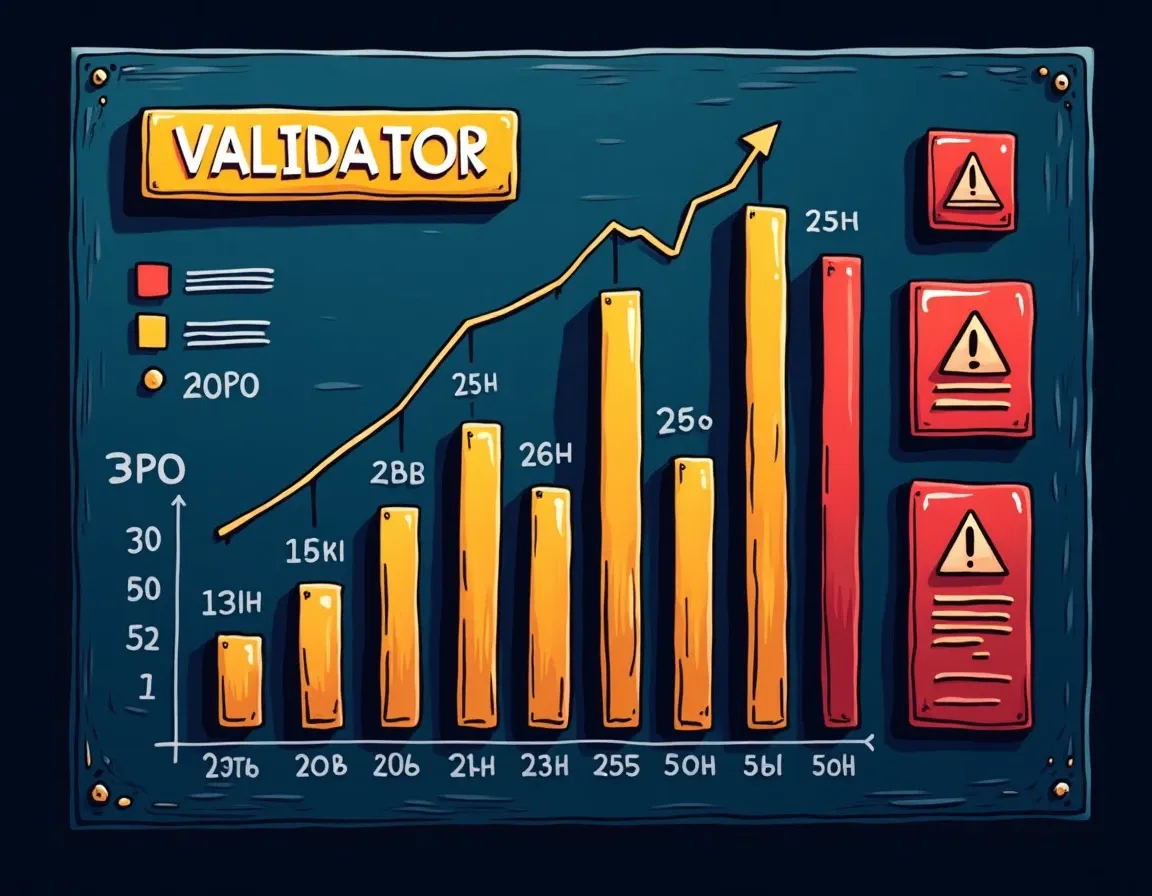
Three major risks affect staking positions: slashing, liquidity lockup, and price volatility. Each one matters differently depending on which network you stake on and how you stake.
Slashing Risk
Slashing is a penalty for validator misbehavior. If a validator double-signs a block, proposes conflicting blocks, or goes offline for an extended period, the network confiscates a portion of its staked tokens. On Ethereum, slashing penalties start at roughly 1 ETH and can escalate if many validators are slashed at the same time.
Here is what triggers slashing on Ethereum: proposing two different blocks for the same slot, attesting to two conflicting blocks, or surrounding a previous attestation with a new one. These are protocol violations that require either malicious intent or catastrophic software failure. Routine downtime does not trigger slashing. If your validator goes offline for a few hours, you miss rewards and pay small inactivity penalties, but you don't lose principal.
If you delegate to a validator run by someone else, slashing risk transfers to the operator. Your tokens can still be slashed if the operator makes a mistake, but reputable validators have strong uptime records and rarely get slashed. Coinbase, Kraken, Lido, and Rocket Pool have multi-year track records with no major slashing incidents.
Cardano has no slashing. Delegators never lose principal, even if the pool operator shuts down. Solana has slashing rules in theory, but in practice slashing events are extremely rare and almost never affect delegators.
Lockup and Liquidity Risk
Many staking protocols require you to lock tokens for a fixed period before you can withdraw. Ethereum staking used to require indefinite lockup. Now withdrawals are enabled, but you join an exit queue when you unstake. The queue can take anywhere from 9 to 50 days depending on how many other validators are exiting at the same time. ETF demand in 2026 has pushed Ethereum's validator queue to multi-year highs, which extends withdrawal times.
Solana requires a 2-3 day unbonding period. When you unstake, your tokens remain locked for roughly two epochs before they become liquid again. During that time, you can't sell or transfer them.
Cardano has no lockup. You can unstake anytime, and your ADA remains liquid throughout the staking period. This makes Cardano the most beginner-friendly option for anyone worried about getting locked in.
Lockup risk matters most during market downturns. If the price drops 30% while your tokens are locked, you can't exit to stop the loss. You ride the volatility whether you want to or not.
Price Volatility
Price risk is the biggest risk in staking. Your APY means nothing if the token's price falls faster than you earn rewards.
Here is a worked example. You stake $10,000 of ETH at 4% APY. After one year, you earn $400 in rewards. If ETH's price stays flat, you end with $10,400, a 4% gain. If ETH appreciates 20% during the year, your $10,000 becomes $12,000, plus $400 in rewards, for a total of $12,400 and a 24% gain. If ETH drops 20%, your $10,000 becomes $8,000, plus $400 in rewards, for $8,400 total and a 16% loss.
The 4% yield does not protect you from the 20% price drop. Staking earns income, but it doesn't hedge volatility.
This is why many beginners prefer liquid staking tokens like stETH or rETH. These tokens represent your staked position but remain tradeable. If the market crashes and you need to exit, you can sell your stETH on a DEX without waiting for the unbonding period. The price risk is the same, but the liquidity risk is lower.
Your First Staking Position Under $1,000
If you have under $1,000 to stake, I recommend Cardano (ADA) as your first position. Here is why.
Cardano has no minimum stake, no lockup period, and no slashing risk. You delegate ADA to a stake pool through your wallet. Your tokens never leave your custody. The pool operator does the validator work, takes a small commission (usually 2-3%), and distributes rewards to delegators every five days. If the pool shuts down or underperforms, you can redelegate to a different pool anytime with no penalty.
At current rates, Cardano pays roughly 3-4% APY. On $1,000, that's $30-$40 per year. Not life-changing, but enough to learn how staking works without risking lockup or slashing.
Here is how to do it. Buy ADA on Coinbase, Kraken, or Binance. Transfer it to a self-custody wallet like Yoroi or Daedalus. Open the staking tab in your wallet, browse the list of stake pools, pick one with consistent uptime and reasonable fees, and delegate. The first reward arrives in 15-20 days. After that, rewards compound every epoch.
Total cost: zero beyond the ADA purchase. Cardano's transaction fees are a fraction of a cent.
Ethereum Staking for Beginners
If you prefer Ethereum, liquid staking services like Lido, Rocket Pool, or Coinbase accept any amount. You don't need the 32 ETH required for solo staking. You deposit ETH, receive a liquid staking token (stETH, rETH, or cbETH), and start earning rewards immediately.
On $1,000 of ETH at 3.5% APY, you earn $35 per year. The advantage over Cardano is Ethereum's better risk-adjusted return. ETH has lower inflation, stronger network effects, and a deflationary mechanism that can turn positive real yield during high activity periods. The disadvantage is the unbonding queue, which can take weeks if you decide to exit.
For a detailed walkthrough of exchange staking, validator selection, and fee structures, read How To Start Staking Crypto: A Beginner's Complete Guide.
Solana for Higher Nominal Yield
Solana offers 6-7% APY with a 2-3 day unbonding period. On $1,000, that's $60-$70 per year. The higher nominal yield is attractive, but remember that Solana's inflation is around 5-6% in 2026, so your real yield after dilution is only 1-2%.
Solana staking works through delegation, similar to Cardano. You choose a validator, delegate your SOL, and start earning rewards within one epoch (roughly two days). Transaction fees on Solana are a fraction of a cent, so the entry cost is negligible.
The trade-off is Solana's higher price volatility. SOL swings more than ETH or ADA. If you're risk-averse, the extra 3% nominal yield doesn't compensate for the wider price bands.
Exchange Staking vs Self-Custody
You can stake directly on exchanges like Coinbase, Kraken, Binance, or Gemini without moving tokens to a self-custody wallet. The advantage is simplicity. You click "stake," confirm, and start earning. The disadvantage is the exchange takes a cut, usually 25-40% of your rewards.
Coinbase charges roughly 25% commission on ETH staking rewards. If the network pays 4% APY, you receive 3%. Kraken's fee structure is similar. Binance's fees vary by token but average 15-25% commission.
Self-custody staking through wallets like Yoroi (Cardano), Phantom (Solana), or Lido (Ethereum) lets you keep 100% of network rewards minus only the validator's commission, which is typically 2-5%. On a $1,000 position, the difference between 25% exchange commission and 3% validator commission is roughly $8-$10 per year. Not huge, but it compounds over time.
The operational risk is higher with self-custody. You manage your own seed phrase, approve transactions yourself, and choose validators without exchange vetting. If you lose your seed phrase or pick a bad validator, the exchange won't help you. For beginners, I recommend starting on an exchange for your first $500-$1,000, then moving to self-custody once you understand the workflow. To compare fee structures and break-even points, see Exchange Staking vs Self-Custody Staking: Real Yield and Risk.
When Staking Makes Sense and When It Doesn't
Staking makes sense when you plan to hold a token for at least six months and want to earn yield on an otherwise idle position. If you believe ETH, ADA, or SOL will appreciate or hold value over the medium term, staking turns a static holding into an income-generating asset.
Staking does not make sense if you are trading actively, if you need liquidity on short notice, or if the token's price volatility exceeds your risk tolerance. A 4% APY on a token that drops 30% is a bad trade.
Staking also does not make sense as a way to "try out" a token you don't already want to hold. The yield is too low to justify speculative positions. If you wouldn't buy and hold ADA for six months without staking, you shouldn't stake it either.
Here is the decision tree I use. If I'm holding ETH long-term anyway, I stake it and capture the 3-4% yield. If I'm holding a smaller alt for speculation, I don't stake it because I want liquidity when the price moves. If I'm unsure whether I want exposure to a token, I don't stake it until I've decided on the hold period.
For more on when staking fits into a broader yield strategy, see A Beginner's Guide to Staking and Yield Farming in Cryptocurrency.
Common Mistakes Beginners Make
The first mistake is chasing the highest APY without checking unbonding periods or inflation rates. A 15% APY on a token with 12% inflation is worse than 4% APY on a token with 0.5% inflation. Always subtract inflation to calculate real yield.
The second mistake is staking more than you can afford to lock up. If you stake $5,000 of ETH and the market crashes two weeks later, you can't unstake and exit quickly. The unbonding queue takes days or weeks. Only stake capital you won't need for at least three months.
The third mistake is ignoring validator commission. Some validators charge 10-15% commission, others charge 2-3%. On a $1,000 position earning 5% gross APY, the difference between 3% and 10% commission is $35 vs $45 net annual return. Check the fee before you delegate.
The fourth mistake is assuming staking is risk-free because it's not trading. Staking carries price risk, liquidity risk, and slashing risk. It's safer than leverage or DeFi farming, but it's not a savings account.
The fifth mistake is staking on an exchange without understanding how withdrawals work. Some exchanges batch unstaking requests and process them weekly. Others have minimum withdrawal amounts or charge withdrawal fees. Read the fine print before you stake.
For a deeper post-mortem on the mistakes that cost real money, see The 5 Beginner Crypto Mistakes That Cost You Real Money.
Tax Treatment of Staking Rewards
The IRS treats staking rewards as ordinary income at the fair market value on the day you receive them. If you earn 10 ADA in rewards and ADA is worth $0.50 when the reward arrives, you owe income tax on $5. When you later sell those 10 ADA, you owe capital gains or losses on the difference between $5 and the sale price.
This is the same tax treatment as interest income or freelance income. Staking rewards are not capital gains. They are ordinary income.
Most validators and exchanges don't issue 1099 forms for staking rewards under certain thresholds, but you are still required to report the income. You track the date, amount, and fair market value of each reward yourself. If you stake through an exchange, the platform may provide a CSV export with this data. If you stake via self-custody, you use a block explorer or third-party tax software to reconstruct your reward history.
For the full IRS position and what "dominion and control" means for staking, see Crypto Staking Tax Treatment: What The IRS Actually Says.
The Takeaway
Staking lets you earn 3-7% APY on proof-of-stake tokens by helping secure the network. Ethereum pays 3-4%, Solana pays 6-7%, and Cardano pays 3-4% with no lockup. Real yield is lower once you subtract token inflation. Price volatility is the biggest risk, followed by liquidity lockup and slashing.
Your first staking position should be under $1,000. Cardano is the safest starting point because it has no lockup, no slashing, and no minimum. Delegate through Yoroi or Daedalus, pick a pool with good uptime, and expect your first reward in 15-20 days. That $30-$40 annual yield teaches you the workflow without exposing you to the risks of higher-yield networks.
Once you understand how delegation works, how rewards arrive, and how to redelegate if needed, you can move to Ethereum or Solana for better risk-adjusted returns or higher nominal yield. Until then, keep the position small and treat it as tuition.
Frequently Asked Questions
How much can I realistically earn from staking $1,000?
On $1,000 staked, you'll earn $30-$40 per year with Ethereum or Cardano at 3-4% APY, or $60-$70 per year with Solana at 6-7% APY. These are gross rewards before validator commission and inflation. Real yield after accounting for token dilution is typically 1-3% annually. Price changes matter more than yield. If your token drops 20% while you earn 4% APY, you still lose 16% overall.
Can I lose money staking crypto?
Yes, in three ways. First, price volatility. If the token drops 30% while staked, your 4% yield doesn't offset the loss. Second, slashing. Validators can lose a portion of staked tokens for misbehavior, though this rarely affects delegators on reputable platforms. Third, lockup risk. If you need liquidity during a market crash but your tokens are locked in unbonding, you can't exit quickly. Cardano has no lockup or slashing, making it the safest option for beginners.
What is the difference between staking on an exchange and self-custody staking?
Exchange staking is simpler but costs more. Coinbase and Kraken take 25-40% of your rewards as commission. Self-custody staking through wallets like Yoroi or Phantom lets you keep 97-98% of rewards, paying only the validator's 2-3% commission. The trade-off is operational risk. You manage your own seed phrase, choose validators, and approve transactions yourself. Start on an exchange for your first $500, then move to self-custody once you understand the workflow.
Is staking safe for beginners?
Staking is safer than leverage trading or high-risk DeFi farming, but it's not risk-free. You face price volatility, liquidity lockup, and small slashing risk. Cardano is the safest beginner option because it has no lockup period and no slashing. Your ADA stays liquid, and you can unstake anytime. Ethereum and Solana have unbonding periods of 9-50 days and 2-3 days respectively. Start with under $1,000 on Cardano to learn the mechanics before staking larger amounts.
How is staking taxed in the United States?
The IRS treats staking rewards as ordinary income at fair market value on the day you receive them. If you earn 10 ADA worth $5 total, you owe income tax on $5. When you later sell those 10 ADA, you owe capital gains or losses on the difference between $5 and the sale price. This applies whether you stake on an exchange or through self-custody. Most platforms don't issue 1099 forms for staking, so you track dates, amounts, and values yourself using block explorers or tax software.
You now have APY ranges for Ethereum, Solana, and Cardano, plus the lockup and slashing risks that matter in 2026. Those rates and queue times change every quarter.
Every Thursday: where crypto yield actually is - stablecoins, liquid staking and DeFi lending, with the risk named next to the rate and what changed since last week.
Get it free every ThursdayFree. No trade calls, no allocations, no hype. Unsubscribe in one click.