Table of Contents
What Is Layer 2 In Crypto?
A Layer 2 is a separate blockchain that processes transactions off Ethereum, then posts transaction data and a state commitment back to Ethereum for final settlement. Ethereum validates the commitment and guarantees the funds. You get faster confirmations and fees 10-100x cheaper than L1, while inheriting Ethereum's security guarantees through the proof system.
Ethereum processes over 1 million transactions daily. When demand spikes, gas prices rise substantially. A simple swap can cost $15-50 in gas during peak hours. Layer 2 rollups solve this by moving transaction execution off the main chain while keeping Ethereum as the final arbiter of what is valid.
The core question: how does a separate chain prove to Ethereum that its transactions are valid without Ethereum re-executing every transaction? Two proof mechanisms answer this question. Optimistic rollups assume every batch is valid and rely on fraud proofs plus a seven-day challenge window. ZK rollups attach a cryptographic validity proof to every batch that Ethereum verifies in milliseconds.
Both are Layer 2. Both inherit Ethereum's security. The proof mechanism determines withdrawal time, finality guarantees, and computational overhead.
How Layer 2 Rollups Actually Work

A rollup batches thousands of transactions offchain, compresses them, and submits three things to Ethereum:
- Transaction data (inputs, outputs, signatures), posted to Ethereum as calldata or blob data.
- A state root (a cryptographic hash representing the new account balances after the batch).
- A proof (either implicit via fraud-proof mechanism or explicit via zero-knowledge proof) that the state root is the correct result of executing those transactions.
Ethereum stores the transaction data and the state root. This is the security anchor. If the rollup operator disappears, anyone can reconstruct the rollup state from the data Ethereum holds. If the operator submits an invalid state root, the proof mechanism catches it.
The rollup sequencer collects user transactions, orders them, executes them in a virtual machine (often EVM-compatible), and computes the new state root. The sequencer then posts the batch to Ethereum. Users interact with the rollup through wallets and dApps that connect to the rollup RPC, not Ethereum mainnet. Confirmations are near-instant on the rollup. Final settlement happens when Ethereum accepts the batch.
This architecture enables the scalability gain. Ethereum no longer executes every transaction. It only verifies proofs and stores compressed data. With EIP-4844 (introduced in the Dencun upgrade in 2024), the cost of posting Layer 2 data fell by more than 90%. Arbitrum, Base, and Optimism process transactions for cents instead of dollars as a result.
Optimistic Rollups vs. ZK Rollups: The Security Model Divide
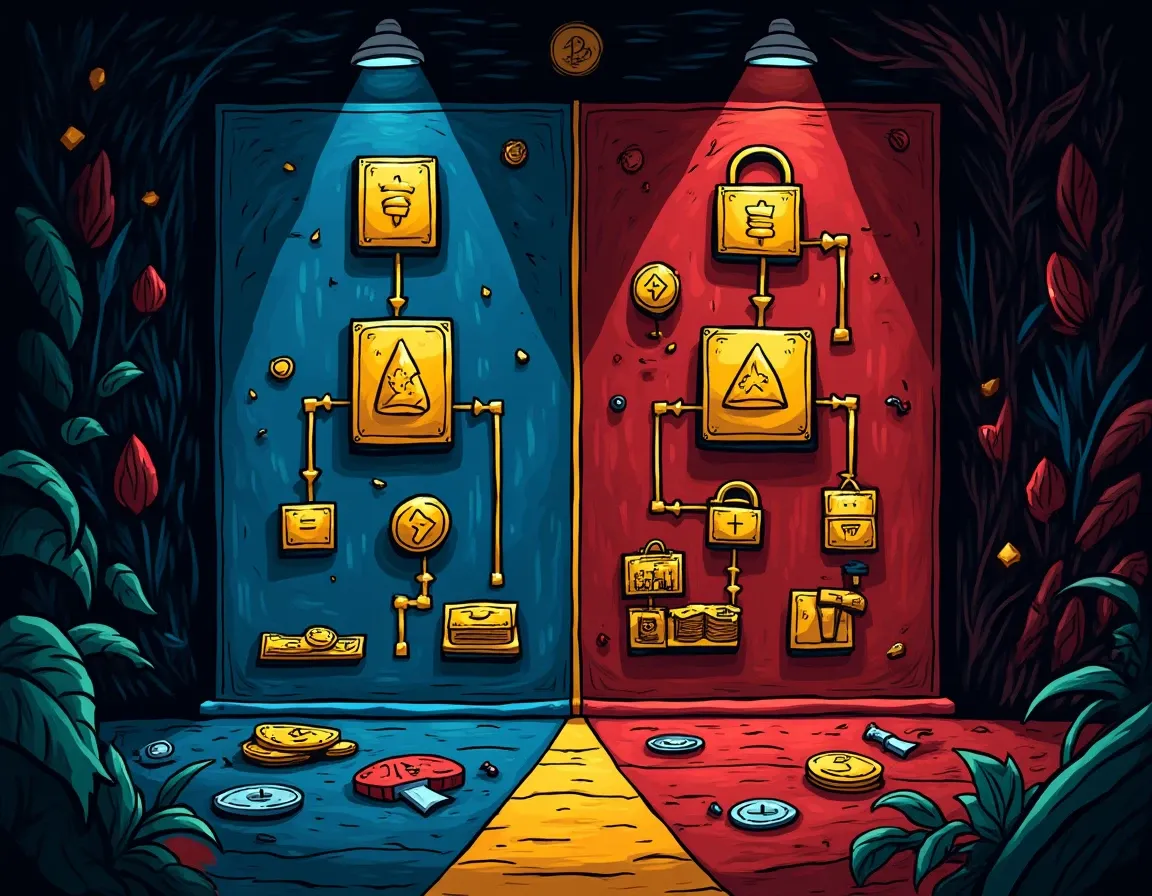
Optimistic rollups (Arbitrum, Optimism, Base) assume every batch is valid. The rollup posts transaction data and a state root to Ethereum. If the state root is incorrect, any honest validator can submit a fraud proof within a seven-day challenge window. The fraud proof re-executes the disputed transaction on Ethereum to determine the correct outcome. If fraud is proven, the malicious sequencer loses its bond and the incorrect state root is reverted.
The advantage: fraud proofs require only one honest node. As long as someone is watching the chain, invalid batches will be challenged. The disadvantage: withdrawals from the rollup to Ethereum take seven days unless you use a third-party bridge that fronts liquidity for a fee. Malicious actors can steal funds if no honest nodes challenge invalid transactions during the window.
ZK rollups (zkSync Era, Polygon zkEVM, Scroll, StarkNet) attach a cryptographic validity proof to every batch. The proof mathematically guarantees that the new state root is the correct result of executing the transactions. Ethereum verifies the proof in milliseconds. No challenge window is needed because the proof itself is the security guarantee.
The advantage: withdrawals finalize in under an hour. The proof provides instant cryptographic certainty without relying on human actors. The disadvantage: validity proofs require sophisticated hardware and specialized proving circuits. This can centralize sequencer and prover control in the hands of a few operators who determine transaction ordering.
Both models inherit Ethereum's security. Optimistic rollups rely on economic incentives and at least one honest challenger. ZK rollups rely on mathematics and cryptographic assumptions. Neither can steal user funds without Ethereum detecting it, as long as the security mechanism functions as designed.
Why Sidechains Are Not Layer 2s
A sidechain has its own validator set and its own security budget, even if it bridges assets to and from Ethereum. Polygon PoS, for example, is a sidechain. It runs a proof-of-stake consensus with its own validators. If those validators collude, they can rewrite the sidechain state. Ethereum does not validate Polygon PoS blocks. Ethereum does not store Polygon PoS transaction data.
A rollup, by contrast, posts every transaction's data to Ethereum and submits every state root to Ethereum for validation. Ethereum is the ultimate arbiter of what is final. If a rollup operator tries to submit an invalid state root, Ethereum rejects it (via fraud proof or invalid validity proof). Sidechains do not have this property. Their security is independent of Ethereum.
The test: does the network store its data on the Ethereum main network? If yes, it is a rollup. If no, it is a sidechain or an independent chain, regardless of marketing claims. Projects that do not use Ethereum for data availability or security are not Layer 2.
Current Layer 2 Landscape In 2026
Arbitrum One leads all networks with approximately $16 billion in TVL, representing roughly 40% of the entire Layer 2 market. Base holds second position at $11-13 billion TVL. OP Mainnet holds third at $5.6 billion. Together, these three optimistic rollups control roughly 80% of DeFi TVL and 77% of secured value across Layer 2s.
ZK rollups collectively represent about 10% of the Layer 2 market by TVL, with $3.5 billion distributed across zkSync Era, StarkNet, and Scroll. Despite lower absolute TVL, zkSync is carving out dominance in high-value transactions, institutional use cases, and privacy-sensitive applications. The architecture enables features impossible with optimistic rollups: instant finality without 7-day withdrawal delays, native privacy through zero-knowledge proofs, and granular control over data availability modes.
Fee differences have narrowed substantially. Typical ZK rollup transaction fees in 2026 sit in the single-digit cents range for simple transfers and tens of cents for moderately complex DeFi interactions. Optimistic rollup fees on Arbitrum and Optimism range from $0.01-0.03 for ETH transfers, $0.02-0.05 for ERC-20 transfers, and $0.05-0.15 for Uniswap-style swaps. With median fee differences below $0.05 per transaction across all major networks, optimizing for gas costs alone is not a rational primary criterion.
Security maturity varies. Arbitrum One is the only optimistic rollup rated Stage 1 by L2Beat as of mid-2026. Stage 1 requires permissionless fraud proofs and a Security Council that cannot unilaterally upgrade contracts. The other major rollups remain at Stage 0, where a multisig can pause contracts or upgrade the system without a delay. This is a trust assumption. If the multisig is compromised or colludes, user funds are at risk.
When Layer 2 Matters For Income Strategies
Layer 2 understanding is prerequisite for income strategies with lower gas overhead. If you are deploying $500 into a yield position and gas costs $40 per interaction, two rebalances consume 16% of your capital. On a rollup, the same interactions cost under $1 total. This changes the feasibility threshold for small-position yield farming, stablecoin yield strategies, and active LP management.
DeFi protocols on Layer 2 offer the same yield mechanisms as Ethereum mainnet (LP fees, staking rewards, lending interest, protocol incentives), but gas no longer erodes returns. A $2,000 position in an Arbitrum liquidity pool can be entered, rebalanced, and exited for under $0.50 total gas. On Ethereum mainnet, the same operations cost $60-150 depending on congestion. The yield mechanism is identical. The capital efficiency is not.
Specific income strategies enabled by Layer 2:
- Active LP positions with frequent rebalancing. Concentrated liquidity on Uniswap V3 requires periodic range adjustment. On L1, gas makes this impractical for positions under $10,000. On L2, the threshold drops to $1,000.
- Stablecoin yield farming with weekly or monthly compounding. Manual compounding costs $20-40 on L1. On L2, it costs under $0.10. The difference turns a 6% APY into an effective 6.2% with weekly compounding instead of quarterly.
- Small-position testing of new protocols. Deploying $200 to test a new yield strategy costs $30 in gas on L1 (15% overhead). On L2, it costs $0.20 (0.1% overhead).
- Cross-protocol yield optimization. Moving capital between protocols to chase yield becomes economically rational at smaller amounts. On L1, migration gas costs lock you into a position. On L2, you can move $500 between venues for $0.15.
The mechanism does not change. The gas friction disappears. That changes the viable position size and rebalancing frequency for most DeFi income strategies. Understanding which rollup hosts which protocols, what the withdrawal time is, and what the security model guarantees becomes prerequisite knowledge for deploying capital efficiently.
What Layer 2 Does Not Solve
Layer 2 does not eliminate smart contract risk. A buggy lending protocol on Arbitrum can drain funds just as easily as a buggy protocol on Ethereum. The rollup does not audit the dApp code. It only guarantees that transactions execute as submitted and that the state root Ethereum accepts is mathematically correct.
Layer 2 does not eliminate oracle risk, liquidation risk, or impermanent loss. These are protocol-level and market-level risks. A collateralized debt position on Optimism can still be liquidated if the oracle reports a price drop. An LP position on zkSync can still suffer impermanent loss if the token pair diverges.
Layer 2 does not eliminate withdrawal risk during the challenge period for optimistic rollups. If you need to exit an Arbitrum position and withdraw to Ethereum, the canonical bridge requires seven days. Third-party bridges front liquidity for a fee (typically 0.1-0.3%), but this introduces counterparty risk. The bridge operator could fail or freeze withdrawals. ZK rollups eliminate the time risk but not the bridge contract risk.
Layer 2 does not eliminate sequencer centralization risk. Most rollups currently run a single centralized sequencer controlled by the project team. If the sequencer censors your transaction, you cannot interact with the rollup until the sequencer includes it or a decentralized fallback is available. Arbitrum and Optimism have published roadmaps for decentralized sequencing, but as of 2026, execution is still centralized.
The Specific Stress Condition That Tests Each Model
For optimistic rollups, the stress condition is a coordinated fraud attempt during a period when no honest validators are monitoring the chain. If every fraud-proof watcher goes offline and the sequencer submits an invalid state root, the seven-day window passes unchallenged and the fraudulent state becomes final. This is why rollup operators and third-party services run redundant watchers. The mechanism assumes at least one honest node with sufficient capital to post a fraud proof.
For ZK rollups, the stress condition is a soundness break in the proof system or a vulnerability in the prover implementation. If the cryptographic proof can be forged or if the prover can be tricked into generating a valid proof for an invalid state transition, the rollup can finalize fraudulent batches without detection. This is why zkEVM teams conduct extensive audits of proving circuits and why ecosystem maturity matters when evaluating ZK rollup security.
For both models, the stress condition is Ethereum itself failing or censoring rollup batches. If Ethereum stops accepting Layer 2 data postings or if validators collude to censor rollup transactions, the security inheritance breaks. This is the shared dependency. Rollups are only as secure as Ethereum's base layer consensus.
The Takeaway
A Layer 2 rollup is a separate execution layer that posts transaction data and state commitments to Ethereum for final settlement. Optimistic rollups use fraud proofs and a seven-day challenge window. ZK rollups use cryptographic validity proofs verified in under an hour. Both inherit Ethereum's security by making Ethereum the final arbiter of state. Sidechains do not. The proof mechanism determines withdrawal time, trust assumptions, and the specific failure mode. For income strategies, Layer 2 eliminates gas friction without eliminating protocol risk, market risk, or bridge risk. The viable position size for yield farming and LP strategies drops from $10,000 on Ethereum to $1,000 on rollups purely due to gas cost reduction. The mechanism is the same. The capital efficiency is not.
You now know the difference between optimistic and ZK rollups, why sidechains are not Layer 2s, and what specific conditions would cause each proof system to fail. The next step is identifying which protocols on which rollups offer sustainable yield mechanisms and what the withdrawal path looks like under stress.
Frequently Asked Questions
What is the difference between Layer 2 and a sidechain?
A Layer 2 rollup posts all transaction data to Ethereum and uses Ethereum to validate state roots through fraud proofs or validity proofs. Ethereum is the final arbiter of what is valid. A sidechain has its own validator set and security budget. Ethereum does not validate sidechain blocks or store sidechain data. If sidechain validators collude, they can rewrite the chain state. Rollups cannot, because Ethereum would reject the invalid state root.
How long does it take to withdraw from a Layer 2 to Ethereum?
ZK rollup withdrawals finalize in under an hour because the validity proof provides instant cryptographic certainty. Optimistic rollup withdrawals take seven days when using the canonical bridge, because the fraud-proof challenge window must expire before the withdrawal is final. Third-party bridges can front liquidity for a fee (typically 0.1-0.3%) to enable faster withdrawals, but this introduces bridge counterparty risk.
Are Layer 2 transaction fees always cheaper than Ethereum?
Yes, by 10-100x in 2026. A simple ETH transfer on Arbitrum or Optimism costs $0.01-0.03 versus $3-15 on Ethereum mainnet. A Uniswap swap costs $0.05-0.15 on Layer 2 versus $15-50 on L1 during peak congestion. ZK rollups like zkSync offer similar or lower fees. EIP-4844 reduced Layer 2 data costs by over 90%, making rollup fees consistently low even during Ethereum congestion spikes.
Can a Layer 2 rollup steal my funds?
No, if the security mechanism works as designed. Optimistic rollups require at least one honest node to submit fraud proofs during the seven-day window. If all watchers go offline, fraudulent batches can finalize. ZK rollups require the cryptographic proof system to be sound. If the proof can be forged, invalid state can be accepted. Both models also depend on Ethereum not censoring rollup batches. The rollup cannot steal funds without Ethereum detecting it under normal operation.
Do DeFi protocols on Layer 2 offer the same yields as Ethereum?
The yield mechanisms are identical (LP fees, lending interest, staking rewards, protocol incentives), but gas efficiency changes capital requirements. A yield strategy requiring weekly rebalancing costs $30-50 per interaction on Ethereum, making it impractical for positions under $10,000. On Layer 2, the same rebalancing costs under $0.50, lowering the viable position size to $1,000. The yield rate is the same. The capital efficiency and feasible position size are not.
You have just compared optimistic rollups and ZK rollups across proof mechanisms, withdrawal times, and security models. Those architectures will evolve and new rollups will launch with different trade-offs.
Every Thursday: where crypto yield actually is - stablecoins, liquid staking and DeFi lending, with the risk named next to the rate and what changed since last week.
Get it free every ThursdayFree. No trade calls, no allocations, no hype. Unsubscribe in one click.