Table of Contents
What DEX Aggregators Do and Why They Matter
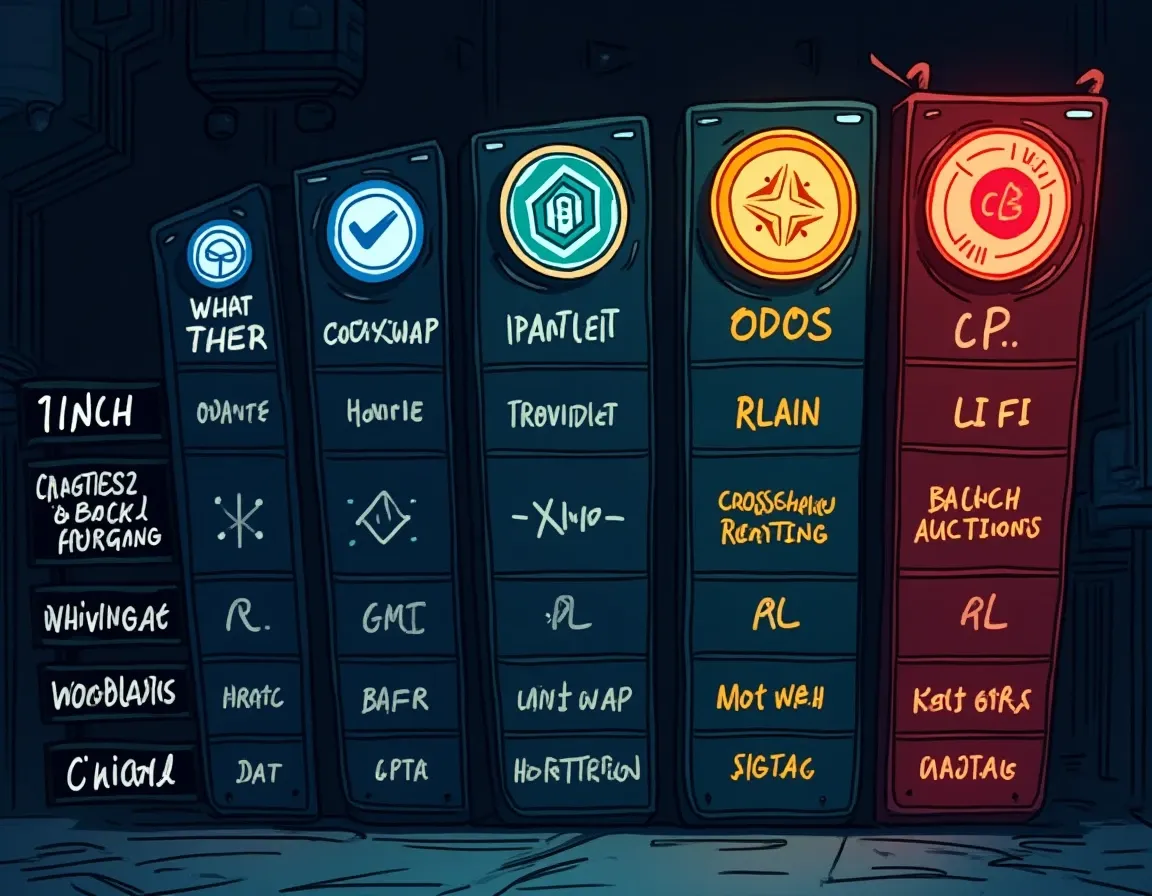
A DEX aggregator routes your swap across multiple liquidity sources to find better execution than any single DEX can deliver. Instead of swapping ETH for USDC on Uniswap alone, an aggregator queries Uniswap, Curve, Balancer, SushiSwap, and hundreds of other pools simultaneously, splits your trade across the best routes, and delivers a better price net of gas costs.
This matters for income strategy execution. Every LP entry, farm rotation, position rebalance, and yield harvest involves at least one swap. The difference between a direct DEX swap and aggregator routing compounds over dozens of trades. A liquidity provider rotating from Curve to Aura needs two swaps: exit from Curve, enter Aura. Each swap loses value to slippage and fees. An aggregator reduces that cost.
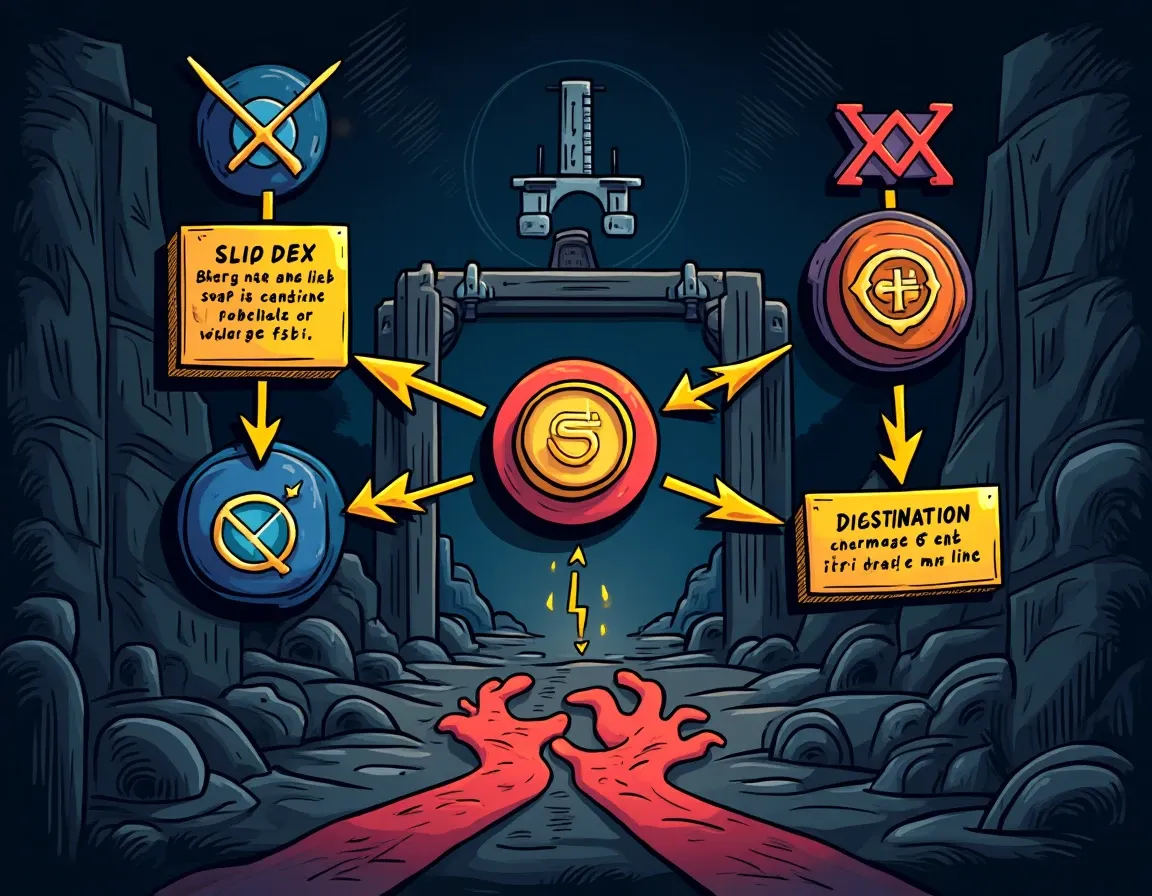
The aggregators reviewed here operate on different routing models. 1inch uses on-chain pathfinding across 350+ sources. Matcha prioritizes RFQ quotes from market makers. CoWSwap batches orders into auctions. Odos specializes in multi-input/multi-output basket swaps. LI.FI aggregates cross-chain routes. Each excels at specific trade types.
Selection Criteria

The aggregators below were evaluated on five factors:
- Routing quality: Does the algorithm consistently deliver better execution than a direct DEX swap?
- Gas efficiency: Does the routing overhead cost more in gas than it saves in price improvement?
- MEV protection: Does the aggregator leak value to front-runners, or does it route through private mempools?
- Trade size performance: Does the aggregator excel at small retail trades, large institutional trades, or both?
- Fee transparency: Are the aggregator's revenue mechanisms disclosed, or does it clip spread without disclosure?
Trade size performance splits the field. Below $1,000, aggregator differences are noise. Between $1,000 and $50,000, RFQ networks and split routing deliver measurable value. Above $50,000, pulling quotes from multiple aggregators and comparing them manually is the only reliable approach.
1inch: Pathfinder Routing and Fusion Mode
1inch is the most-used DEX aggregator with over $700 billion in lifetime swap volume as of 2026. The platform integrates 350+ liquidity sources across 15+ EVM chains and offers two execution modes: Classic and Fusion.
Classic mode uses the Pathfinder algorithm, which queries all integrated liquidity sources, splits your trade across optimal routes, and minimizes slippage. No explicit swap fee. 1inch monetizes through its governance token (1INCH), which secures resolver collateral in Fusion mode.
Fusion mode is MEV-protected. You sign an off-chain intent. Private resolvers compete to fill your order, and the best execution wins. Gas costs are bundled into the fill price, so the interface shows "gasless" swaps. This is not free. The resolver's margin is embedded in the spread between your quoted price and the actual fill. Fusion reported $214 billion in swap volume and 114 million trades in 2025.
Fusion+ extends this model to cross-chain swaps. One signed intent, one settlement transaction, execution across multiple EVM chains. The resolver handles bridge routing behind the scenes.
Best for: Retail trades between $1,000 and $50,000 where MEV protection and split routing deliver value. Fusion mode is default and works well for most users.
Not ideal for: Trades below $1,000 where the Fusion spread exceeds the benefit of aggregation. In that range, a direct Uniswap swap is often cheaper.
Matcha (0x Protocol): RFQ-First Market Maker Quotes
Matcha is the consumer-facing interface for 0x Protocol, which aggregates liquidity from both on-chain AMMs and off-chain RFQ (request-for-quote) networks. The platform supports over five million tokens across nine chains: Ethereum, Arbitrum, Optimism, Polygon, BNB Chain, Base, Avalanche, Fantom, and Linea.
The routing model prioritizes RFQ. When you submit a trade, 0x queries professional market makers (Wintermute, Amber, GSR) who sign off-chain quotes. The API selects the best mix of RFQ and AMM liquidity in real time. For large trades, RFQ quotes frequently beat pure on-chain routing because market makers can internalize order flow and avoid on-chain gas overhead.
Matcha charges no protocol fee. The interface is clean, with limit orders and a portfolio tracker. The 0x v4 smart contracts were audited by ConsenSys Diligence.
Best for: Large trades above $50,000 where RFQ quotes from professional market makers deliver tighter spreads than AMM routing. Also strong for limit orders and DCA strategies.
Not ideal for: Chains outside the nine supported networks. If you need cross-chain aggregation or non-EVM execution, use LI.FI or 1inch Fusion+.
CoWSwap: Batch Auctions and MEV Protection
CoWSwap uses a fundamentally different execution model. Instead of routing each trade individually, CoWSwap collects orders into discrete batches, then runs an auction where third-party solvers compete to find the best execution path. Solvers can match orders peer-to-peer (CoW = Coincidence of Wants), route through on-chain liquidity, or combine both.
This delivers two benefits. First, peer-to-peer matching bypasses AMM fees entirely. If one user wants to swap ETH for USDC and another wants USDC for ETH, CoWSwap matches them directly at midpoint price with no liquidity provider fee. Second, batch auctions eliminate MEV. Your order is never broadcast to the public mempool, so sandwich attacks and front-running are structurally impossible.
CoWSwap users never pay gas directly. You sign an off-chain meta-transaction that costs nothing. The winning solver pays gas and takes a solver fee embedded in the execution spread. CoWSwap and the solver split any positive slippage (the amount by which the actual fill beats the quoted minimum).
The trade-off: batch auctions are not real-time. Settlement happens every few minutes, so CoWSwap is not ideal for time-sensitive trades in volatile markets.
Best for: MEV-sensitive trades where front-running risk is high. CoWSwap is the benchmark for MEV protection. Also strong for large trades where peer-to-peer matching and solver competition deliver price improvement.
Not ideal for: Time-sensitive trades requiring immediate execution. Batch settlement introduces latency. CoWSwap only operates on Ethereum mainnet, so multi-chain users need a different aggregator.
ParaSwap (Velora): Augustus Router and Positive Slippage
ParaSwap, now rebranded as Velora, routes trades through the Augustus smart contract, which splits orders across 10+ EVM chains and hundreds of liquidity sources. The platform offers ParaSwap Delta, an MEV-protected mode that routes through Flashbots Protect or similar private relay infrastructure.
ParaSwap's revenue model is transparent: the protocol captures a share of positive slippage. When your trade fills at a better price than the quoted minimum, ParaSwap takes a percentage of the difference. This aligns incentives. The aggregator profits only when you get a better deal than expected.
Best for: Retail to mid-size trades ($1,000 to $50,000) where split routing and MEV protection deliver consistent value. Delta mode is opt-in and works well for sandwich-prone token pairs.
Not ideal for: Cross-chain swaps. ParaSwap operates on multiple chains but does not aggregate bridge routes the way LI.FI does.
LI.FI: Cross-Chain Aggregation Infrastructure
LI.FI is not a consumer-facing aggregator. It is infrastructure that other wallets and dApps embed. LI.FI aggregates both DEXs and bridges, routing trades across 25+ chains and selecting optimal paths based on speed, cost, and security preferences.
A cross-chain swap through LI.FI involves three steps: a same-chain DEX leg on the source chain, a bridge transfer, and another DEX leg on the destination chain. LI.FI integrates major bridge protocols (Stargate, Across, Mayan, Circle CCTP, Wormhole) and selects the best route for each trade.
LI.FI lost $11.6 million in July 2024 to a deployment error. Only wallets with infinite token approvals were drained. A full post-mortem was published, and the issue was resolved. This was not a protocol design flaw. It was a deployment misconfiguration.
Best for: Cross-chain swaps where you start with one token on one chain and end with a different token on another chain. LI.FI's bridge aggregation is the strongest in the market.
Not ideal for: Same-chain swaps. If you are swapping ETH for USDC on Ethereum mainnet, 1inch or Matcha will deliver better execution without the overhead of bridge routing logic.
Odos: Multi-Input/Multi-Output Basket Swaps
Odos is the only DEX aggregator that supports multi-input, multi-output swaps in a single transaction. You can swap a basket of five tokens (ETH, USDC, DAI, USDT, WBTC) into a target allocation (80% stETH, 20% rETH) in one atomic transaction.
This matters for portfolio rebalancing and wallet cleanup. If you hold small dust positions across ten tokens and want to consolidate into one asset, Odos executes all swaps in one transaction with one gas payment. The routing algorithm uses a proprietary graph-search technique across 500+ liquidity sources, including DEXs, lending protocols, and yield optimizers.
Odos operates on 14 EVM chains as of 2026: Ethereum, Arbitrum, Optimism, Polygon, BNB Chain, Base, Avalanche, Fantom, zkSync Era, Linea, Mantle, Mode, Scroll, and Polygon zkEVM. The protocol charges 0% to direct users. Partners using the Odos API can add a referral fee split with the protocol.
Best for: Portfolio rebalancing and multi-token swaps. If you need to rotate five LP positions simultaneously, Odos is the only aggregator that handles this atomically.
Not ideal for: Single-pair swaps where the routing overhead exceeds the benefit. For a simple ETH to USDC swap, 1inch or Matcha will deliver equivalent or better execution with less complexity.
Trade Size Recommendations
Under $1,000: any aggregator works. Execution differences are rounding error, often smaller than the gas cost overhead. For micro-trades below $200, a direct Uniswap swap is frequently cheaper than aggregator routing.
$1,000 to $50,000: use 1inch Fusion or ParaSwap Delta. Split routing and MEV protection deliver consistent value in this range. Fusion mode is default on 1inch and requires no configuration.
Above $50,000: pull quotes from 1inch, ParaSwap, CoWSwap, and Matcha. Compare them manually. Price improvement from RFQ networks and solver competition can exceed 30 basis points on large trades. The extra 60 seconds of comparison time is worth $300+ on a $100,000 swap.
For cross-chain swaps: use LI.FI or 1inch Fusion+. Do not attempt to route cross-chain swaps manually through individual bridges. The failure modes are too complex, and the gas cost of a failed bridge transaction is prohibitive.
Security and Risk
KyberSwap lost $47 million to a reentrancy attack on its Elastic pools in November 2023. Most funds remain unrecovered. This was not a routing aggregation issue. It was a liquidity pool design flaw. KyberSwap is not included in this review because the protocol's liquidity pool product failed catastrophically, and the aggregator routing service has low adoption post-exploit.
LI.FI's $11.6 million loss in July 2024 was a deployment error, not a protocol design flaw. The post-mortem was transparent, and the issue was patched within hours. Only wallets with infinite approvals to the affected contract were drained.
All aggregators reviewed here use audited smart contracts. CoWSwap, Matcha, and 1inch have multi-year track records with no protocol-level exploits. The primary risks are not smart contract bugs. They are bridge failures (for cross-chain aggregators), oracle manipulation (for exotic token pairs), and MEV extraction (for aggregators without private mempool routing).
How to Pick the Right Aggregator
By trade size: Under $1,000, use anything. $1,000 to $50,000, use 1inch Fusion or ParaSwap Delta. Above $50,000, compare quotes from multiple aggregators.
By feature priority: MEV protection equals CoWSwap. Cross-chain equals LI.FI or 1inch Fusion+. Multi-input/multi-output equals Odos. Limit orders and DCA equal Matcha. Embeddable API equals 0x.
By chain: Ethereum mainnet has full coverage from all aggregators. Layer-2 chains (Arbitrum, Optimism, Base) have strong coverage from 1inch, Matcha, and Odos. Exotic chains (Fantom, Linea, Mantle) are best covered by LI.FI.
For income strategy execution, aggregators reduce the cost of every trade in your rotation. A yield farmer moving capital between Curve, Aura, Convex, and Pendle makes dozens of swaps per month. Each swap loses value to slippage and fees. An aggregator reduces that cost and preserves more capital for redeployment.
The Takeaway
DEX aggregators deliver measurable value for trades above $1,000. Below that threshold, the routing overhead often exceeds the benefit. Between $1,000 and $50,000, 1inch Fusion and ParaSwap Delta are reliable defaults. Above $50,000, compare quotes manually.
CoWSwap is the benchmark for MEV protection but only operates on Ethereum mainnet. LI.FI is the strongest cross-chain aggregator but adds complexity for same-chain swaps. Odos is the only aggregator that handles multi-input, multi-output swaps atomically. Matcha delivers the best RFQ execution for large trades but has limited chain coverage.
No aggregator is universally optimal. The right choice depends on trade size, chain, and whether you prioritize MEV protection, cross-chain routing, or basket swaps. For liquidity providers and yield farmers, aggregators are prerequisite infrastructure. Every entry, exit, and rebalance involves at least one swap. The aggregator you choose determines how much value you lose to slippage, gas, and MEV on every trade.
The specific stress condition for aggregators is low liquidity on exotic token pairs. When a token has thin order books across all DEXs, no aggregator can route around the slippage. In that condition, splitting a trade across multiple pools increases gas costs without improving execution. Check the token's liquidity depth before assuming an aggregator will deliver better pricing than a direct swap on the deepest pool.
Frequently Asked Questions
What is a DEX aggregator and how does it improve swap prices?
A DEX aggregator queries hundreds of liquidity sources simultaneously and splits your trade across optimal routes to minimize slippage and fees. Instead of swapping on a single DEX like Uniswap, the aggregator checks Uniswap, Curve, Balancer, SushiSwap, and hundreds of other pools, then routes your trade through the combination that delivers the best net price after gas costs. This routing consistently delivers better execution for trades above $1,000.
Which DEX aggregator is best for large trades above $50,000?
For trades above $50,000, compare quotes manually from 1inch, Matcha, CoWSwap, and ParaSwap before executing. Matcha's RFQ network delivers strong execution because professional market makers (Wintermute, Amber, GSR) compete to fill large orders with tighter spreads than pure on-chain routing. CoWSwap's batch auction model and peer-to-peer matching also excel at large sizes. Price improvement from RFQ and solver competition can exceed 30 basis points on six-figure trades.
How do DEX aggregators protect against MEV and sandwich attacks?
CoWSwap offers the strongest MEV protection through batch auctions. Orders are collected off-chain and never broadcast to the public mempool, making sandwich attacks structurally impossible. 1inch Fusion routes through private resolvers who compete to fill your order without exposing it to front-runners. Matcha and ParaSwap offer optional MEV protection through Flashbots Protect submission. For MEV-sensitive trades, CoWSwap is the benchmark, though it only operates on Ethereum mainnet and introduces settlement latency.
When should I use a cross-chain DEX aggregator like LI.FI?
Use LI.FI when you need to swap tokens across different blockchains in a single transaction, for example swapping USDC on Arbitrum for ETH on Optimism. LI.FI aggregates both DEX liquidity and bridge protocols (Stargate, Across, Circle CCTP, Wormhole) to find the optimal route across chains. For same-chain swaps, 1inch or Matcha deliver better execution without bridge routing overhead. LI.FI operates on 25-plus chains and is strongest for cross-chain income strategy rotations.
Do DEX aggregators charge fees, and how are they monetized?
Fee structures vary. 1inch Classic charges no swap fee and monetizes through Fusion spreads and its governance token. Matcha charges no protocol fee; 0x monetizes through API partnerships. CoWSwap and ParaSwap capture a share of positive slippage when your trade fills better than the quoted minimum. Odos charges 0% to direct users but allows API partners to add referral fees. Always compare the final quoted price net of all fees and gas costs rather than assuming zero-fee aggregators deliver the best execution.
Exchange fees and withdrawal terms change more often than anyone announces.
Every Thursday: where crypto yield actually is - stablecoins, liquid staking and DeFi lending, with the risk named next to the rate and what changed since last week.
Get it free every ThursdayFree. No trade calls, no allocations, no hype. Unsubscribe in one click.