Table of Contents
Fee Structure: What You Pay To List And What You Keep
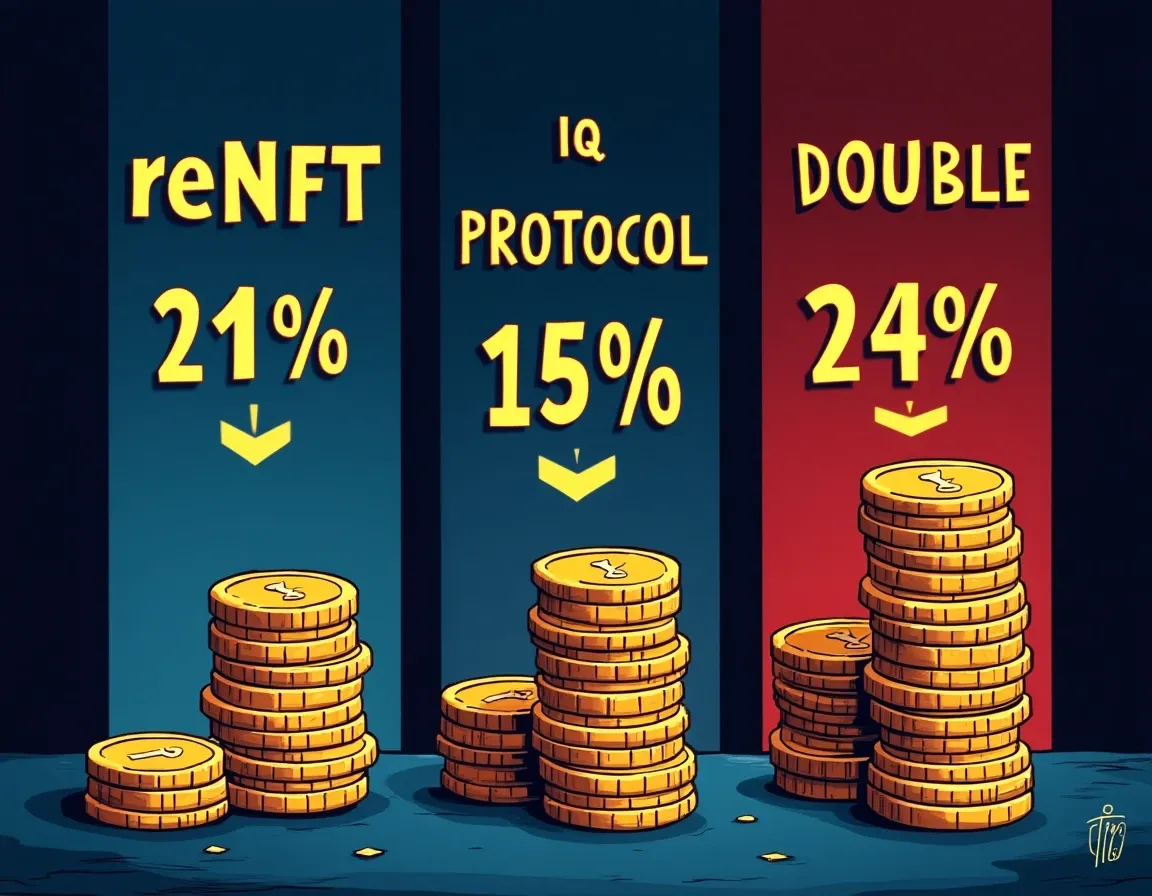
reNFT charges zero fees as of May 2025. The protocol eliminated all transaction fees to drive adoption across gaming and metaverse projects. According to the official reNFT documentation, future fees will be percentage-based with revenue shared between the protocol and integrated projects, but no launch date or rate has been published.
That makes reNFT the cheapest option today, but not necessarily tomorrow.
IQ Protocol does not publish a global platform fee. Instead, IQVerse (the marketplace layer) allows customizable rental fees, payment tokens, and revenue splits. Lenders set the rental price. The protocol then distributes revenue across three parties: the IQVerse operator, the NFT holder, and the protocol treasury. The exact split varies by integration and is visible per listing on the IQ Market interface.
Double Protocol uses a performance-based pricing model where rental fees adjust based on the NFT's earning potential. The protocol does not publish a fixed platform fee. Lenders set rental fees, and the platform tracks yield data to ensure fair compensation. Double also offers a unique "rental pool" feature where multiple users collectively rent expensive NFTs and split the utility cost.
On the numbers: if you rent a gaming NFT generating 8% monthly yield, reNFT currently lets you keep 100% of what the renter pays (zero platform fee). IQ Protocol's revenue split might reduce that to 85-92% depending on the IQVerse configuration. Double Protocol's performance-based model adjusts the rental price dynamically, so your net income depends on how accurately the protocol tracks and prices the underlying yield.
One thing worth noting: reNFT's zero-fee advantage disappears the moment the protocol activates its planned fee structure. If you're building a long-term NFT rental income stream, assume reNFT will eventually charge fees comparable to IQ and Double.
Collateral Requirements: Who Holds The Risk
reNFT offers two paths. The first is collateral-free, where the renter pays the rental fee and receives use rights without depositing collateral. This path only works if the NFT's project integrates reNFT's rental registry. If the game, metaverse, or gated app does not check the registry to verify who currently holds use rights, the renter gains nothing and the rental fails.
The second path is collateralized. The lender sets a collateral amount, typically pegged to the NFT's floor price or replacement cost. The renter deposits that collateral, receives the NFT for the rental period, and must return it to reclaim the collateral. If the floor price rises during the rental, the renter has an incentive to keep the NFT and forfeit the collateral.
That creates a floor-price arbitrage risk that the lender must actively monitor.
IQ Protocol eliminates collateral entirely through the Warper pattern. The original NFT is locked in a smart contract. The renter receives a wrapped expirable version (the Warper) that contains all metadata and utility but expires at the end of the rental period. The renter cannot sell or transfer the original NFT because they never hold it. When the rental expires, the Warper becomes worthless and the original automatically returns to the lender's wallet.
Default is structurally impossible.
Double Protocol uses a similar model. Ownership never transfers to the renter. Instead, a doNFT (a token containing all the original's metadata) is transferred to the renter. As long as rental payments continue, the doNFT remains active and mapped to the original. If the renter stops paying, the doNFT expires automatically and permissions are revoked across all integrated dApps. The protocol is built on ERC-4907 and ERC-5006 standards, which define dual-role architecture: the owner holds the asset, the user holds the rental right.
Measured by collateral exposure: reNFT's collateralized path places full floor-price risk on the lender. IQ and Double shift that risk to the protocol's expiration mechanism. The trade-off is smart contract risk (if the Warper or doNFT expiration logic fails, the lender could lose the NFT) versus manual monitoring risk (if the lender misprices collateral on reNFT, they lose money).
The interesting variable is whether you trust the protocol's code more than you trust your ability to track floor prices in real time.
Rental Default Mechanics: What Happens When Things Break
On reNFT's collateralized path, default is a manual process. If the renter does not return the NFT by the agreed end date, the lender claims the collateral. The lender must actively monitor the rental period and floor price. If the NFT's value rises above the collateral amount during the rental, the renter profits by keeping the NFT and forfeiting the lower-value collateral.
This happened multiple times in 2023 when gaming NFTs spiked 40-60% during unexpected game updates or tournament announcements.
On reNFT's collateral-free path, there is no default mechanism because the NFT never leaves the lender's wallet. The renter receives use rights via the registry. If the project does not integrate the registry, the renter has no functional access and the rental is worthless, but no asset is at risk.
IQ Protocol makes traditional default impossible. The renter holds a Warper, not the original NFT. The Warper expires at the end of the rental period and becomes non-functional. The original NFT is released from the smart contract escrow and returns to the lender's wallet automatically. There is no return transaction for the renter to skip.
Double Protocol uses the same auto-expiration model. The doNFT expires when the rental period ends or when the renter stops paying. Permissions are revoked instantly across all integrated dApps. The lender does not need to reclaim anything because ownership never transferred in the first place.
Worth watching: both IQ and Double depend on the expiration mechanism executing correctly. If a smart contract bug delays or blocks expiration, the lender's NFT remains locked. reNFT's collateralized model avoids that risk but introduces the manual monitoring burden. The trade is automated convenience versus manual control.
Supported Chains And Integration Depth
reNFT operates on Ethereum, Polygon, and Avalanche. The protocol uses role-based access in its v2 architecture, where a registry contract assigns a "renter role" to the wallet holding use rights. Integration is minimal for projects: a simple SDK ping or API check to verify who currently holds the renter role. reNFT also integrates with Gnosis Safe and Seaport for advanced custody and marketplace functionality.
The GitHub repository shows active development across all three chains, with recent commits focused on gas optimization and SDK improvements.
IQ Protocol supports Polygon and BNB Chain as of May 2025. The roadmap published in Q1 2024 listed Arbitrum, Avalanche, and Solana as planned additions, though no firm deployment dates were announced. Integration is more complex than reNFT: each project must deploy a Warper contract specific to the NFT collection and utility. That Warper defines how the wrapped expirable version behaves, what metadata it carries, and which permissions it grants.
The protocol has 30-plus active partnerships, which demonstrates that the integration effort is manageable for serious projects.
Double Protocol is deployed on Ethereum and BNB Chain. The platform authored the ERC-4907 and ERC-5006 standards, which means any project adopting those standards natively supports Double Protocol rentals. Current integrations include Decentraland (virtual land) and Warena (in-game assets). Integration requires ERC-4907 compliance, which older NFT collections do not support without a contract upgrade or wrapper.
Measured by coverage: reNFT has the broadest current chain support. IQ has the most aggressive expansion roadmap. Double has the structural advantage of owning the rental standards, which gives it long-term interoperability if ERC-4907 adoption grows.
Asset Type Fit: Which Platform Works For Which NFT
reNFT fits utility NFTs where the project integrates the rental registry. Gaming assets, metaverse land, and membership passes work well if the game or dApp checks the registry to verify use rights. The collateralized path also works for generalized P2P rentals where trust is low and floor price is stable. If you're renting out a Bored Ape for an event appearance, the collateral model makes sense.
If the NFT has no utility or the project does not integrate reNFT, the platform adds no value.
IQ Protocol is strongest for GameFi and in-game assets where revenue-sharing makes sense. The Warper model allows renters to earn yield from the NFT (staking rewards, tournament prizes, guild income) and split that yield with the lender. The platform supports three pricing models: fixed fee, reward sharing, or a combination. That flexibility fits assets with variable or performance-based income.
One thing worth noting: the Warper can only be used in recognized IQVerse integrations. If you try to use the wrapped NFT in an external platform that does not recognize the Warper contract, it will not function.
Double Protocol fits structured utility NFTs where ownership and usage are clearly separated. In-game items, virtual land, and access keys work well because the doNFT can carry all metadata and permissions while the original remains locked. The protocol's performance-based pricing model works best when the NFT's earning potential is trackable (staking yield, rental income from metaverse land, access fee revenue).
Double's rental pool feature is unique: multiple users can collectively rent a high-value NFT and split the utility. That fits expensive metaverse land or rare gaming assets where individual rental cost is prohibitive.
Historically, the highest rental yields come from utility NFTs in active games or metaverses. Data from Q3 2024 showed gaming NFTs on Polygon generating 6-12% monthly rental income, with metaverse land on Ethereum averaging 3-8%. Those numbers only materialize when the platform integrates with the project and the renter can actually use the NFT.
If you're building rental income from NFTs, flipping strategies and royalty income are alternative paths worth comparing.
Revenue And Incentive Models: How You Actually Get Paid
reNFT uses direct P2P payment. The renter pays the lender the agreed rental fee for the rental period. If the rental is reward-share (where the renter and lender split income generated by the NFT), both parties agree to the split upfront and the protocol facilitates distribution. The lender receives payment in the token agreed upon at listing (ETH, USDC, or project-specific tokens).
No intermediary fee currently applies, so the lender keeps 100% of the rental fee minus gas costs.
IQ Protocol splits revenue across three parties: the IQVerse operator, the NFT holder (lender), and the protocol treasury. The exact split is configurable per IQVerse and visible at the listing level. Revenue is distributed immediately at the end of the rental period. The protocol supports multiple payment tokens, and revenue can be converted to other assets via integrated DEX swaps.
The three-party split reduces net income compared to reNFT's direct model, but the trade-off is deeper integration and yield-tracking across GameFi ecosystems.
Double Protocol lets lenders set rental fees and offers a unique sub-rental feature. A renter can re-rent the doNFT to another user and earn the spread between what they pay and what they charge. That creates a secondary rental market where liquidity providers can earn without owning the original NFT. The protocol does not publish a fee-sharing model, so net income depends on the lender's pricing and the renter's ability to sub-rent.
Measured by take-home income: reNFT currently offers the highest net percentage (100% minus gas). IQ reduces that by 8-15% depending on the IQVerse split. Double's net income varies based on sub-rental activity and performance-based pricing adjustments.
Edge Cases And Failure Modes: Where Each Platform Breaks
reNFT's collateralized model fails when the lender sets collateral too low and the NFT's floor price rises during rental. A gaming NFT worth 0.5 ETH at rental start might spike to 0.9 ETH during a tournament. If the collateral was set at 0.5 ETH, the renter profits by keeping the NFT and forfeiting the collateral. The lender loses the NFT and receives only the original collateral value.
This requires active monitoring and dynamic collateral adjustment, which most lenders do not perform.
reNFT's collateral-free model fails when the project does not integrate the rental registry. The renter pays the fee but receives no functional access because the game or dApp does not check who holds use rights. The rental generates zero value. That risk disappears if you verify integration before listing, but many lenders skip that step.
IQ Protocol's Warper model fails if the wrapped NFT is used outside a recognized IQVerse. The Warper carries metadata but not universal interoperability. If the renter tries to use the Warper in an external platform or game that does not recognize the IQ Protocol contract, it will not function. That limits utility to IQ-integrated ecosystems.
There is also revenue-share exploit potential: if the renter bypasses the platform and claims 100% of yield directly from the game or staking contract, the lender receives nothing. That depends on whether the game enforces yield splits via the Warper contract or trusts off-chain reporting.
Double Protocol's doNFT model fails if the NFT collection does not comply with ERC-4907 or ERC-5006. Older NFT collections built on standard ERC-721 cannot use Double Protocol without a contract upgrade or wrapper deployment. That excludes a large portion of legacy NFTs from the platform.
The performance-based pricing model also introduces oracle risk. If the protocol relies on external data feeds to track the NFT's earning potential, a feed failure or manipulation can misprice rentals and reduce lender income. Double has not published details on how yield data is sourced or validated.
One thing worth noting across all three platforms: smart contract risk is universal. A bug in the rental contract, escrow mechanism, or expiration logic can lock NFTs or fail to distribute payments. reNFT, IQ, and Double have all undergone audits, but code vulnerabilities remain the primary failure mode for any DeFi protocol.
If you're evaluating protocol risk more broadly, multisig governance audits and protocol terms monitoring are relevant checks.
Who Each Platform Is Right For
Use reNFT if you want zero fees today and are willing to manage collateral or verify project integration. The platform fits lenders who rent gaming NFTs or metaverse land in projects that have integrated the reNFT registry. It also fits collateralized rentals where you trust your ability to monitor floor prices and adjust collateral in real time.
Avoid reNFT if the NFT's project has not integrated the registry and you're relying on collateral-free rentals. Verify integration before listing.
Use IQ Protocol if you rent GameFi assets with variable yield and want automated revenue splits. The Warper model fits renters who earn staking rewards, tournament prizes, or guild income and need the protocol to enforce yield-sharing. IQ works well for lenders who want zero collateral exposure and are comfortable with the three-party revenue split.
Avoid IQ if your NFT is on a chain IQ does not support (anything outside Polygon and BNB Chain as of May 2025) or if the project has not deployed a Warper contract.
Use Double Protocol if you rent NFTs that comply with ERC-4907 or ERC-5006 and want performance-based pricing. The platform fits metaverse land, in-game items, and membership passes where earning potential is trackable. Double's rental pool feature is the only option if you want to collectively rent high-value NFTs with other users.
Avoid Double if your NFT is a legacy ERC-721 collection without ERC-4907 compliance or if you need broad chain coverage beyond Ethereum and BNB.
Recommendation: Which Platform To Use First
Start with reNFT if your NFT is on Ethereum, Polygon, or Avalanche and the project has integrated the rental registry. The zero-fee structure maximizes net income during the current adoption phase. Use the collateral-free path if integration is confirmed. Use the collateralized path only if you can monitor floor prices daily and adjust collateral before spikes.
If the project has not integrated reNFT or you want to avoid collateral management, use IQ Protocol. The Warper model eliminates default risk and works well for GameFi assets on Polygon or BNB Chain. Accept the 8-15% revenue split as the cost of automated expiration and yield enforcement.
If your NFT complies with ERC-4907 and generates trackable yield, use Double Protocol. The performance-based pricing model ensures you're compensated fairly as the asset's earning potential changes. The rental pool feature is valuable for expensive NFTs where individual rental demand is low but collective demand is high.
Do not spread rentals across all three platforms simultaneously. Each platform requires listing effort, integration verification, and ongoing monitoring. Pick the one that fits your NFT's chain, standard, and integration status, then measure income over 30 days before expanding.
The Takeaway: Fee Structure And Default Risk Are Not Separable
The platform with the lowest fee is not necessarily the one that nets you the most income. reNFT charges zero today but shifts all default risk to the lender via collateral management or integration dependency. IQ charges 8-15% but eliminates default through expiration. Double uses dynamic pricing but excludes legacy NFTs. The decision rule is simple: if the NFT's project integrates reNFT and you can monitor collateral, use reNFT. If the NFT generates variable GameFi yield on Polygon or BNB, use IQ. If the NFT complies with ERC-4907 and earns trackable yield, use Double. The platform that fits your asset's chain, standard, and integration is the one that works.
Frequently Asked Questions
Which NFT rental platform has the lowest fees?
reNFT currently charges zero fees to stimulate adoption, though a percentage-based fee structure is planned for the future. IQ Protocol and Double Protocol use configurable fee models where lenders set rental prices and revenue splits vary by platform integration. The lowest-fee option depends on whether reNFT's free period is still active when you list your NFT.
Do I need collateral to rent out NFTs on these platforms?
IQ Protocol and Double Protocol require zero collateral for all rentals because the original NFT never leaves your wallet. reNFT offers both collateral-free rentals (when the project integrates reNFT's registry) and collateralized rentals where you set the collateral amount. Collateral-free doesn't eliminate risk; it shifts risk from the renter's wallet to the smart contract's expiration mechanism.
What happens if a renter doesn't return my NFT?
On reNFT's collateralized path, you claim the collateral if the renter fails to return the NFT by the agreed date. On IQ Protocol, the renter receives a wrapped expirable version that automatically returns the original to your wallet when the rental period ends. Double Protocol uses the same auto-expiration model via doNFT tokens that expire and revoke permissions without requiring the renter to return anything.
Which chains do these NFT rental platforms support?
reNFT supports Ethereum, Polygon, and Avalanche. IQ Protocol currently operates on Polygon and BNB Chain, with a 2024 roadmap including Arbitrum, Avalanche, and Solana. Double Protocol is deployed on Ethereum and BNB Chain. If your NFT is on a chain not supported by a platform, you cannot rent it through that protocol.
Can I earn rental income from any NFT on these platforms?
No. Rental income depends on the NFT having utility that persists during rental (gaming assets, metaverse land, membership access). On reNFT, collateral-free rentals require the project to integrate reNFT's registry. On IQ Protocol, the project must deploy a Warper contract. On Double Protocol, the NFT must comply with ERC-4907 or ERC-5006 standards. Random art NFTs without project integration generate no rental demand.
You just compared three platforms with fee structures ranging from zero to performance-based and collateral models spanning manual to auto-expiring. Those mechanics and integrations will shift as protocols compete.
Every Thursday: where crypto yield actually is - stablecoins, liquid staking and DeFi lending, with the risk named next to the rate and what changed since last week.
Get it free every ThursdayFree. No trade calls, no allocations, no hype. Unsubscribe in one click.