Table of Contents
Introduction
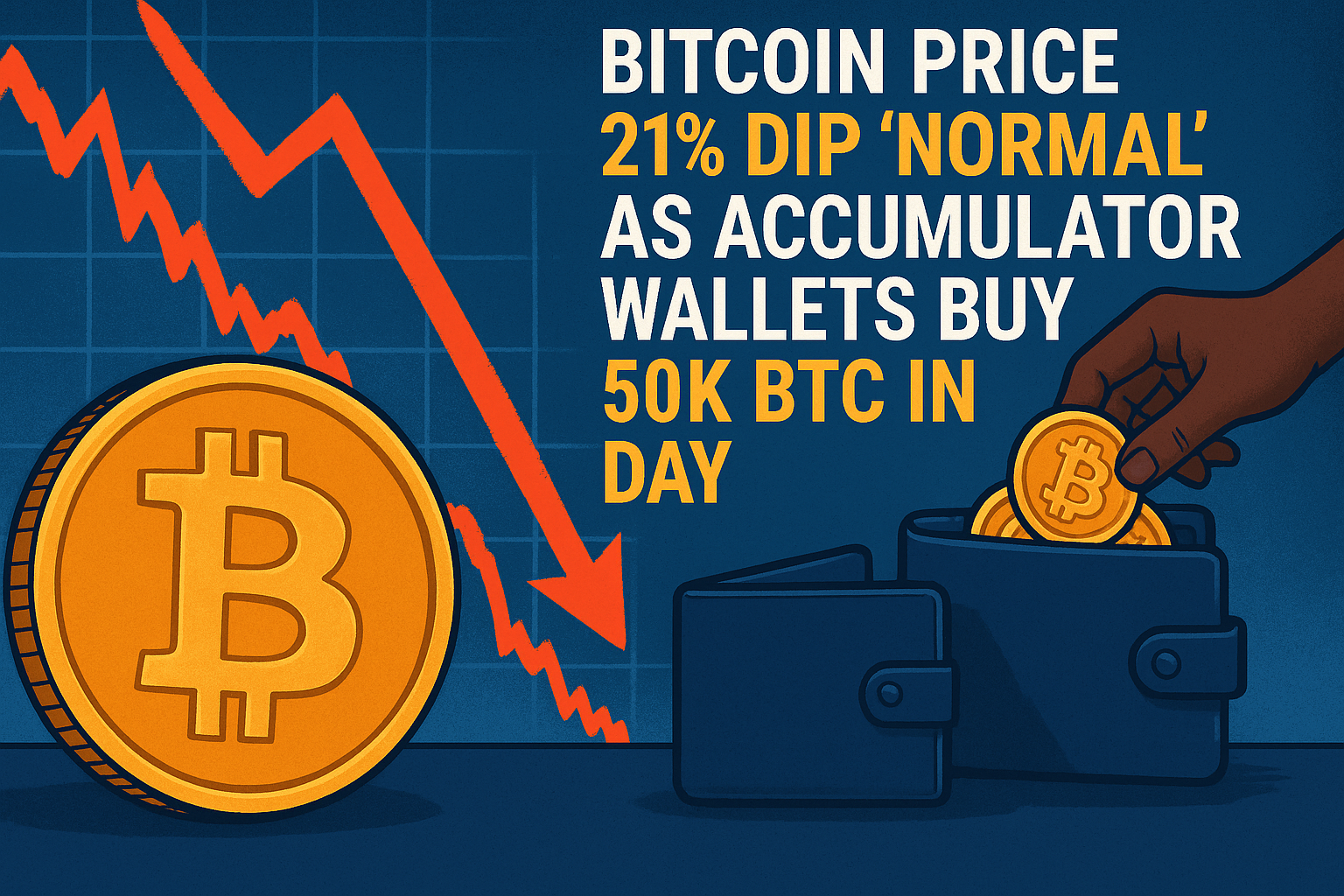
Bitcoin recently experienced a notable 21% price correction, raising eyebrows across major financial news outlets and sparking worry among retail crypto investors. But for experienced participants in the digital asset space—ranging from early adopters to seasoned institutional players—such volatility is nothing new. In fact, it’s a feature rather than a bug in the cryptocurrency ecosystem. While the headlines focus on price dips and market fear, savvy investors are watching a very different signal: a massive spike in activity from accumulator wallets, with over 50,000 BTC absorbed in just one day alone. Instead of sounding alarm bells, this event may prove to be a golden opportunity for those looking beyond the surface-level noise.
Understanding the Dip
Market drawdowns are an integral part of Bitcoin’s long-term market cycle. Since its inception, Bitcoin has seen multiple corrections of 20% or more. These sharp reversals aren’t random; they often mark key turning points that set the stage for future rallies. In the traditional financial world, such moves might trigger widespread liquidation or even recessionary panic. In crypto, however, they frequently act as reset buttons—purging excess leverage and flushing out weak hands.
So, what caused this latest 21% drop? The answer is multi-faceted. Several factors converged to impact market sentiment:
- Macroeconomic stress: Global markets have grappled with interest rate hikes, inflation concerns, and central bank policy shifts that have impacted risk-on assets like cryptocurrencies.
- Profit-taking at recent highs: Bitcoin had enjoyed a solid uptick prior to the correction, leading many traders to lock in gains.
- Mass liquidations: Overleveraged positions across perpetual futures markets triggered cascading margin calls, further accelerating downward pressure.
For unseasoned market participants, these events may suggest long-term weakness. But historically, they represent temporary volatility—an inevitable downside of an asset class that has delivered some of the highest gains in modern history. The high beta of Bitcoin is both a warning and a reward: the price you pay for potential exponential returns is short-term pain.
Seasoned crypto investors understand that these events are part of the broader market rhythm. Short-term corrections are often precursors to significant uptrends, especially when on-chain metrics point toward strong accumulation. As outlined in our comprehensive Bitcoin Bull and Bear Market History, major bull runs have frequently emerged after periods of consolidation and price pullbacks. This isn’t the end, but likely the beginning of a new chapter.
What Are Accumulator Wallets and Why Do They Matter?
During times of extreme volatility, it’s crucial to look past price charts and headlines. One of the most insightful tools for doing this is on-chain analysis, which tracks blockchain data in real time to evaluate investor behavior. Among these metrics, activity from accumulator wallets stands out as especially important.
Accumulator wallets are digital addresses that consistently acquire Bitcoin without receiving inflows from exchange addresses or showing signs of short-term trading. These wallets are considered long-term holders—investors who are likely to stay committed for months or even years. Their behavior reflects strategic accumulation rather than speculative flipping.
Remarkably, on the very day of the latest 21% crash, these wallets absorbed an eye-popping 50,000 BTC. At prevailing market prices, this haul translates to well over $2 billion worth of Bitcoin. This wasn’t retail panic buying—it was deliberate accumulation, likely by institutional entities, whales, and crypto-native funds that understand market cycles better than most.
Such behavior reflects the classic behavior modeled in our Contrarian Investor Framework, where savvy investors deploy capital exactly when fear dominates sentiment. These are players who have done their homework, examined the fundamentals, and made a strategic bet based on long-term value rather than short-term emotions.
The Strategic Advantage Behind Accumulation
So what can we learn from the sudden rise in accumulator activity? The key takeaway is this: this is accumulation, not distribution. While many panic-sell during sharp market downturns, experienced investors quietly deploy dry powder to build their positions at lower prices.
This behavior highlights the growing sophistication of the crypto investment landscape. We're no longer operating in a market dictated solely by emotional retail swings. Institutional-grade analysis and data-driven strategies are increasingly shaping the market's response to volatility.
Historically, accumulation during downturns leads to tangible long-term gains. Wallets that increased their Bitcoin holdings during similar pullbacks in previous cycles later enjoyed massive upside as sentiment shifted, adoption grew, and macro conditions improved. This is not theoretical; it’s a pattern strongly supported by years of on-chain data and price action.
For serious investors looking to position themselves for future growth, it’s vital to ask: Am I reacting to today's fear, or investing for tomorrow's opportunity?
Implications for Crypto Investors
Understanding the motivations and patterns of accumulator wallets offers a distinct edge. It allows investors to align their strategies with high-conviction capital and make informed decisions rooted in data—not headlines. For those seeking strong long-term positioning in the cryptocurrency space, this moment presents a unique entry opportunity.
Here’s how you can take advantage:
- Use Dollar-Cost Averaging (DCA): Instead of attempting to time the perfect bottom, allocate a fixed amount of capital to invest regularly. This strategy minimizes the emotional impact of volatility and leverages the power of compounding gains over time.
- Monitor On-Chain Metrics: Tools such as Glassnode, CryptoQuant, and CoinMetrics provide insights into wallet behavior, exchange flows, and block-level activity that can signal accumulation or distribution phases.
- Separate Narrative from Reality: Don’t let short-term headlines cloud long-term judgment. When smart money is accumulating, ask yourself what they might be seeing that the crowd is missing.
- Build a Thesis-Driven Portfolio: Define your investment objectives, time horizon, and risk tolerance. Invest in assets that align with your belief in blockchain's long-term potential, not just hype cycles.
As emphasized in our comprehensive Crypto Investing Guide, success in this asset class isn't about predicting the next headline—it's about understanding the trends that shape the broader landscape.
Conclusion
The recent 21% correction in Bitcoin’s price might have triggered fear among retail investors, but the data tells a different story. The accumulation of massive BTC amounts by long-term holders isn’t just a vote of confidence—it’s a validation of the asset's enduring value. When experienced capital enters during a panic, it often signals future strength.
The key insight: Smart money is not deterred by price corrections—they embrace them. By tuning into on-chain metrics and understanding wallet behavior, retail investors can ride the same wave as institutional players who think in years, not days.
In the volatile world of cryptocurrencies, there are few indicators more reliable than deliberate accumulation during chaotic drawdowns. It’s a signal that cuts through the noise, providing clarity in uncertainty.
Bottom Line: Ignore the flash of red candles across exchanges. Focus on fundamentals, long-term adoption, and the conviction of those investing through the storm. Accumulator activity speaks volumes: while some are selling in fear, others are quietly building wealth. The question is—whose side do you want to be on?