Table of Contents
The $500-$2000 Range Forces Bad Choices
A cheap crypto mining rig sounds like an affordable entry point to earning mining income. The economics say otherwise. The $500-$2000 budget range forces you into one of two unfavorable positions: multiple used GPUs mining altcoins with thin margins and 1,500-day payback periods, or older ASICs with efficiency ratings that will be unprofitable within six to twelve months as difficulty rises. Neither setup breaks even before hardware obsolescence in most residential power environments.
I have analyzed mining operations from both the operator and the income side for five years. The current market presents the narrowest profitability window I have seen. GPU mining profitability collapsed in 2026. ASIC mining remains viable only with industrial power rates below $0.06 per kilowatt-hour. Most residential electricity in the United States costs $0.16 per kWh. At that rate, even efficient hardware loses money daily.
This article compares actual payback periods for budget mining setups at current network difficulty and realistic power costs. It identifies the narrow exceptions where used equipment retains economic sense, and the point at which buying the coin directly outperforms running the hardware. If you are considering a cheap mining rig, the income math matters more than the upfront price.
Used GPU Economics: Payback Periods and Profitable Coins
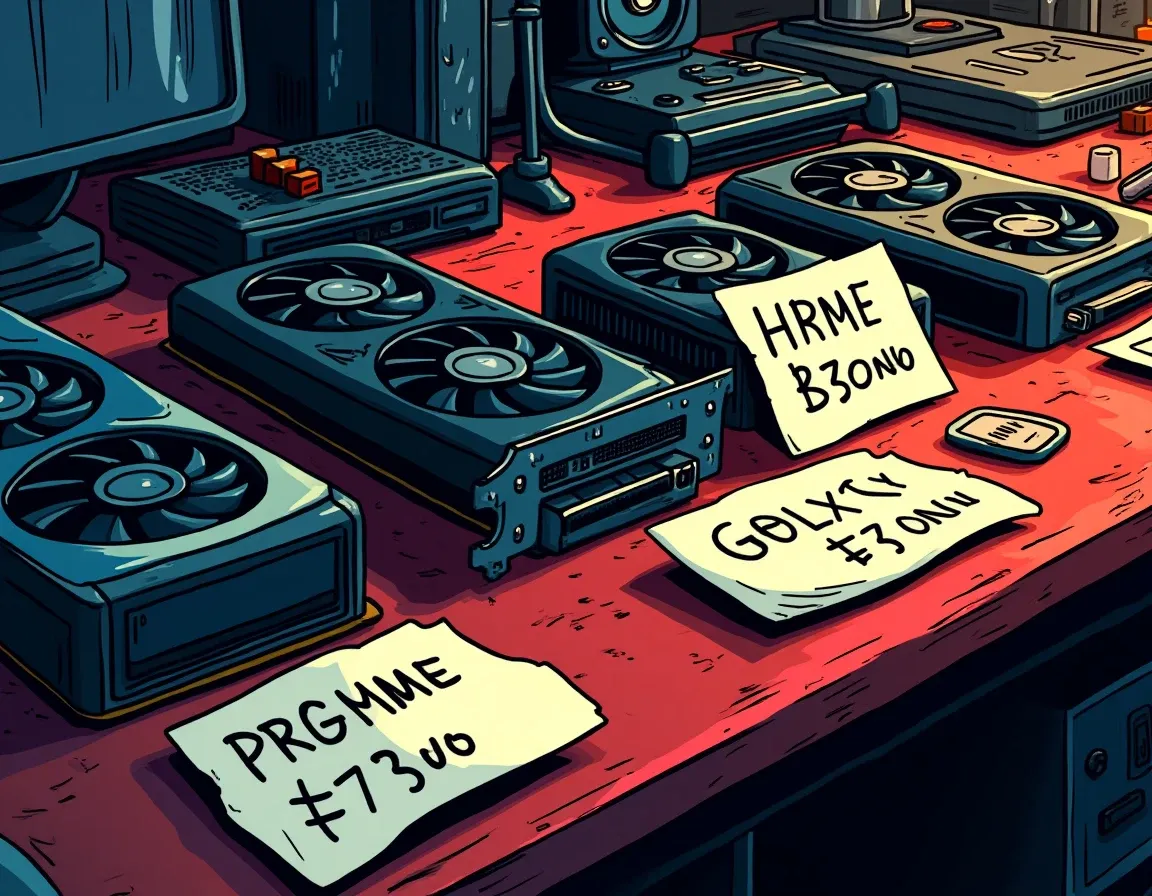
Used GPUs are widely available in the $150-$280 range. An RTX 3070 costs $220-$250 used. An RX 6700 XT costs $200-$240. An RTX 3060 costs $150-$200. These cards were profitable during the 2021 mining boom. They are not profitable in most environments today.
Daily profitability examples at $0.10 per kWh show the problem clearly. A single GPU earning $0.60 per day in mining revenue pays $0.30 in electricity. That leaves $0.30 in net income. At that rate, a $220 RTX 3070 has a payback period of 733 days, or just over two years. That assumes stable coin prices, stable network difficulty, and no hardware failure. None of those assumptions hold in practice.
An RTX 3070 Ti generates $0.08-$0.12 daily profit at cheap power between $0.05 and $0.08 per kWh. That is the best-case scenario. Most residential power costs more. At $0.10 per kWh, the same card generates $0.05-$0.10 daily profit. Payback periods stretch to 2-5 years for mid-range cards. Graphics cards like the RTX 4090 show profitability returns of 13 years. Mid-range cards range from 5-10 years even with very cheap power.
GPU mining remains viable only for a narrow set of ASIC-resistant altcoins. Kaspa (KAS) is the most profitable coin to mine with NVIDIA GPUs in 2026, using the kHeavyHash algorithm. For AMD GPUs, Alephium (ALPH) using the Blake3 algorithm often delivers the best returns. Frencoin (FREN), Ravencoin (RVN), and Ergo (ERG) also generate small positive returns with efficient GPUs and cheap power.
These coins share a common pattern. Network difficulty is lower than Bitcoin or Ethereum Classic. ASIC miners have not yet dominated the hashrate. Price volatility is high. A coin that pays $0.50 per day today may pay $0.10 per day in three months if difficulty rises or price drops. GPU mining margins are thin, and one difficulty spike or price correction can extend payback periods indefinitely.
The other consideration is hardware failure risk. Used GPUs have unknown operational history. A card that mined continuously for two years has elevated failure risk compared to a card used for gaming. Thermal wear, fan degradation, and capacitor aging are not visible at purchase. If a $220 card fails after 400 days of operation, you have lost both the purchase price and the mining revenue. That risk is real and cannot be hedged.
For readers considering GPU mining in 2026, the income test is straightforward. Calculate daily net profit after electricity. Multiply by 365 to estimate annual income. Compare that number to the upfront hardware cost plus expected difficulty increases over the next 12 months. In most cases, including resale value does not change the outcome. The card will lose more value from age and mining wear than it generates in net income.
Entry-Level ASIC Mining: Break-Even Timelines and Difficulty Risk
Entry-level ASIC miners start around $1,500 for used units and $4,000-$5,500 for current-generation machines. The Canaan Avalon A1566 delivers 185 TH/s at 19.5 J/TH for around $3,100. The Antminer S21 costs $5,500 and produces 200 TH/s at similar efficiency. These machines are designed for Bitcoin mining, and they are far more efficient than GPUs. ASICs achieve 20-30 joules per terahash. GPUs require 500+ joules per terahash.
That efficiency advantage translates directly into payback timelines. Top-tier ASIC miners like the Antminer S21 XP can break even within 18 to 27 months at electricity rates below $0.05 per kilowatt-hour. At $0.05 per kWh, the Antminer S21 generates $12-$18 daily profit and breaks even in 10-15 months. At $0.10 per kWh, the same machine generates $2-$5 daily profit and breaks even in 3-7 years. The difference between industrial and residential power rates determines whether the machine is profitable or unprofitable.
Most residential environments cannot achieve the power costs required for ASIC profitability. Industrial rates average $0.08 per kWh in the United States. Profitable mining operations run on rates between $0.03 and $0.06 per kWh through direct power purchase agreements or locations with cheap hydroelectric power. If you are paying residential rates, ASIC mining will lose money monthly.
The other critical variable is network difficulty. Bitcoin mining difficulty adjusts every 2,016 blocks, roughly every two weeks. As more efficient hardware comes online, difficulty increases and revenue per terahash decreases. Hashprice is back above $40 for the first time since May 2026. Difficulty is sitting 15% below where it was a year ago. Revenue per machine went up this quarter. The price of a machine went down. Those two lines rarely cross in the buyer's favor at the same time, and this month they do.
That favorable moment will not last. Miners with efficiency ratings above 20 joules per terahash have an estimated six to twelve months before rising difficulty renders them permanently unprofitable. ASICs typically lose their edge within one to two years. Resale value drops sharply. Used machines, often sold by miners upgrading their fleet or by liquidating mining farms, can cost 30-60% less than new units. That discount reflects economic reality. The machine was profitable when purchased at full price. It is no longer profitable at current difficulty and power costs. The seller knows that. You should too.
For readers considering entry-level ASIC mining, the decision hinges on electricity cost. If you have access to power below $0.06 per kWh, an Antminer S21 or Canaan Avalon A1566 can generate positive cash flow for 12-18 months. If you are paying residential rates, home mining is not profitable in 2026. The hardware will cost more in electricity than it generates in mining revenue. In that scenario, buying Bitcoin directly produces better returns than running the hardware.
Critical Comparison Factors: Electricity, Difficulty, and Resale Value
Electricity cost is the single most important variable in crypto mining profitability. It outweighs hardware efficiency in determining break-even timelines. Profitable mining typically requires electricity below $0.06 per kWh for Bitcoin or $0.10 per kWh for GPU-mineable altcoins. The average U.S. residential electricity rate is $0.16 per kWh as of 2025. At that rate, both GPU and ASIC mining lose money.
The second factor is network difficulty. Bitcoin difficulty adjusts bi-weekly. GPU-mineable coins adjust at varying intervals depending on their algorithm. As more hashrate comes online, difficulty increases and revenue per unit of hashrate decreases. GPU profitability on Kaspa will continue to decline as more ASICs come online. By late 2026 or early 2027, GPU mining on Kaspa may become unprofitable for many operators. That pattern repeats across every mineable coin. The window of profitability closes as network participants optimize for the same revenue.
The third factor is resale value. GPUs retain resale value because they have utility beyond mining. An RTX 3070 sells to gamers, AI developers, and content creators. An Antminer S21 sells only to other miners. When an ASIC becomes unprofitable at current difficulty, its resale value drops to near zero. GPUs retain 40-60% of original value after four years. ASICs drop to 10% after two years. That difference changes the entire profitability equation.
As of 2026, buying brand new graphics cards for mining rarely makes sense. Used RTX 3060 Ti cards cost $200-$250. New cards cost $400 or more. The payback period on new cards is 18-24 months, too risky given coin price volatility. With current GPU prices, payback periods are 12-18 months assuming stable coin prices. One difficulty spike or price drop can extend that indefinitely. In most cases, buying the coin is a better financial decision than mining it with used hardware.
For ASIC miners, resale value is minimal. The Antminer S21 Pro has low resale value after obsolescence. The NVIDIA RTX 5090 has high resale value because gaming and AI markets provide ongoing demand. That difference matters for total cost of ownership calculations. A GPU that loses 50% of its value over two years while generating $300 in net mining income produces a different return than an ASIC that loses 90% of its value while generating $600 in net mining income. The GPU may outperform on a risk-adjusted basis.
When Buying Used Equipment Becomes Uneconomical
The question is not whether used equipment is cheaper upfront. It always is. The question is whether the payback period is short enough to justify the hardware failure risk and the difficulty increase risk. In most cases, the answer is no.
A used RTX 3070 at $220 with $0.30 daily net profit has a 733-day payback period. That assumes zero difficulty increases, zero price declines, and zero hardware failures over 24 months. All three assumptions are unrealistic. Difficulty increases on GPU-mineable coins average 5-10% monthly in 2026. A 5% monthly difficulty increase reduces daily net profit by 5% each month. After twelve months, daily net profit has declined from $0.30 to $0.16. The payback period extends from 733 days to over 1,200 days.
Price volatility adds additional risk. Coins like Ergo and Vertcoin remain GPU-mineable, but profitability depends heavily on the coin's price. Pearl, Quantus, and Epic Cash now pay graphics cards more than GPU mining has paid in years as of October 2026. Those returns rarely last. New-coin pump cycles produce temporary profitability followed by sustained unprofitability as difficulty adjusts and price corrects. Chasing new coins with high initial returns is a losing strategy over time.
For ASIC miners, the economics are similar. A used Antminer S19 costs $1,000-$1,500. It produces 90-100 TH/s at 34 J/TH. At $0.06 per kWh, it generates $2-$4 daily profit. At current difficulty, the payback period is 300-500 days. That looks favorable until you account for efficiency obsolescence. Machines above 20 J/TH have six to twelve months before they become unprofitable. The S19 is already near that threshold. Buying a used S19 in late 2026 means the machine will likely become unprofitable before it breaks even.
The point at which buying used equipment becomes uneconomical is when the expected payback period exceeds the expected profitability window. For GPUs, that threshold is roughly 18 months. For ASICs, it is 12 months. Any payback period longer than those windows introduces unacceptable risk of obsolescence. In those cases, buying the coin directly outperforms mining on both a risk-adjusted and absolute-return basis.
Narrow Exceptions and Edge Cases
There are narrow exceptions where budget mining setups produce positive returns. They require specific conditions that most operators cannot replicate.
The first exception is access to extremely cheap or free electricity. If you have access to power below $0.03 per kWh, or if you can offset electricity costs through heat reuse, solar generation, or subsidized rates, both GPU and ASIC mining become viable. An RTX 3070 at $0.03 per kWh generates $0.50-$0.55 daily net profit. Payback period drops to 400-450 days. That is still long, but it falls within the range where resale value and ongoing income justify the upfront cost.
The second exception is access to hardware at significant discounts. If you can purchase used GPUs at 50-60% below market rates through liquidation sales, bankruptcy auctions, or direct purchases from exiting miners, the payback math improves substantially. An RTX 3070 at $120 instead of $220 has a payback period of 400 days instead of 733 days. That difference matters.
The third exception is operational expertise in switching between coins based on profitability. Miners who actively monitor and switch between Kaspa, Alephium, Ravencoin, and Ergo can capture short-term profitability spikes that passive miners miss. This requires daily monitoring, automated switching software, and deep knowledge of altcoin mining economics. It is not a strategy for beginners.
The fourth exception is dual-use hardware. If you purchase a GPU for gaming, AI development, or content creation and mine during idle hours, the mining income becomes a secondary revenue stream rather than the primary justification for the purchase. In that scenario, any positive net income improves total return on the hardware. The payback calculation changes because the upfront cost is justified by the primary use case, not by mining alone.
These exceptions are real, but they are narrow. Most readers considering a cheap crypto mining rig do not have access to $0.03 per kWh electricity. Most do not have access to hardware at 50% discounts. Most do not have the operational expertise to switch coins profitably. For the majority of potential buyers, a budget mining rig will not break even before hardware obsolescence or difficulty adjustments render it unprofitable.
What to Do Instead
If the payback math does not support buying a cheap mining rig, what should you do instead? The answer depends on your goal.
If your goal is exposure to Bitcoin or altcoins, buy the coin directly. At $0.10 per kWh, an Antminer S21 costs $5,500 and generates $2-$5 daily profit with a 3-7 year payback period. Buying $5,500 of Bitcoin directly produces the same exposure without the operational complexity, electricity costs, or obsolescence risk. If Bitcoin appreciates, you benefit. If it depreciates, you lose the same amount either way, but without the ongoing electricity costs.
If your goal is to earn yield on crypto holdings, staking, liquidity provision, and lending generate higher risk-adjusted returns than mining in most environments. Validator staking on Ethereum pays 3.5-4% APY with minimal operational complexity. Lending protocols offer 2.6-8% on stablecoins. Liquidity provision on high-volume pairs generates fee income with lower capital requirements than mining hardware. All three strategies produce ongoing income without the electricity costs, hardware depreciation, and difficulty risk that define mining.
If your goal is specifically to mine cryptocurrency because you have access to cheap electricity or other structural advantages, focus on current-generation ASICs with efficiency ratings below 20 J/TH. The Antminer S21 and Canaan Avalon A1566 are the only machines that remain profitable at residential power rates in limited scenarios. Avoid used ASICs with efficiency above 25 J/TH. They will become unprofitable within months.
If you are committed to GPU mining despite the unfavorable economics, focus on cards with strong resale value. The RTX 3060 Ti, RTX 3070, and RX 6700 XT retain value in gaming and AI markets. Calculate payback periods using realistic assumptions: 5% monthly difficulty increases, 10-20% annual price declines, and 5-10% annual hardware failure rates. If the payback period exceeds 18 months under those assumptions, do not buy the hardware.
The final option is to wait. Mining profitability cycles with Bitcoin halving events, difficulty adjustments, and hardware release cycles. October 2026 presents a briefly favorable moment where hashprice is up and hardware prices are down. That moment will not last. If current conditions do not support profitable mining, future conditions may. Waiting for better entry points is a legitimate strategy.
The Takeaway
A cheap crypto mining rig is rarely a profitable investment in 2026. Used GPUs in the $500-$2000 range face payback periods of 1,500+ days with thin margins that disappear after one difficulty adjustment. Entry-level ASICs require electricity below $0.06 per kWh to break even within 18 months, a threshold most residential operators cannot meet. The narrow exceptions where budget mining hardware produces positive returns require access to extremely cheap power, discounted hardware, or dual-use justifications that most buyers do not have.
Before you purchase any mining hardware, calculate the daily net profit after electricity costs. Multiply by 365 to estimate annual income. Compare that number to the upfront hardware cost plus expected difficulty increases over the next 12 months. Include hardware failure risk and resale value in your model. If the payback period exceeds 18 months for GPUs or 12 months for ASICs, buying the coin directly outperforms mining on both a risk-adjusted and absolute-return basis. That is the income test every budget mining rig must pass, and most fail.
Frequently Asked Questions
What is the actual payback period for a used GPU mining rig in 2026?
Used GPU mining rigs face payback periods of 733-1,500+ days depending on electricity costs and hardware choice. An RTX 3070 at $220 generating $0.30 daily net profit requires 733 days to break even, assuming zero difficulty increases. With realistic 5% monthly difficulty increases, payback extends beyond 1,200 days. Most GPUs become unprofitable before breaking even due to rising network difficulty on mineable altcoins like Kaspa, Alephium, and Ravencoin.
Can entry-level ASIC miners break even at residential electricity rates?
No. Entry-level ASIC miners require electricity below $0.06 per kWh to break even within 18-27 months. The Antminer S21 at $5,500 generates $12-$18 daily profit at $0.05 per kWh with a 10-15 month payback. At typical residential rates of $0.10-$0.16 per kWh, the same machine generates $2-$5 daily profit with a 3-7 year payback period, or loses money entirely. Industrial power rates averaging $0.08 per kWh are required for profitable Bitcoin mining.
Which coins remain profitable to mine with budget GPUs?
Kaspa (KAS) is the most profitable coin for NVIDIA GPUs using the kHeavyHash algorithm. Alephium (ALPH) using Blake3 works best for AMD cards. Ravencoin (RVN), Ergo (ERG), and Frencoin (FREN) also generate small positive returns with efficient GPUs and electricity below $0.10 per kWh. Daily net profit ranges from $0.05-$0.30 per card depending on power costs. New coins like Pearl, Quantus, and Epic Cash show temporarily high returns but rarely sustain profitability after difficulty adjusts.
When does buying used mining equipment become uneconomical?
Used mining equipment becomes uneconomical when the expected payback period exceeds the profitability window. For GPUs, that threshold is 18 months. For ASICs, it is 12 months. Any longer payback introduces unacceptable obsolescence risk. Used ASIC miners with efficiency above 20 joules per terahash have six to twelve months before becoming unprofitable at current difficulty. Used GPUs face 5-10% monthly difficulty increases that extend payback periods beyond break-even. Buying the coin directly outperforms mining in most scenarios.
What electricity cost is required for profitable crypto mining?
Profitable Bitcoin mining requires electricity below $0.06 per kWh. GPU mining on altcoins requires rates below $0.10 per kWh. The average U.S. residential rate is $0.16 per kWh, making home mining unprofitable in most environments. Industrial rates average $0.08 per kWh. Successful mining operations access power between $0.03-$0.06 per kWh through direct purchase agreements, hydroelectric sources, or subsidized rates. At residential rates, electricity costs exceed mining revenue for both GPU and ASIC hardware.
You have just reviewed payback math for budget mining setups ranging from 733 to 1,500 days at current difficulty and power costs. Those numbers will change next month.
Every Thursday: where crypto yield actually is - stablecoins, liquid staking and DeFi lending, with the risk named next to the rate and what changed since last week.
Get it free every ThursdayFree. No trade calls, no allocations, no hype. Unsubscribe in one click.