Table of Contents
The Source-of-Return Test

Before you deposit one dollar into any yield opportunity, answer this question: where does the yield actually come from?
There are three possible sources. Interest payments from borrowers, trading fees from market activity, and token emissions from protocols. Only the first two represent real yield. The third is dilution dressed up as income.
Pull the protocol's fee revenue from DeFiLlama or Token Terminal. Compare against the total yield being distributed. If a protocol claims to pay $10M per year in real yield but only earns $3M in fees, the gap is being made up somewhere. Usually emissions or treasury drawdown.
Real yield is typically paid in ETH, stablecoins, or another productive asset the protocol earned. If the yield is paid in the protocol's own governance token, ask where those tokens came from. Buybacks from revenue are fine. Fresh mints are not.
According to DL News Research in February 2025, 77% of DeFi yield in 2024 came from real fee revenues. That number matters because emission-funded yield depends on a steady stream of new buyers absorbing the inflation. Real yield can sustain itself as long as the underlying protocol keeps earning fees.
The distinction shows up in volatility. Revenue-sharing models typically deliver 40-60% lower return volatility than speculative emission-based approaches. That's not because the APY is lower. It's because the return isn't dependent on token price appreciation or liquidity mining subsidies.
Check the protocol's DeFiLlama page for a steady or growing TVL trend over at least three months. Sudden spikes followed by drops mean mercenary capital that leaves when rewards dry up. A rising total value locked tells you that users keep trusting the protocol.
Red Flags: The Anchor Protocol Pattern
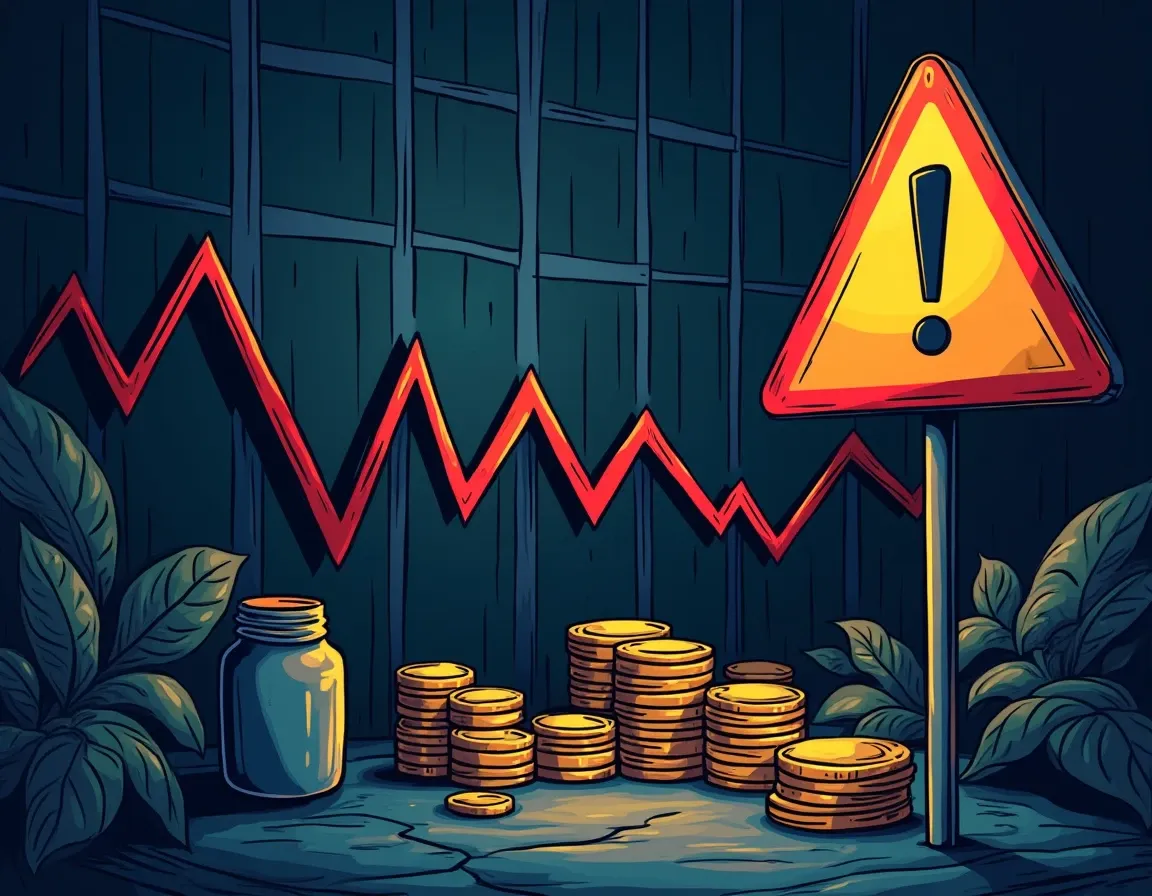
Anchor Protocol promised depositors 20% APY. The yield supposedly came from lending operations. In reality, Anchor attracted 75% of UST's circulating supply before Terra collapsed.
The mechanics tell you everything you need to know about unsustainable yield.
Anchor created a yield reserve to maintain the 20% interest rate. That reserve ran a deficit for weeks because there were more deposits than borrowers. The yield reserve was projected to last 1.5 years. Deposit assets tripled in only a few months, draining reserves nearly to depletion.
The structure was Ponzi-like. Users were rewarded with ANC tokens for borrowing UST and could reinvest that UST back into Anchor for greater returns. The 19.45% advertised rate was unsustainable. A 4-5% yield paid to depositors could have been feasible long term based on the borrower-to-depositor ratio.
Here's the red flag checklist derived from Anchor and similar collapses:
- APY more than double the sustainable market rate for that asset class (stablecoin lending in 2026 pays 3-7%, not 20%)
- Yield reserve declining month-over-month without corresponding revenue growth
- Circular incentives that reward borrowing and redepositing in the same protocol
- TVL growth outpacing revenue growth by a factor of three or more
- Governance-controlled emissions with no hard cap or tapering schedule
The era of four-digit APYs driven by unsustainable token emissions is mostly behind us. What replaced it is a more mature ecosystem of protocols that generate yield from real activity. Trading fees. Lending interest. Perpetuals funding rates. Those activities generate sustainable returns in the 3-20% APY range depending on strategy and risk.
Most governance tokens have high emission schedules, making them hyperinflationary. Their demand falls because of little or no utility, and their prices shrink. If you're earning 30% APY in a governance token but that token inflates at 50% annually, your real return is negative.
The Risk Stack: Four Layers

Every DeFi yield opportunity carries four distinct risk types. Smart contract risk, oracle risk, liquidity risk, and governance risk. You need to evaluate all four before committing capital.
Smart Contract Risk
Look for at least one audit from a recognized firm. CertiK, Trail of Bits, or OpenZeppelin are the baseline. Check if the protocol has had any exploits by searching the protocol name with "hack" or "exploit" on Google.
An audit does not mean the code is safe. It means someone competent reviewed it. Exploits still happen to audited protocols. But unaudited code is a non-starter unless you can read Solidity yourself.
Oracle Risk
Oracles feed price data into smart contracts. If the oracle is manipulated, the protocol can be drained. Oracle risk has already led to millions in losses in live DeFi systems.
The deployment practices for oracles are often opaque. How frequently does the price update? How is the price aggregated from multiple nodes? These details are not always transparent, leaving room for external malicious behavior.
Best practice is to use oracle networks that pull from multiple sources. Chainlink, Band, or UMA aggregate data and apply consensus mechanisms. That avoids single points of failure. If a protocol relies on a single oracle or a custom in-house oracle, treat that as elevated risk.
Liquidity Risk
Liquidity depth is your second-tier gauge. Deep liquidity means trades can happen without moving the price much. In crypto, a deep order book paired with low token price volatility usually signals a more reliable yield stream.
If you're earning yield in a token with shallow liquidity, you may not be able to exit your position without slippage. Check 24-hour trading volume on CoinGecko or CoinMarketCap. If volume is less than 10% of the protocol's TVL, you're exposed to liquidity risk.
Governance Risk
Protocols are governed by token holders. Governance can change fee structures, emission schedules, and risk parameters. If a protocol has low voter participation or a small number of whales controlling decisions, governance risk is high.
Check whether the token has a hard emissions schedule or whether emissions are governance-controlled. A protocol paying real yield can still be diluting holders elsewhere through unrelated emissions. If the governance forum shows proposals to increase emissions or reduce fees, that's a signal.
Sustainability Signals You Can Measure
Sustainable yield comes from protocols with predictable revenue, controlled emissions, and growing user bases. Here are the specific metrics to track.
TVL growth should be steady and compound-like. Not short spikes. Protocols focusing on real yield saw a 37% increase in TVL during 2024, compared to 12% for traditional emission-based platforms.
Check the token's emission schedule. A predictable, slowly tapering release keeps inflation in check. That protects your yield from being eroded by a flood of new coins. When the schedule is front-loaded, you'll see higher inflation rates early on, and the real return can drop sharply once the supply surge hits.
Revenue trends matter more than TVL. Pull quarterly fee data from DeFiLlama. If fees are flat or declining while TVL grows, the protocol is paying yield it isn't earning. That's not sustainable.
For most participants in 2026, the safest yield comes from established protocols like Aave and Curve. Aave V4 introduces isolated markets, allowing you to limit risk to a specific pool. Typical yields on stablecoins range from 3-8%, and 1-4% on ETH or BTC. Curve stable pools have been running for years with minimal exploits.
Pendle is the breakout protocol of 2025-2026. It offers 8-30% yields depending on strategy. The advantage is fixed yield via principal tokens (PT), which is unique in DeFi. You can lock in a rate without exposure to token price volatility.
Stress Tests To Apply Before You Deposit
Run three stress tests on any yield opportunity before you commit capital.
The Revenue Coverage Test
Take the protocol's annual fee revenue. Divide by the total yield distributed annually. If the ratio is below 1.0, the protocol is not covering its yield from fees. Ask where the difference comes from. Treasury drawdown is a temporary solution. Token emissions are not.
The Concentration Test
No more than 20% of your total capital should sit in any single protocol. Even Aave or Curve can be exploited. Diversify across two or three protocols matched to your risk tolerance and chain. The strongest approach is not chasing the single highest APY. It's combining protocols that balance yield and risk.
The Exit Liquidity Test
Assume you need to exit your position today. Can you withdraw and swap to stablecoins or ETH without more than 2% slippage? If not, you're exposed to liquidity risk. Check the protocol's withdrawal queue or lock-up periods. Some liquid staking platforms have multi-day unbonding. That's fine if you're aware. It's not fine if you assumed instant liquidity.
Remember that the highest theoretical yield isn't always the most profitable after accounting for risks, gas fees, and opportunity costs. Gas on Ethereum can eat 1-3% of your yield if you're compounding frequently with small positions. Layer-2 protocols like Arbitrum or Optimism reduce that drag.
Data Dashboards and Ongoing Monitoring
All of these data points are tracked on-chain in real time. Platforms like Dune, DeFiLlama, and Glassnode let you slice the numbers, set alerts, and watch the metrics evolve as market conditions shift.
Set up alerts for TVL drops of more than 10% in a single week. That signals either an exploit or a mass exodus. Both require immediate attention.
Monitor the protocol's governance forum. Proposals to increase emissions, reduce fees, or change risk parameters can erode your yield overnight. If you're earning from a protocol, you need to watch governance as closely as you watch price.
Check the protocol's fee dashboard monthly. Declining fees with stable or growing TVL means yield per dollar deposited is falling. That's your signal to reassess the position.
What Real Yield Looks Like in 2026
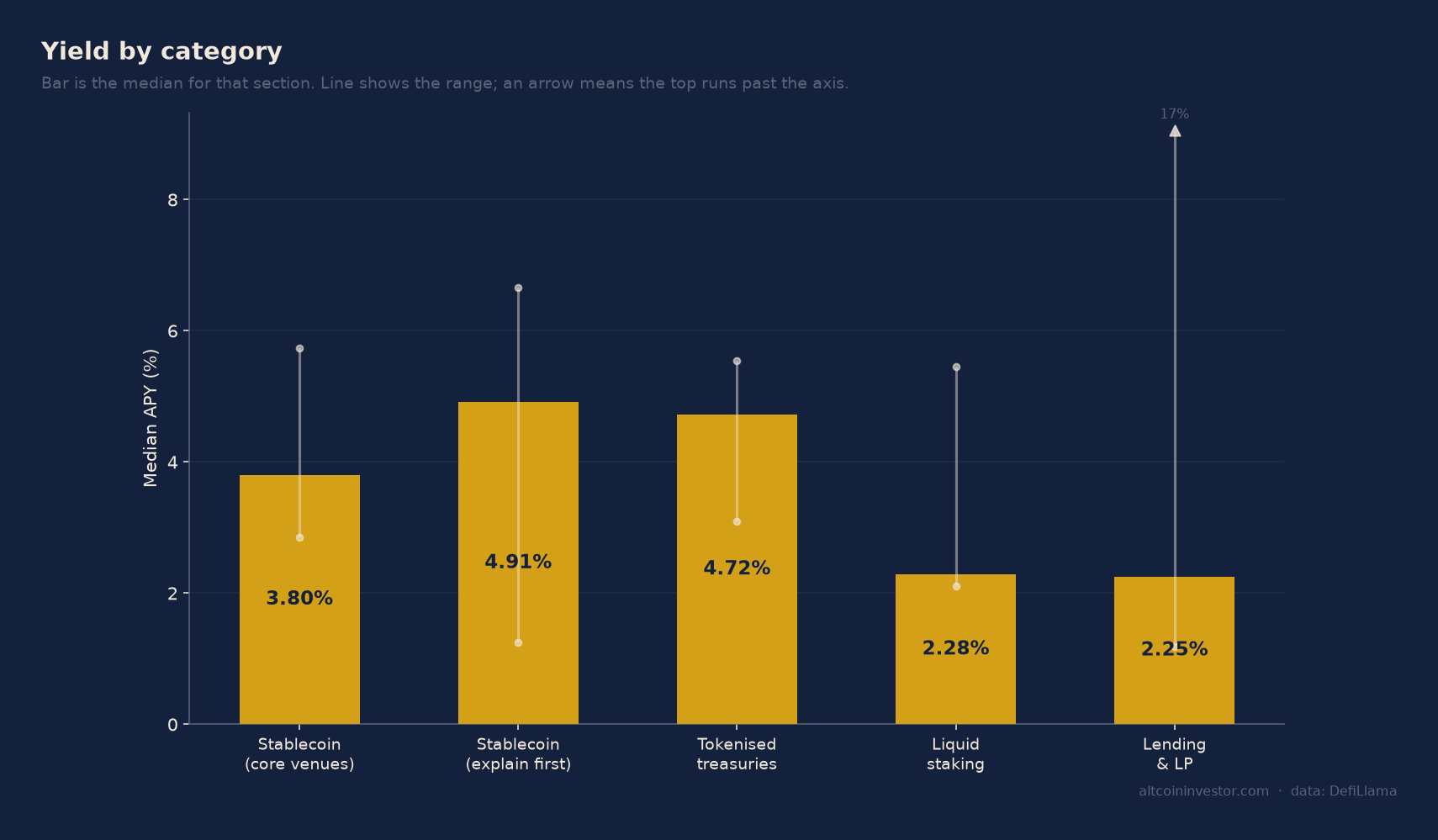
The most sustainable returns in 2026 come from real fees and interest. Stablecoin lending pays 3-7% APY. AMM liquidity provision delivers 8-20% depending on pool activity. Liquid staking earns 3-4.5%.
RWA (real-world asset) yield farming offers predictable APYs of 4-12% backed by treasuries, private credit, and real estate. These are not speculative bets. They're yield instruments with counterparty and smart contract risk, but without token price exposure.
A blended portfolio typically delivers 7-11% annually. The stablecoin component provides the stable floor. Other strategies add return layers. That's not the 100% APYs of 2021. It's sustainable income you can compound over years without worrying about the protocol collapsing.
Emissions can bootstrap liquidity in early-stage protocols. But they aren't sustainable yield. They're marketing budgets disguised as returns. Incentive yields depend on future expectations. Once emissions end, yield must come from elsewhere or disappear entirely.
The Takeaway
The single most important question is source-of-return. Not TVL. Not APY. Not the audit badge.
If the protocol earns less in fees than it distributes in yield, you're not earning income. You're extracting value from a subsidy that will end. When it ends, your position will be worth less than you deposited.
Run the revenue coverage test first. Everything else is secondary.
Frequently Asked Questions
What is the difference between real yield and token emissions in DeFi?
Real yield is paid from actual protocol revenue like trading fees, lending interest spreads, or MEV capture, typically distributed in ETH or stablecoins. Token emissions are freshly minted governance tokens used to subsidize returns, which dilute existing holders and depend on continuous new capital inflows to sustain the APY. Real yield can persist as long as the protocol generates fees. Emission-based yield ends when the subsidy budget runs out or when new buyers stop absorbing the inflation.
How do I check if a DeFi protocol's yield is sustainable?
Pull the protocol's annual fee revenue from DeFiLlama or Token Terminal and compare it to the total yield distributed annually. If the ratio is below 1.0, the protocol isn't covering its yield from fees. Also check TVL trends over three months for steady growth, review the token emission schedule for predictable tapering, and verify that at least one reputable audit firm has reviewed the smart contracts. Declining fees with stable TVL means yield per dollar is falling.
What were the red flags in Anchor Protocol's 20% APY that led to collapse?
Anchor's yield reserve ran a persistent deficit because deposits far exceeded borrowing demand. The reserve was projected to last 1.5 years but deposit assets tripled in months, draining it nearly to zero. The protocol created circular incentives where users borrowed UST, earned ANC tokens, then redeposited the UST for more yield. The 20% rate was three to four times the sustainable market rate for stablecoin lending, and TVL growth massively outpaced revenue generation.
What are the four types of risk in DeFi yield opportunities?
Smart contract risk involves code vulnerabilities that can be exploited even after audits. Oracle risk occurs when price feeds are manipulated or fail, allowing protocols to be drained. Liquidity risk means you cannot exit positions without significant slippage if trading volume is too low relative to TVL. Governance risk involves token holder votes that can change fee structures, emission schedules, or risk parameters overnight, eroding your yield or increasing your exposure.
What is a realistic sustainable APY range for crypto yield in 2026?
Stablecoin lending on mature protocols like Aave pays 3-7% APY. AMM liquidity provision on active pairs delivers 8-20% depending on trading volume and pool composition. Liquid staking earns 3-4.5%. Real-world asset protocols offer 4-12% backed by treasuries and private credit. A blended portfolio typically delivers 7-11% annually. These ranges reflect real fee-based yield, not token emission subsidies, and are sustainable as long as underlying protocol activity continues.