Table of Contents
How Allocation Mechanisms Determine What You Actually Receive
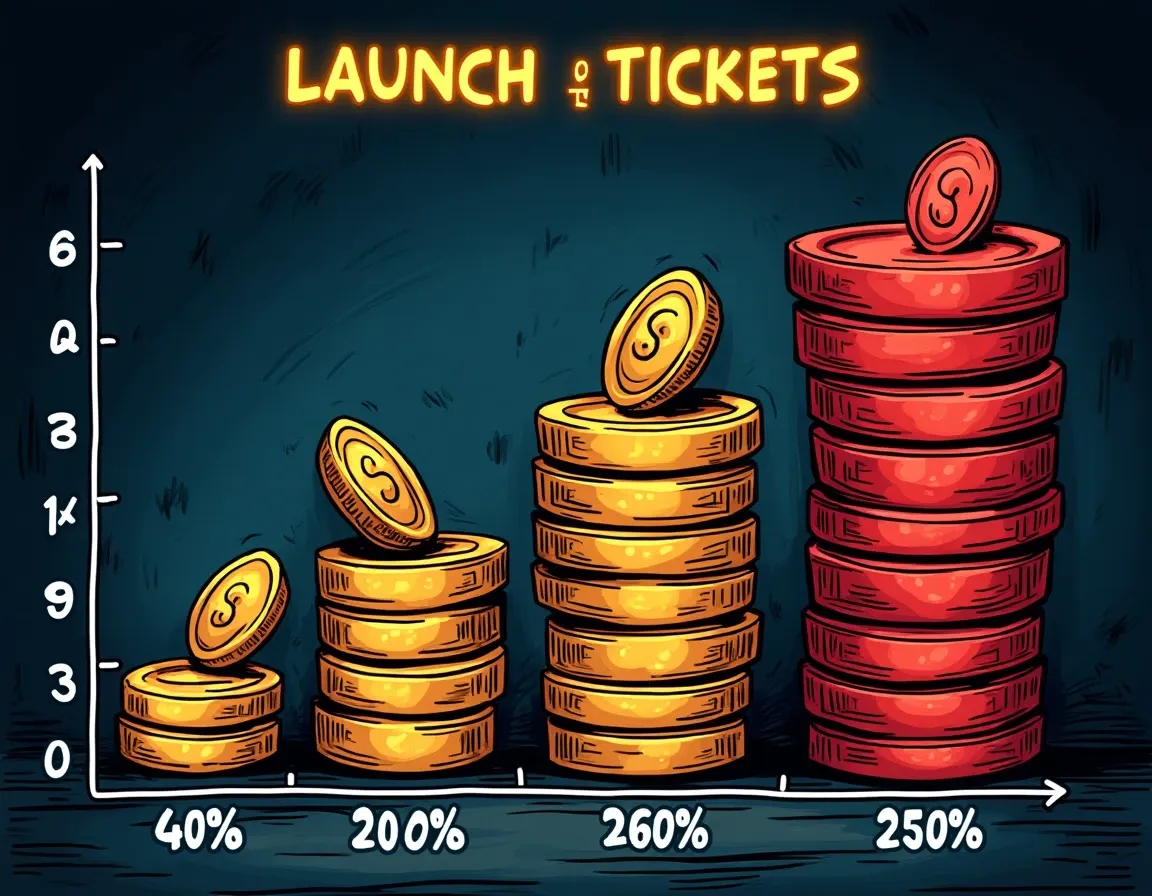
Most platforms advertise guaranteed allocations. What they do not advertise is how oversubscription dilutes your share. A $500 guaranteed allocation sounds certain until 10x oversubscription reduces it to $50. Understanding the difference between lottery, tiered, and proportional systems determines whether you lock $5,000 for 30 days or buy tokens two days post-launch at better pricing.
Three primary allocation mechanisms run major launchpads in 2026. Lottery systems distribute tickets to qualified users with winners drawn randomly. Oversubscription ratios often exceed 20:1 for hyped projects. Lower tiers face single-digit win rates even after staking platform tokens.
Tiered guaranteed systems provide users who meet staking thresholds with fixed or proportional allocations. BSCPad uses a six-tier model where users stake $BSCPAD tokens to earn spots. Investors know upfront how much they can invest, removing first-come chaos. Seedify runs a nine-tier structure where higher tiers get earlier access and larger allocation caps.
StakeWeight algorithms allocate based on token quantity multiplied by staking duration. This balances fairness against economic incentives. A user staking $2,000 for 60 days receives more allocation than someone staking $2,000 for 15 days, even in the same nominal tier.
The critical insight: guaranteed allocations do not protect against extreme oversubscription. When total demand exceeds supply, allocations are adjusted after the sale. Higher tiers receive priority. Lower tiers receive reduced amounts. A platform may promise you $500, but if the sale oversubscribes 4x, you receive $125.
What Tier Upgrades Cost And When The Math Works

Capital requirements vary across platforms, but the pattern is consistent. Most require staking native governance tokens between $500 and $10,000 to qualify for higher tiers. Lower tiers face lottery systems. Top tiers demand six-figure stakes but deliver guaranteed allocations.
You can start with as little as $50 to $200 on some platforms, especially those with low entry barriers. Many crypto launchpad platforms use staking tiers, which means higher investment often leads to better allocation. The practical framework for 2026 IDO decisions breaks into three bands.
$500 to $2,000 represents the minimum viable allocation for tier-based platforms. This range gets you out of pure lottery systems and into proportional or small guaranteed tiers. Seedify offers staking rewards with up to 11% APR for $SFUND and 40% APR for $SNFT. If you are already earning yield on staked tokens, the opportunity cost of locking them for an IDO drops.
$5,000 to $15,000 covers staking requirements for guaranteed tiers on most major platforms. Higher staking tiers receive fixed allocations like $500, $2,000, or $5,000. Top tiers require 30-plus days of staking before the sale date. Your capital is locked even if projects are delayed or cancelled. Some platforms allow no withdrawal once the staking snapshot begins.
The break-even calculation is straightforward. If a tier upgrade costs $5,000 in additional locked capital for 45 days and increases your allocation from $200 to $1,500, you gain $1,300 in allocation. If the token launches at a 3x premium to IDO price, your profit increases by $3,900. If your $5,000 could earn 8% APY elsewhere, the opportunity cost for 45 days is $164. The upgrade pays off.
If the same upgrade grants you $1,500 allocation but the token launches at 0.8x IDO price, you lose $300 on the allocation itself. Your locked $5,000 also lost $164 in forgone yield. Total cost: $464. The upgrade destroyed value.
Typical oversubscription rates range from 10x to 50x for competitive launches. When a project raises $5 million on a $500,000 hard cap, every participant receives 10% of their expected allocation regardless of tier. In this scenario, a higher-tier staker with $5,000 capital guaranteeing a $2,000 allocation receives $200. A lower-tier lottery entrant with a $500 ceiling receives $50 if they win the lottery at all.
The tier upgrade still delivers 4x the allocation in absolute terms, but both participants are diluted identically in percentage terms. This is why tracking historical oversubscription data for specific platforms matters more than advertised allocation sizes. CryptoSlate's launchpad reviews publish oversubscription ratios for past launches, giving you baseline expectations.
Staking Duration, Lock-Up Risk, And Multi-Platform Strategies
Staking duration multipliers create a second variable beyond tier entry. Platforms using StakeWeight algorithms reward users who lock tokens longer. A 60-day stake might receive a 1.5x multiplier compared to a 15-day stake. This introduces time-based strategy decisions independent of capital size.
Lock-up risk increases with duration. Top tiers require 30-plus days of staking before the sale date. If a project delays its launch or cancels, your capital remains locked. If market conditions shift and you want to exit your staked position, withdrawal is often blocked once the snapshot period begins. You are holding the platform token through whatever volatility arrives.
The 2025 cohort of top-performing IDOs delivered an average return of 29% within the first two weeks of listing. This data point suggests that secondary market entry two to three days post-TGE often beats launchpad allocation ROI for hyped projects. For mid-tier projects without significant listing hype, launchpad entry still outperforms secondary.
Multi-platform staking reduces single-platform risk but increases total capital lock-up. Staking simultaneously on Seedify, BSCPad, and Polkastarter diversifies your IDO access. You participate in more launches. You reduce the impact of any single project failing to deliver returns. The trade-off is that you now have $6,000 to $15,000 locked across three platforms instead of $2,000 to $5,000 on one.
If you deploy $15,000 across three platforms and capture allocations in six IDOs over 90 days, your average allocation per project might be $800. If four projects return 2x, one returns 5x, and one loses 40%, your blended return is approximately 2.1x on deployed allocations. Your $15,000 in staked platform tokens remains locked, earning whatever staking yield the platforms offer. Seedify's 11% APR on $SFUND adds $412 over 90 days on a $5,000 stake.
The alternative is keeping $15,000 liquid and buying tokens on secondary markets 48 to 72 hours post-launch. You avoid lock-up risk. You avoid oversubscription dilution. You pay whatever premium or discount the market assigns after launch. For projects that launch below IDO price, you win. For projects that 3x immediately, you lose. The historical data shows that top-performing IDOs often spike hard at launch, then retrace. Timing secondary entry requires monitoring, but it eliminates the staking requirement entirely.
KYC, Geographic Restrictions, And Vesting Schedules
Regulatory scrutiny has tightened across major launchpads. Nearly all platforms now mandate full KYC: government-issued ID, proof of address, and sometimes live selfie verification. Geographic restrictions block users from the U.S., China, and several other jurisdictions on most major platforms. This eliminates entire user bases from high-performing platforms.
If you are in a restricted jurisdiction, the tier math is irrelevant. You cannot participate. Some users route through VPNs and foreign KYC documents. This introduces legal risk and potential loss of funds if the platform detects it. The ROI calculation must now include the probability of account termination and fund seizure.
Vesting schedules add a second post-allocation variable. Many projects implement vesting to prevent instant dumps. Lock-up periods vary widely. Some IDOs release 100% at launch. Others vest over 6 to 24 months with cliff periods. Understanding token unlock schedules becomes essential if you are locking capital for an allocation that itself locks for another 12 months.
A project offering a $1,500 allocation with 12-month linear vesting means you receive $125 worth of tokens per month. If the token price drops 60% over that year, your $1,500 allocation is worth $600 at full vesting. You cannot sell the unvested portion to cut losses. Your effective return depends on price action over 12 months, not just launch day performance.
Instant-unlock IDOs create the opposite dynamic. If 100% of tokens unlock at TGE and the project has weak post-launch demand, everyone dumps simultaneously. The token craters. Your $1,500 allocation might be worth $400 within 48 hours. The lack of vesting concentrates sell pressure at launch. Tier upgrades that cost you $5,000 in locked capital for 45 days now deliver a $400 allocation that you could have bought for $350 on secondary markets three days later.
Calculating Real Allocation Under Oversubscription
Oversubscription handling varies by platform, but the math is consistent. When total amounts invested exceed the target, tokens received by users are diluted based on actual investment amount. The formula: ETH or token price multiplied by hard cap amount raised, divided by actual amount raised.
A project with a $500,000 hard cap that raises $5 million experiences 10x oversubscription. Every participant receives 10% of their committed allocation. A user committed for $2,000 receives $200 in tokens. A user committed for $500 receives $50. The advertised guaranteed allocation is adjusted downward proportionally.
Some platforms apply tiered oversubscription adjustments. Higher tiers receive full allocations up to a threshold, then proportional reductions beyond that. Lower tiers receive proportional reductions from the start. This structure rewards higher capital commitment and longer staking duration but still dilutes everyone when demand massively exceeds supply.
Tracking historical oversubscription ratios for specific platforms gives you baseline expectations. If BSCPad consistently runs 8x to 12x oversubscription on popular launches, you can estimate that a $1,000 guaranteed allocation will deliver $83 to $125 in actual tokens. If Seedify runs 15x to 25x on hyped projects, your $2,000 tier allocation might deliver $80 to $133.
Adjusting your tier entry decision based on expected oversubscription changes the break-even math. Paying $5,000 for a $2,000 guaranteed allocation that you expect to be diluted to $150 means you are paying $5,000 in locked capital (plus opportunity cost) for $150 in tokens. If the token 10x from IDO price, your $150 becomes $1,500. If it 2x, your $150 becomes $300. The tier upgrade cost you $164 in forgone yield for a $300 payout. You are breakeven at best.
When Secondary Market Entry Beats Launchpad Access
The case for skipping IDO allocation and buying post-launch rests on three factors: oversubscription dilution, vesting lock-ups, and secondary market pricing inefficiency. If a project oversubscribes 20x, your $1,000 allocation becomes $50. If it vests over 12 months, you receive $4.17 per month. If the token dumps 50% in month two, your allocation is worth $25 total over the full vesting period.
Buying $1,000 worth of the same token on secondary markets 72 hours post-launch gives you immediate liquidity. You can sell if momentum breaks. You avoid the 30-day staking lock-up before the sale. You avoid the vesting lock-up after the sale. You pay whatever price the market sets, which for many projects is below IDO price within the first week.
Top-performing IDOs in 2025 delivered an average return of 29% within the first two weeks. This includes the winners that 5x and the losers that dropped 60%. For mid-tier projects without major exchange listings or influencer hype, secondary prices often settle 10% to 30% below IDO price in the first week as early participants take profit.
The staking opportunity cost calculation tilts further toward secondary entry when platform token prices are volatile. If you stake $5,000 in $SFUND at $2.50 per token and the token drops to $1.80 over 45 days, your staked capital lost $1,400 in value. Even if your IDO allocation 3x, you need that profit to exceed $1,400 just to offset the platform token loss. If your allocation was diluted from $2,000 to $150 due to oversubscription, your 3x profit is $450. You are down $950 net.
Multi-IDO strategies partially hedge this risk by spreading capital across several platform tokens. But if the broader market corrects during your 45-day staking period, all platform tokens likely decline together. Correlation does not disappear through diversification when the entire sector moves in sync.
The Takeaway
The math on tier upgrades depends on three numbers you can estimate before committing capital: expected oversubscription ratio, platform token price stability, and post-launch secondary market behavior. If historical data shows a platform runs 15x oversubscription, your $2,000 guaranteed allocation delivers $133 in tokens. If the platform token you must stake drops 20% during lock-up, your opportunity cost includes that loss. If secondary markets price the token 15% below IDO within 72 hours, buying there beats the allocation. Run the numbers with your own capital size and risk tolerance. For hyped launches on tier-based platforms, higher tiers still win when the token delivers a 5x-plus return. For everything else, secondary entry after the initial dump captures better pricing without the lock-up risk.
Frequently Asked Questions
What is the typical oversubscription ratio for popular IDOs in 2026?
Oversubscription ratios for competitive launches typically range from 10x to 50x in 2026. This means a project with a $500,000 hard cap might raise $5 million to $25 million in commitments. Your actual allocation is your committed amount divided by the oversubscription ratio. A $1,000 commitment at 20x oversubscription delivers $50 in tokens. Platforms publish historical oversubscription data that helps you estimate dilution before staking.
How much capital do I need to stake for guaranteed allocations?
Most platforms require $500 to $2,000 in staked platform tokens for entry-level guaranteed tiers. Mid-tier allocations typically require $5,000 to $15,000 in staked tokens. Top tiers offering the largest allocations can require six-figure stakes. Staking periods range from 15 to 45 days before the sale date. Some platforms lock your tokens from snapshot through token distribution, which can extend to 60-plus days total.
When does buying on secondary markets beat getting an IDO allocation?
Secondary market entry outperforms IDO allocation when oversubscription dilutes your share heavily, when platform tokens lose value during lock-up, or when post-launch prices settle below IDO. Historical data shows many mid-tier projects trade 10% to 30% below IDO price within the first week as early participants take profit. Buying 48 to 72 hours post-launch avoids staking lock-ups and vesting restrictions while often capturing better entry prices.
What are StakeWeight algorithms and how do they affect allocation?
StakeWeight algorithms calculate allocation based on both the quantity of tokens staked and the duration of the stake. A user staking $2,000 for 60 days receives more allocation than someone staking $2,000 for 15 days. Platforms apply multipliers ranging from 1x for minimum duration to 1.5x or 2x for longer lock-ups. This rewards users who commit capital earlier and for longer periods, independent of tier level.
How does vesting impact the value of my IDO allocation?
Vesting schedules lock your allocated tokens over periods ranging from zero (instant unlock) to 24 months with cliff periods. A $1,500 allocation with 12-month linear vesting releases $125 worth of tokens per month. If the token price drops 60% over that year, your allocation is worth $600 at full vesting. You cannot sell unvested portions to cut losses. Instant-unlock IDOs concentrate sell pressure at launch, often causing sharp price drops within 48 hours.
You now have the oversubscription math and tier break-even calculations for six major platforms. Those ratios will change with the next hyped launch.
Every Thursday: where crypto yield actually is - stablecoins, liquid staking and DeFi lending, with the risk named next to the rate and what changed since last week.
Get it free every ThursdayFree. No trade calls, no allocations, no hype. Unsubscribe in one click.