Table of Contents
What You Will Accomplish
You will learn to read a crypto whitepaper as a decomposition exercise, not a marketing document. By the end of this guide, you will know how to extract the tokenomics structure, identify vesting red flags, verify team legitimacy, assess consensus mechanisms, and spot the specific language patterns that signal fraud.
Prerequisites: you should understand basic crypto concepts like circulating supply, market cap, and what a blockchain does. You do not need technical expertise. You need attention to detail.
Step 1: Tokenomics Decomposition
Start here. The tokenomics section reveals whether a project is structured for long-term value or short-term extraction. Every legitimate whitepaper includes total supply, circulating supply at launch, and allocation breakdown.
Extract These Numbers
Look for the token distribution table. A typical 2026 allocation includes team and founders (15-20%), early investors and venture capital (10-20%), community and ecosystem fund (25-40%), liquidity provision (5-10%), advisors (2-5%), and public sale participants (10-20%).
Red flag: team allocations exceeding 30%, or investor allocations exceeding 25%.
When team and investor allocations together exceed 40 to 50 percent of total supply, expect significant sell pressure. Founders holding 40-50% of all tokens with no vesting period can execute a rug pull the moment the price rises.
Calculate the Circulating Supply Gap
Circulating supply is the percentage of tokens unlocked and tradeable at launch. Total supply is the sum of all tokens in existence, including locked and vested. Max supply is the maximum coins that can theoretically be created.
The optimal range is 15-30% initial circulating supply. This provides adequate liquidity while preserving scarcity value.
Analysis of 200+ token launches shows that projects with TGE unlocks exceeding 25% experience median first-year price declines of 72%, compared to 38% for those with sub-15% unlocks.
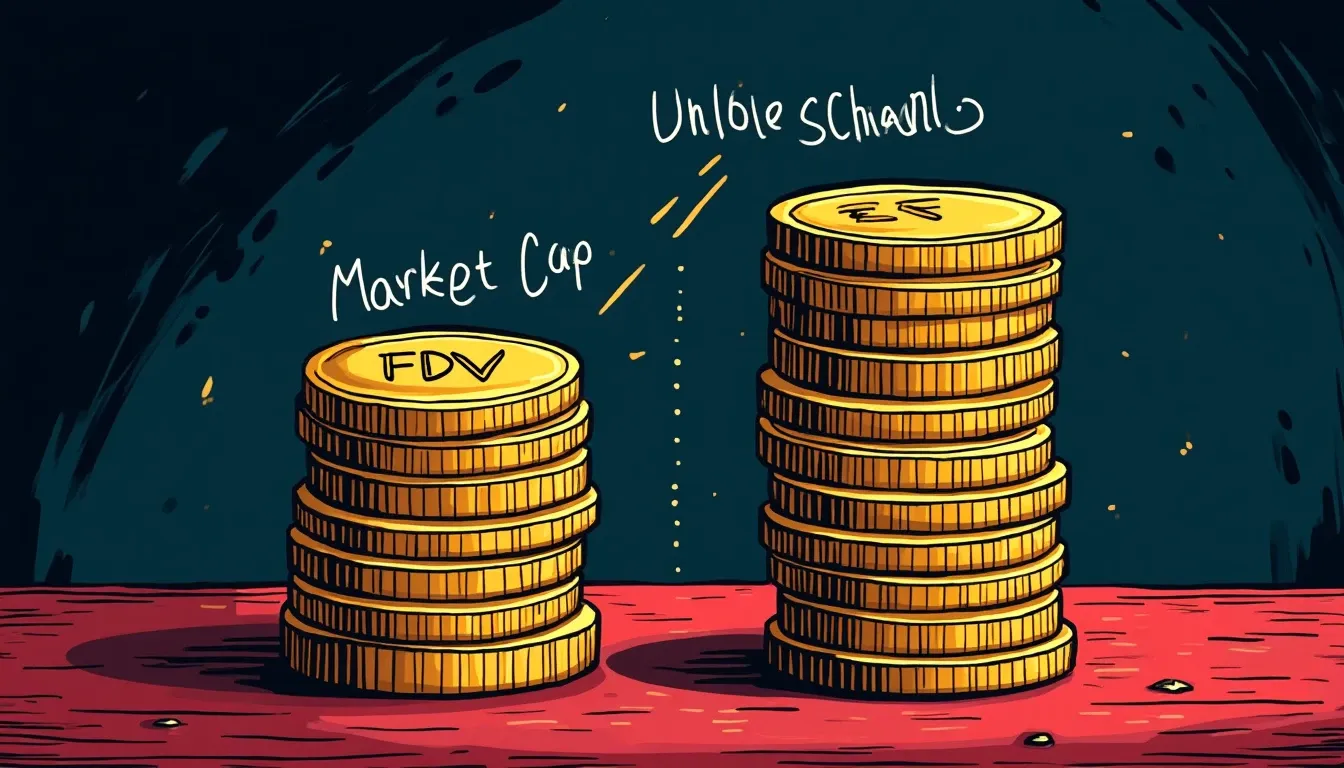
Example: a project claims $100M market cap but has only 5% circulating supply versus 100% max supply. That is 20x dilution risk. The real fully diluted valuation (FDV) is $2 billion, not $100 million.
Large gaps between circulating supply and fully diluted valuation signal future dilution as locked tokens enter the market through vesting and unlock schedules.
Check Vesting Schedules
Vesting is a time-based process that gradually releases tokens to recipients like team members or investors. A typical schedule has a cliff (an initial period when nothing unlocks) followed by a steady release over months or years.
Red flags: vesting periods under 12 months, or no cliff at all.
Projects with vesting cliffs of 6-12 months signal founder alignment. Projects with immediate or 3-month unlocks signal exit intent.
You can verify vesting schedules on-chain using platforms like Tokenomist, which tracks live vesting schedule and release data.
Identify Unlimited Minting or Extreme Supply
Tokens with unlimited minting or an extremely large supply may be a bad sign. Tokenomics may also skew the supply to the team or investors, leaving retail buyers with minimal influence.
If the whitepaper uses deliberately vague language or omits total supply details entirely, skip the project.
Step 2: Team Verification
Anonymous teams present significant risks. Founders face no reputational consequences for abandoning projects or executing exit scams. While Bitcoin's creator Satoshi Nakamoto was anonymous, this is the exception.
Search LinkedIn and GitHub
Team information is often available on the official website or in the project's whitepaper. Search for development team members on LinkedIn, GitHub, and professional networks.
Legitimate teams typically maintain public profiles showcasing their experience in blockchain technology, software development, or relevant industries.
Founders whose public profiles look fake are a red flag. LinkedIn accounts with only a handful of connections, created last week, are a clear sign that something doesn't add up.
Check for Generic Stock Photos
Generic stock photos for team profiles serve as a definitive red flag. Run a reverse image search on team photos. If the same face appears on multiple unrelated projects or stock photo sites, the team is fabricated.
Real-World Scam Examples
Pincoin took over $660 million in investor funds, then the team went missing. LoopX vanished with $4.5 million. Confido made off with $374,000 and subsequently disappeared. The company's alleged team members had fake identities.
You can cross-reference team credentials using the methods outlined in our guide to crypto scams.
Step 3: Consensus Mechanism Analysis
A serious project will explain why it chose its consensus mechanism and how it mitigates known attack vectors. Vague or absent consensus descriptions signal lack of technical depth.
Proof of Work vs. Proof of Stake
There are two major consensus mechanisms used by most cryptocurrencies today. Proof of Work (PoW) was popularized by Bitcoin, where miners compete to solve complex mathematical puzzles to validate and add blocks to the blockchain. PoW requires significant computational power and energy consumption, making it secure but resource-intensive.
Proof of Stake (PoS) is a type of consensus mechanism that uses the amount of stake (or value) held in the system to determine consensus. The newer consensus mechanism powers Ethereum 2.0, Cardano, Tezos, and other generally newer cryptocurrencies.
You can read more about the technical differences in Coinbase's comparison of PoW and PoS mechanisms.
Look for Formal Specifications
A legitimate whitepaper in 2026 contains formal mathematical specifications or pseudocode for core mechanisms, explicit citations to prior work and technical standards, tokenomics with clear formulas and on-chain enforcement, a roadmap with measurable engineering milestones, links to audited open-source code, verifiable team identities and track records, and honest risk disclosure including stress tests and failure modes.
If the consensus section is just buzzwords without formulas or code references, the project lacks technical depth.
Step 4: Problem Statement Evaluation
Every quality whitepaper should contain a clear, real, measurable problem. As a good example, take the Bitcoin whitepaper, which opens with a clear problem: online payments rely on financial institutions as intermediaries, which creates costs and risks.
Distinguish Real Problems from Marketing Copy
A red flag is when a project solves a problem that doesn't really exist, or the problem is described so vaguely that it could mean anything.
If you see claims of guaranteed high returns with little risk, be wary. Legit projects focus on solving real problems, not making unrealistic profit promises.
If the entire whitepaper is mostly focusing on the marketing side or the project's potential value, this may be a bad sign. Also, be wary if a whitepaper explicitly predicts the token's price growth over time.
Check for Hype Language
If it's stuffed with terms like "revolutionary" or "game-changing" without much backing, that's a sign they might be relying on hype.
Marketing-heavy language is a substitute for technical substance. Look for specifics: what does the protocol do, what contract state does it maintain, what are the edge cases.
Step 5: Red Flag Forensics
Some whitepapers are made in haste to tap into a trend or copy another successful project. Look out for plagiarized sections, outright copy-paste, or possible AI-generated content.
Writing Quality and Consistency
An inconsistent, shoddily written whitepaper with typos may signal that a project may lack the resources or the willingness to produce a quality document.
If it's riddled with jargon or grammatical errors, that's a red flag. You should see clarity in the document, making sure the complex stuff is explained simply.
AI-Generated Content Detection
Apply a four-step forensic workflow: (1) run NLP and plagiarism checks on key sections, (2) perform a tokenomics sanity check for logical consistency, (3) validate claims against deployed contracts on-chain, and (4) verify the team's track record and ecosystem partnerships.
AI-generated whitepapers often lack formal mathematical specifications, have no citations to prior work, contain tokenomics without clear formulas, feature generic roadmaps without measurable milestones, provide no links to audited code, and omit honest risk disclosure.
Common Failure Modes
The Circulating Supply Trap
You read a whitepaper, see a $50M market cap, and assume that's the valuation. You missed the circulating supply line: only 3% of tokens are unlocked. The fully diluted valuation is $1.67 billion. When the next vesting cliff hits in 6 months, 20% of total supply unlocks. The price drops 60% overnight.
Fix: always calculate FDV. Always check the vesting schedule. Always assume locked tokens will hit the market.
The Generic Team
You skim the team section, see professional-looking photos and impressive titles. You skip the LinkedIn check. Six weeks after launch, the team disappears with $12 million. Later you discover the photos were stock images and the LinkedIn profiles were created two weeks before the whitepaper launched.
Fix: verify every team member on LinkedIn and GitHub. Check account age, connection count, and post history. Run reverse image searches on all photos.
The Vague Problem Statement
The whitepaper claims to solve "inefficiencies in global finance" or "the lack of transparency in traditional systems." You can't identify a specific user who would benefit, a specific workflow that would change, or a specific metric that would improve.
Fix: if you can't explain the problem to someone outside crypto in one sentence, the problem statement is marketing, not engineering.
What to Do Next
After reading the whitepaper, cross-check the claims against on-chain data. If the project is already deployed, verify the tokenomics by reading the contract state on a block explorer. Check the vesting contracts to confirm the unlock schedule matches what the whitepaper claims.
Search for the team on LinkedIn, GitHub, and Twitter. Read the commit history if the code is open-source. Look for third-party audits from reputable firms like CertiK, Trail of Bits, or OpenZeppelin.
Compare the project's tokenomics to similar projects in the same category. If the team allocation is 35% and similar projects allocate 18%, ask why.
Finally, read the project's community channels. Look for critical questions and how the team responds. Teams that deflect or ignore tokenomics questions are teams that don't want you to understand the mechanism.
The Takeaway
A whitepaper is not a pitch deck. It is a technical specification and a transparency commitment. If the document lacks tokenomics clarity, verifiable team credentials, formal consensus mechanism descriptions, or honest risk disclosure, the project is either technically incompetent or deliberately opaque.
Both are reasons to skip.
The best whitepapers read like engineering documents: precise, specific, honest about failure modes. The worst read like marketing brochures: vague, aspirational, silent on stress conditions. You now know how to tell the difference.
Check circulating supply gaps. Verify team identities. Decompose the tokenomics. Confirm vesting schedules on-chain. If any of these steps fail, move to the next project.
Frequently Asked Questions
What are the most important sections to check in a crypto whitepaper?
Start with tokenomics: total supply, circulating supply at launch, allocation breakdown, and vesting schedules. Then verify team credentials on LinkedIn and GitHub. Check the consensus mechanism description for formal specifications or pseudocode. Finally, evaluate whether the problem statement is specific and measurable. If any of these sections are vague or missing, the project lacks transparency.
How do I spot a fake team in a crypto whitepaper?
Search every team member on LinkedIn and GitHub. Check account age, connection count, and post history. Run reverse image searches on team photos to detect stock images. Legitimate teams maintain public profiles with verifiable work history in blockchain, software development, or relevant industries. LinkedIn accounts created weeks before launch with minimal connections are red flags.
What is the circulating supply gap and why does it matter?
The circulating supply gap is the difference between tokens tradeable at launch and the total max supply. Large gaps signal dilution risk. If only 5% of tokens are circulating but 100% exist, the fully diluted valuation is 20x higher than the current market cap. When locked tokens unlock through vesting schedules, expect significant sell pressure and price declines.
What tokenomics red flags should I avoid?
Team allocations exceeding 30%, investor allocations exceeding 25%, or combined team and investor allocations exceeding 40-50% of total supply. Vesting periods under 12 months or no cliff period. TGE unlocks exceeding 25% of total supply. Unlimited minting mechanisms or extremely large total supply. Any whitepaper that uses vague language or omits allocation details entirely.
How can I verify a whitepaper's claims after reading it?
If the project is deployed, check on-chain data using a block explorer to verify tokenomics and vesting schedules. Use platforms like Tokenomist to track live vesting release data. Read the contract code if it's open-source and look for third-party audits from reputable firms. Search for team members on LinkedIn and GitHub to confirm identities. Compare the project's tokenomics to similar projects in the same category.