Table of Contents
What You Are Vetting
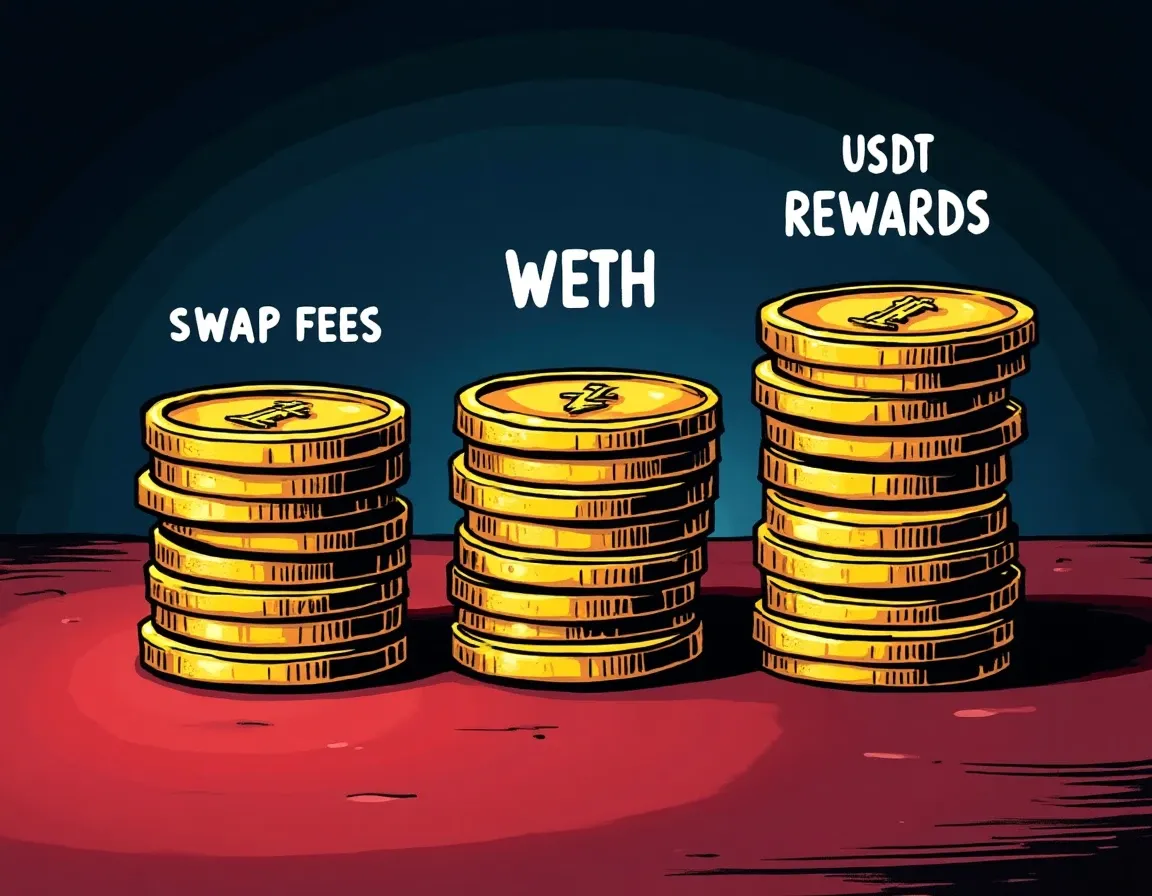
A WETH-USDT pool appeared this week at 24.45% APY on $79 million TVL. USDC-WETH on a higher TVL is 8.48%.
Your task is to determine whether that 24.45% is sustainable fee income or a narrow-range concentration that will cost you more in impermanent loss than it earns in fees.
On a $150,000 position, 24.45% generates $36,675 annually. If the pool is a 0.3% fee tier with 10% ranges and ETH moves 15% against USDT, one price swing erases three months of fees. Missing this calculation costs $9,000+ in unexpected IL.
This vetting protocol isolates the three drivers of high APY: narrow range concentration, temporary volatility surge, or fee tier difference. Then you calculate IL breakeven and compare the pool's first 90 days against established baselines.
Distinguish The Three APY Drivers

Narrow Range Concentration
Uniswap V3 lets you concentrate liquidity within a custom price range. A tighter range amplifies fee capture per dollar deployed, but also amplifies impermanent loss.
Check the pool's position distribution. If the 24.45% APY is driven by whale positions at ±5% ranges, you are looking at leveraged exposure. A 10% price move will push those positions out of range, halting all fee accrual until price reverts.
Best DeFi Protocols By Category tracks how established pools allocate across wider ranges to balance IL and fee income.
Temporary Volatility Surge
New pools often experience high trading volume during launch hype. If WETH-USDT launched this week alongside a token promotion or airdrop campaign, the 24.45% may reflect short-term turnover that collapses within 30 days.
Compare current 7-day volume to the 30-day moving average on established pairs. If the new pool shows 3x the volume of USDC-WETH on half the TVL, that spread will not hold.
Fee Tier Difference
Uniswap V3 offers four fee tiers: 0.01%, 0.05%, 0.30%, and 1.00%. Since December 2025, the protocol fee takes a cut from each tier. A 0.30% tier pays LPs 0.25% net of the 0.05% protocol fee. A 1.00% tier pays 0.8334% net of 0.1666% protocol cut.
If your 24.45% pool is on the 1.00% tier and the 8.48% USDC-WETH baseline is on 0.05%, the difference is structural. But a 1.00% tier only captures volume if traders accept the higher cost, which typically happens on low-liquidity pairs or volatile pairs where slippage dominates fee considerations.
Check GeckoTerminal or Uniswap Analytics for the fee tier and confirm whether the higher tier is attracting routing volume or sitting idle.
Calculate IL Breakeven
Impermanent loss is the opportunity cost of providing liquidity versus simply holding both tokens. On Uniswap V3, concentrated ranges amplify IL proportionally to the concentration factor.
If WETH and USDT move 10% relative to each other, IL is roughly 0.5% for a full-range position. A 50% relative price move generates about 12% IL. A 100% move costs roughly 20%.
But those figures assume full-range liquidity. A narrow ±10% range multiplies that IL by the concentration factor. If your position is 5x concentrated, a 10% price move can generate 2.5% IL instead of 0.5%.
Here is the breakeven calculation:
- 24.45% APY translates to 2.04% per month or 6.11% per quarter.
- If WETH moves 15% against USDT and your position is concentrated at ±10%, IL will approach 5-7% depending on the exact range.
- Breakeven requires fee income to exceed IL over the holding period.
On Ethereum's eight busiest Uniswap V3 pools over 12 months, LPs earned $41.6 million in fees and ended $20.4 million behind simply holding tokens. That is a -49% net return on fee income.
Your vetting job is to determine whether this specific pool, at this specific fee tier and range distribution, can beat that baseline.
Impermanent Loss Calculator lets you model price scenarios against your position size and range width.
Identify Pool Maturity Red Flags
New pools carry liquidity-risk vectors that TVL alone does not capture. Here are the four red flags:
1. Fragmented Position Count
The WETH-USDT 0.3% pool on mainnet shows 1,114 positions with a median net APR of +1.6% after protocol fees. That is 23 percentage points below your 24.45% figure.
If your pool shows 100+ positions fragmented across multiple ranges, each LP is competing for the same fee flow. The 24.45% may be a snapshot of the top-performing position, not the median.
Check the position count and range overlap on Uniswap Analytics. If 80% of TVL is clustered within a 5% range and price moves 10%, the entire pool goes idle.
2. Out-of-Range Earning Halt
Once price moves outside your range, your position stops earning fees entirely. On a volatile WETH-USDT pair, a 1% range can mean zero earnings after a 5% price swing.
Compare the pool's 7-day realized volatility to the median range width. If volatility is 8% and the median range is 5%, positions are cycling in and out of range daily. That is active-management territory, not passive yield.
3. Routing Liquidity Gap
High APY requires consistent trader flow. A new pool with $79 million TVL may lack routing liquidity if Uniswap's router prefers established pools with deeper depth.
Check 24-hour volume relative to TVL. A healthy pool turns over 10-30% of TVL daily. Below 5%, the APY is speculative.
4. Protocol Fee Double-Dip
New pools launched after March 2026 have active protocol fees. Quoted APYs on third-party trackers often omit this cost.
For a 0.30% tier, subtract the 0.05% protocol fee from gross APY. For a 1.00% tier, subtract 0.1666%. That is the LP's true take-home rate.
How To Verify If Uniswap V3 WETH-USDT 28.9% Is Sustainable walks through the 48-hour forensics protocol for isolating base fee APY from emissions and incentive expiry.
Track The Pool For 90 Days
Your unique edge is historical tracking. Most platforms show you current APY. No single source tracks how a newly-listed pool performs over its first 90 days relative to established baselines.
Here is the tracking protocol:
Day 1: Baseline Snapshot
- Record TVL, fee tier, position count, median range width, 7-day volume, and quoted APY.
- Note the contract address and confirm it on Etherscan.
- Capture the same metrics for USDC-WETH 0.05% as your control group.
Weekly Check-In (Days 7, 14, 21, 30, 60, 90)
- Log TVL delta, volume delta, APY delta, and position count delta.
- Calculate cumulative fees earned assuming a constant $150,000 position.
- Calculate realized IL using the Uniswap V3 LP returns research methodology: compare your current token balance to what you would hold if you had not provided liquidity.
- Net P&L = cumulative fees - realized IL.
90-Day Verdict
- If net P&L is positive and APY held above 18% for 60+ days, the pool is sustainable.
- If APY collapsed below 10% by day 30 and IL exceeded fee income, the pool was a launch-hype trap.
- If APY held but IL breakeven required constant rebalancing, the pool is active-management territory, not passive yield.
This comparison dataset (new vs. established pools over 90 days) does not exist in real-time on any single tracker. You build it yourself, or you allocate blind.
How To Respond When Your Uniswap V3 Pool Drops Off Yield Trackers covers the six-hour protocol for distinguishing tracker glitches from liquidity crises.
Compare Against Established Baselines
USDC-WETH 0.05% is your control group. It shows 8.59% supply APY on $99.17 million TVL with stable performance over 12+ months.
Your WETH-USDT pool at 24.45% on $79 million TVL claims to deliver 3x the return on slightly lower TVL. The question is whether that spread is compensation for higher IL risk or a temporary artifact of launch hype.
Run a side-by-side comparison:
- USDC-WETH 0.05%: 8.59% APY, $99M TVL, 0.0375% LP fee net of 0.0125% protocol fee, established 24+ months.
- WETH-USDT 0.3%: 24.45% APY, $79M TVL, 0.25% LP fee net of 0.05% protocol fee, launched this week.
The fee tier difference accounts for roughly 6.7x higher fees per trade (0.25% vs. 0.0375%). But APY is only 2.85x higher. That gap is either narrow-range concentration or temporary volume.
Check the 30-day volume-to-TVL ratio for both pools. If USDC-WETH turns over 20% daily and WETH-USDT turns over 15%, the APY difference is unsustainable.
How To Evaluate Uniswap V3 USDC-WETH 5.29pp Jump vs WETH-USDT 22.42pp Collapse shows the 72-hour verification protocol for distinguishing volume migration from volatility spikes.
What To Do Next
If you are allocating to the 24.45% pool, size your position to the breakeven IL threshold.
On $150,000 deployed, a 10% ETH price move against USDT will generate $7,500 IL if your range is ±10%. That is three months of fee income at 24.45%. If ETH volatility is running at 60% annualized, a 10% move is probable within 45 days.
Your allocation ceiling is the amount you are willing to lose if price moves out of range and you are forced to rebalance at a loss. For most passive LPs, that is 10-20% of total DeFi allocation.
Set a 30-day review. If APY holds above 20% and TVL is stable or growing, extend to 60 days. If APY collapses below 15% or TVL drops 20%, exit and reallocate to the USDC-WETH baseline.
DefiLlama Uniswap V3 dashboard tracks TVL, fees, and volume across all chains and fee tiers.
The Takeaway
A 24.45% APY on a new WETH-USDT pool is not inherently unsafe, but it is inherently active. The rate is either compensation for narrow-range IL risk or a temporary artifact of launch volume that will collapse within 30 days. Your job is to distinguish the two before you allocate, not after.
Track the pool weekly for 90 days and compare net P&L (fees minus IL) against the USDC-WETH baseline. If you cannot commit to weekly monitoring, stay in the 8.48% pool and accept the lower rate as the cost of passive exposure. If you can monitor and rebalance, the 24.45% pool may justify the active-management overhead, but only if you size your position to survive the first out-of-range event without forced liquidation.
The breakeven calculation is simpler than it appears: divide annualized APY by 12 to get monthly fee income, then model IL under 10%, 20%, and 30% price moves. If IL exceeds three months of fees under a 15% move and WETH volatility is above 50% annualized, the pool is active-management territory. Allocate accordingly.
Frequently Asked Questions
What drives a 24.45% APY on a new Uniswap V3 pool when established pools pay 8.48%?
Three factors drive high APY on new pools: narrow range concentration that amplifies fees per dollar but also amplifies impermanent loss, temporary launch hype that generates short-term trading volume, or a higher fee tier (0.3% or 1.0% versus 0.05%). Check the pool's fee tier, position distribution, and 7-day volume relative to established baselines. If the pool is on a 1.0% tier with whale positions concentrated in ±5% ranges, the 24.45% is real but requires active management to avoid IL exceeding fee income.
How do I calculate IL breakeven on a concentrated Uniswap V3 position?
Convert annualized APY to monthly or quarterly fee income, then model IL under realistic price moves. A 24.45% APY generates 6.11% per quarter. If your position is concentrated at ±10% and WETH moves 15% against USDT, IL will approach 5-7%. Breakeven requires fee income to exceed IL over your holding period. On Ethereum's eight busiest V3 pools over 12 months, LPs earned $41.6M in fees but ended $20.4M behind holding tokens due to IL. Use historical volatility to estimate probable price moves, then size your position to survive the first out-of-range event.
What are the red flags that a high-APY Uniswap pool is unsustainable?
Four red flags indicate unsustainable APY: fragmented position count with 100+ LPs competing for fees, median range width narrower than 7-day realized volatility (positions cycle in and out of range daily), 24-hour volume below 5% of TVL (insufficient routing liquidity), and quoted APY that omits the protocol fee introduced in December 2025. For a 0.3% tier, subtract 0.05% protocol fee; for 1.0% tier, subtract 0.1666%. If three or more red flags are present, the pool requires active management or reallocation to a lower-APY baseline within 30 days.
How long should I track a new Uniswap V3 pool before committing a full position?
Track for 90 days with weekly check-ins at days 7, 14, 21, 30, 60, and 90. Record TVL delta, volume delta, APY delta, and calculate cumulative fees earned versus realized IL. If net P&L (fees minus IL) is positive and APY held above 18% for 60+ days, the pool is sustainable. If APY collapsed below 10% by day 30 or IL exceeded fee income, the pool was a launch-hype trap. Most new pools reveal their true character within 30 days; the 90-day window captures seasonal effects and volatility cycles.
What position size is safe for a 24.45% APY pool on a volatile WETH-USDT pair?
Size your position to the amount you are willing to lose if price moves out of range and forces rebalancing at a loss. On a ±10% range with 60% annualized ETH volatility, a 10% price move is probable within 45 days and will generate 5-7% IL on a concentrated position. That erases three months of fee income at 24.45%. For most passive LPs, allocation ceiling is 10-20% of total DeFi allocation. If you cannot monitor weekly and rebalance within 24 hours of an out-of-range event, stay in the 8.48% USDC-WETH baseline.
You just learned how to distinguish real fee capture from narrow-range IL traps using 90-day tracking. Those pool metrics will shift next week, and the one after that.
Every Thursday: where crypto yield actually is - stablecoins, liquid staking and DeFi lending, with the risk named next to the rate and what changed since last week.
Get it free every ThursdayFree. No trade calls, no allocations, no hype. Unsubscribe in one click.