Table of Contents
What You Are Solving

The WBTC-WETH Uniswap V3 pool you are providing liquidity in has dropped 1.60 percentage points in one week. On $200,000 deployed, that costs $3,200 annually. If the LPs migrated to a 1% fee tier pool now offering 7%, staying in the old pool costs you $5,200 per year compared to following them. If volume dried up across the entire protocol, moving anywhere else saves nothing and burns gas for no reason.
You have 72 hours to determine what happened before the next fee distribution cycle locks in your decision. This guide walks you through the forensic process: isolating TVL changes, cross-checking volume data, identifying new pool deployments, and comparing fee tier economics to determine whether to stay, follow, or exit entirely.
Prerequisites
You need the contract address of your current pool, access to DefiLlama, Uniswap Info, and Etherscan, and $50-100 in ETH reserved for gas if you decide to migrate. You should understand impermanent loss mechanics and how concentrated liquidity positions earn fees only when price stays in range.
Step 1: Isolate TVL Change From Volume Change
APY in a Uniswap V3 pool is a function of two variables: trading volume and total value locked. The relationship is direct. If volume stays constant but TVL doubles, APY halves. If TVL stays constant but volume halves, APY halves. You need to separate these two causes before you can determine what action to take.
Go to DefiLlama's Uniswap V3 protocol page. Search for WBTC-WETH and filter by the fee tier of your pool. The most liquid WBTC-WETH pools are typically the 0.3% fee tier, but 0.05%, 0.3%, and 1% tiers all exist simultaneously. Write down the current TVL. Now click through to the historical chart and pull TVL from seven days ago.
If TVL dropped by 20-40% while your APY dropped 1.60pp, you have a liquidity exit, not a migration. LPs removed capital without redeploying it elsewhere on Uniswap. If TVL stayed flat or grew while APY dropped, volume declined or fee tier competition appeared.
Volume Cross-Check
Open Uniswap Info and navigate to the WBTC-WETH pool in your fee tier. Look at the 24-hour and 7-day volume tabs. Compare current 7-day volume to the figure from one week ago using the chart. If volume fell by 25-30%, that explains a 1.60pp APY drop entirely without any migration. Fee accrual in Uniswap V3 is proportional to swap volume times the fee tier, divided by in-range liquidity. A 27% volume drop with stable TVL produces roughly a 1.60pp APY decline on a pool that started near 6%.
If volume stayed constant or grew, the APY drop is coming from somewhere else. Move to step two.
Step 2: Check for New High-Fee-Tier Pool Deployments
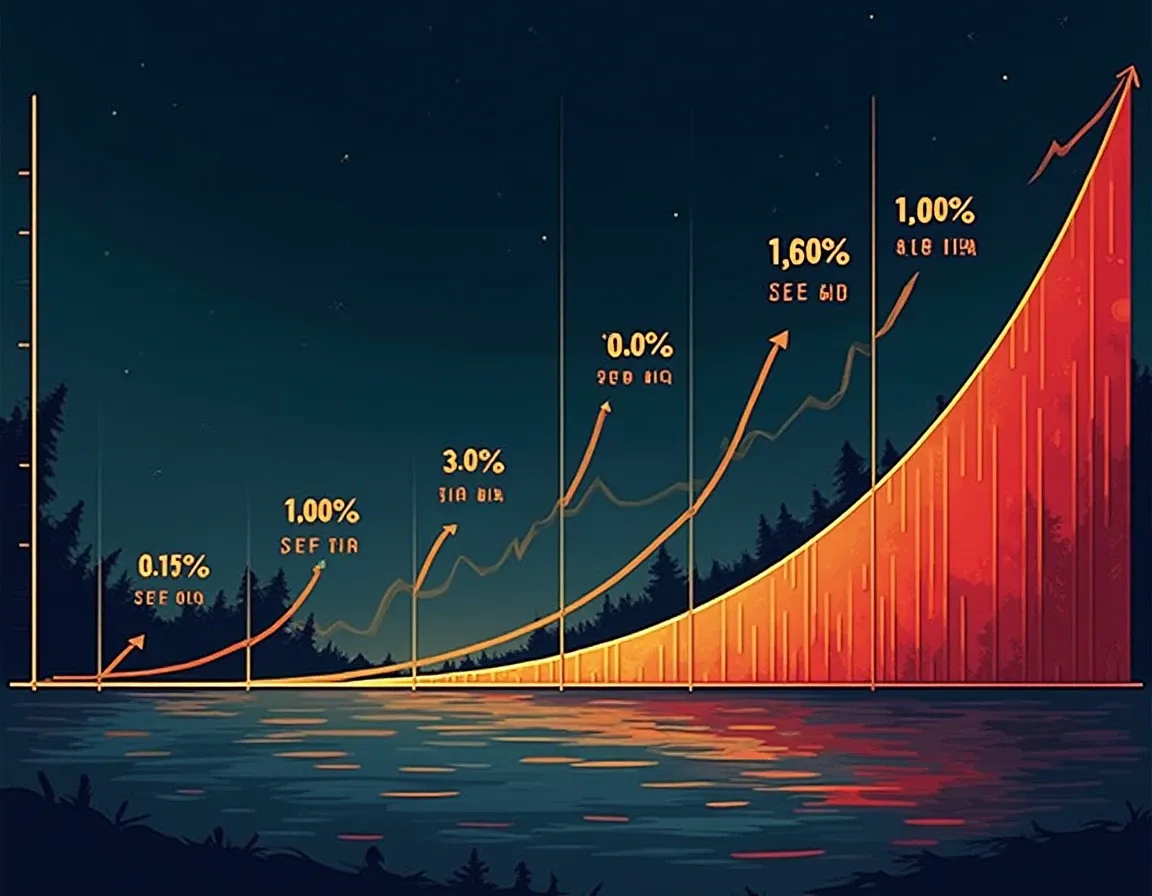
Uniswap V3 allows multiple pools for the same token pair, each with a different fee tier. The standard tiers are 0.01%, 0.05%, 0.3%, and 1%. When volatility increases or liquidity becomes scarce, LPs sometimes migrate from the 0.3% tier to the 1% tier to capture higher fees per swap. When volatility decreases or competition intensifies, they migrate down to the 0.05% tier to attract more volume. A 1.60pp APY collapse in the 0.3% pool can signal that a critical mass of LPs moved to the 1% pool, and your old pool is now undercapitalized and underperforming.
Return to DefiLlama and sort all WBTC-WETH pools by creation date. Look for any pool initialized in the past 7-14 days. If you see a new 1% fee tier pool with rising TVL and an APY in the 7-9% range, that is your migration signal. Cross-reference the TVL in the new pool with the TVL loss in your old pool. If the numbers match within 10-20%, LPs migrated.
Fee Tier Economics
The 1% fee tier pays LPs 0.8334% per swap, while the 0.3% tier pays 0.25% per swap. On volatile pairs like WBTC-WETH, the 1% tier can outperform the 0.3% tier even at lower volume, because the fee per unit of volume is 3.3x higher. Uniswap's fee documentation breaks down how fees accrue based on in-range trading volume. If your original pool is 0.3% and a new 1% pool appeared, the migration makes economic sense for LPs willing to tolerate wider spreads and lower volume.
However, the 1% tier also attracts less volume per dollar of TVL, because traders avoid high-fee pools when they have alternatives. If the 1% pool's APY is only 1-2pp higher than your current 0.3% pool despite the fee tier gap, the migration is not capturing enough volume to justify the move. In that case, the entire WBTC-WETH market is seeing volume decline, and moving pools solves nothing.
Step 3: Use Etherscan to Verify Pool Initialization Events
DefiLlama can lag by 24-48 hours in indexing new pools. If you suspect a migration but do not see a new pool listed, check Etherscan directly. Go to the Uniswap V3 factory contract (0x1F98431c8aD98523631AE4a59f267346ea31F984) and filter events by the PoolCreated log. This event fires every time a new pool is deployed.
Search for WBTC and WETH as token0 and token1. Look at the fee parameter in the event log. Fee tier values are 10000 for 1%, 3000 for 0.3%, 500 for 0.05%, and 100 for 0.01%. If you see a PoolCreated event with fee=10000 in the past week, a new 1% WBTC-WETH pool exists. Copy the pool address from the event log and paste it into DefiLlama or Uniswap Info to pull current TVL and APY.
Timing Matters
If the new pool was created 3-5 days before your APY collapse, the migration is confirmed. LPs typically move in waves over 48-72 hours once a new high-yield pool stabilizes. If the pool was created after your APY dropped, the collapse triggered the migration rather than causing it. In that scenario, the original cause is volume decline, and the new pool is a response, not the driver.
Step 4: Compare In-Range Liquidity Concentration
Uniswap V3 LPs earn fees only when the token pair price stays within their selected range. A sudden APY drop can indicate that price volatility pushed a large portion of liquidity out of range, reducing the effective TVL earning fees. This is distinct from a true liquidity exit or migration, because the capital is still in the pool but no longer active.
Open Uniswap Info and navigate to your pool. Click on the liquidity distribution chart. This shows where LPs have concentrated their positions. If the current WBTC-WETH price is near the edge of the highest liquidity concentration, a small price move will push significant capital out of range, causing APY to spike for the remaining in-range LPs or collapse if most liquidity went idle simultaneously.
Check the price history over the past seven days. If WBTC-WETH moved 5-8% in either direction, and the liquidity chart shows most positions concentrated in a narrow range, the APY drop is temporary. When price mean-reverts, liquidity comes back in range and APY recovers. However, if price stayed stable and liquidity is evenly distributed, the APY drop is not range-related. You are looking at true TVL exit or volume decline.
Rebalancing as a Signal
Mass rebalancing events look like migrations but are not. When WBTC-WETH experiences a sharp price move, LPs withdraw and redeploy in new ranges rather than waiting for mean reversion. This creates a 24-48 hour window where TVL appears to collapse, but the capital returns in adjusted positions within 2-3 days. If your APY dropped and TVL fell by 30-40% but price also moved 6-10%, wait 48 hours before deciding to migrate. The pool may recover on its own as LPs complete their rebalancing.
Step 5: Cross-Check All WBTC-WETH Fee Tiers
At any given time, at least three WBTC-WETH pools operate on Uniswap V3, each with a different fee tier. Current data shows pools at $40.8M TVL with 1.88% APY, $38.7M TVL with 7.62% APY, and $35.21M TVL with 7.3% APY. These figures represent different fee tiers capturing different trade flows. A collapse in one tier does not always correlate with collapses in the others. If your 0.3% pool dropped 1.60pp but the 1% pool jumped 2-3pp in the same window, migration is confirmed.
Pull APY and TVL data for all three major tiers: 0.05%, 0.3%, and 1%. Plot them on a timeline over the past 7-14 days. Look for inverse correlations. When one pool's APY drops and another's rises by a similar magnitude, and TVL shifts proportionally, that is a clean migration signal. When all three pools drop simultaneously, the entire WBTC-WETH market is seeing volume decline, and migrating to a different DeFi protocol is the better move than switching Uniswap fee tiers.
Protocol-Level Volume Check
Open DefiLlama and navigate to Uniswap V3's overall protocol page. Check the 30-day TVL trend. As of late 2026, Uniswap V3 TVL decreased 4.6% over 30 days. If the protocol-wide TVL is declining, your WBTC-WETH pool is declining with it, and the APY drop is part of a broader market shift. In this scenario, migrating to another Uniswap pool does not solve the problem. You are better off evaluating alternative pairs like USDC-WETH or WETH-USDT that may be capturing volume Uniswap is losing on the WBTC side.
Decision Framework: Stay, Follow, or Exit
You now have four pieces of data: TVL change, volume change, new pool deployments, and in-range liquidity concentration. Here is how to combine them.
Scenario A: Migration Confirmed
If TVL in your pool dropped 25-40%, a new high-fee-tier pool appeared in the past 7 days, and that new pool's TVL matches the loss in your pool, LPs migrated. Check the new pool's APY. If it is 2pp or more above your current pool, calculate the gas cost and migration breakeven. On $200k deployed, a 2pp difference is $4,000 annually. If gas costs $80-150 to exit and re-enter, you break even in 7-14 days. Follow the migration.
Scenario B: Volume Decline Confirmed
If TVL stayed flat but volume dropped 25-30%, and no new pools appeared, the WBTC-WETH market is seeing lower trading activity. Check protocol-wide volume on DefiLlama. If Uniswap's overall volume is down, this is a market-wide shift. Staying in the pool makes sense only if you expect volume to recover in 30-60 days. If volume decline persists beyond 90 days, exit and reallocate to higher-volume pairs.
Scenario C: Out-of-Range Event
If price moved 6-10% and liquidity is concentrated in a narrow range, the APY drop is temporary. Wait 48-72 hours for rebalancing to complete. If APY does not recover within that window, treat it as a volume decline scenario.
Scenario D: Protocol-Wide Decline
If all WBTC-WETH fee tiers dropped simultaneously and Uniswap V3's overall TVL is down 4-6% month-over-month, the entire DEX is losing market share. Migrating to another Uniswap pool does not help. Evaluate alternative protocols or stablecoin-focused pools on Curve that are less sensitive to WBTC-specific volume shifts.
Common Failure Modes
LP migrations fail in predictable ways. Here are the most common errors and how to avoid them.
Chasing APY Without Checking Volume Sustainability
A new 1% fee tier pool showing 9% APY is only sustainable if it captures stable volume. If the APY is spiking due to a temporary arbitrage event or a liquidity imbalance, it will collapse within 7-10 days as volume normalizes. Before migrating, check the new pool's 7-day volume trend. If volume is flat or declining despite high APY, the yield is not sustainable. You are better off staying in the 0.3% pool with predictable 4-5% returns than chasing a 9% APY that will revert to 3% within two weeks.
Ignoring Gas Costs Relative to Position Size
On $50,000 deployed, a 1.60pp APY difference is $800 annually. If gas costs $120 to migrate, you need 55 days to break even. If the new pool's APY advantage is temporary, you lose money on the migration. Gas cost as a percentage of position size determines migration viability. On positions under $100k, only migrate if the APY gap is 2pp or more and the new pool shows stable volume for at least 5-7 days.
Misreading Temporary Rebalancing as Permanent Exit
When TVL drops 30% in 48 hours after a sharp price move, new LPs assume the pool is dying. In most cases, it is rebalancing. LPs withdraw, adjust ranges, and redeploy within 72 hours. If you exit during rebalancing, you miss the APY recovery and pay gas twice for nothing. Always wait 48 hours after a sharp TVL drop before deciding to migrate, unless you see a confirmed new pool with inverse TVL growth.
The Takeaway
A 1.60pp APY collapse in WBTC-WETH is actionable information, not noise. On $200,000 deployed, that costs $3,200 per year, and if LPs migrated to a 7% pool, staying costs another $5,200 in opportunity cost. But migration only makes sense when the data confirms where liquidity moved. Check TVL loss against new pool TVL gains. Check volume decline against protocol-wide trends. Check in-range liquidity concentration against recent price moves. The forensic process takes 60-90 minutes and saves you from migrating into a pool that will collapse in two weeks or staying in a pool that will never recover. The LPs who capture Uniswap V3 yield consistently are the ones who verify migration signals before they move, not the ones who chase APY numbers without checking the data behind them.
You now have the complete data-collection checklist. If the migration is real and the new pool's volume is stable, you follow within 48 hours. If the collapse is volume decline, you hold and reassess in 30 days. If it is a rebalancing event, you wait 72 hours and do nothing. Each outcome has a different cost, and the difference between them is $5,000-10,000 annually on a $200k position. The next time WBTC-WETH APY drops 1.5pp or more, you will know within six hours whether to stay, follow, or exit entirely.
Frequently Asked Questions
How quickly can I tell if a Uniswap V3 APY drop is a migration or volume decline?
Check DefiLlama and Uniswap Info for TVL and volume changes over the past 7 days. If TVL dropped 25-40% in your pool and a new high-fee-tier pool appeared with matching TVL gains, that is migration. If TVL stayed flat but volume dropped 25-30%, that is volume decline. The forensic process takes 60-90 minutes and determines whether migration makes economic sense or wastes gas on a move that solves nothing.
What gas cost threshold makes a 1.60pp APY difference worth migrating for?
On $200,000 deployed, a 1.60pp APY difference is $3,200 annually. If gas costs $80-150 to exit and re-enter, you break even in 9-17 days. On positions under $100k, only migrate if the APY gap is 2pp or more and the new pool shows stable volume for at least 5-7 days. Below $50k, gas cost as a percentage of position size usually makes migration uneconomical unless the APY gap exceeds 3pp.
How do I distinguish a temporary rebalancing event from a permanent liquidity exit?
Check if WBTC-WETH price moved 6-10% in the 48 hours before TVL dropped. If yes, and liquidity is concentrated in a narrow range on the Uniswap Info chart, LPs are rebalancing out-of-range positions. Wait 72 hours. If TVL recovers and APY stabilizes, it was rebalancing. If TVL stays down and no new pool appeared, it is a permanent exit driven by volume decline or protocol-wide market share loss.
When should I exit Uniswap entirely instead of migrating between WBTC-WETH fee tiers?
If all WBTC-WETH fee tiers (0.05%, 0.3%, 1%) dropped simultaneously and Uniswap V3 protocol-wide TVL is down 4-6% month-over-month, the entire DEX is losing market share. Migrating to another Uniswap pool does not solve the problem. Evaluate alternative protocols or stablecoin-focused pools on Curve that are less sensitive to WBTC-specific volume shifts. Exit when protocol-level decline persists beyond 60-90 days.
What fee tier should I migrate to if LPs left the 0.3% WBTC-WETH pool?
Check the 1% fee tier first. The 1% tier pays LPs 0.8334% per swap versus 0.25% in the 0.3% tier, making it economically attractive even at lower volume during high-volatility periods. If the 1% pool shows 2pp or higher APY than your current 0.3% pool and stable 7-day volume, migrate there. If the 1% pool APY is only 1pp higher, the migration does not justify gas costs, and the entire WBTC-WETH market is seeing volume decline.
You just verified if 1.60pp WBTC-WETH APY collapse is migration or exit, and isolated the five data points that determine whether to follow or stay. Those signals will look different next week.
Every Thursday: where crypto yield actually is - stablecoins, liquid staking and DeFi lending, with the risk named next to the rate and what changed since last week.
Get it free every ThursdayFree. No trade calls, no allocations, no hype. Unsubscribe in one click.