Table of Contents
The Question That Should Have Been Asked Earlier

Anchor Protocol launched in 2021 advertising 19.45% annual interest on UST deposits, and at its height held more than $14 billion of UST. Celsius offered between 8% and 17% on stablecoin deposits. BlockFi paid 8% APY on USDC and USDT. By the end of 2022, all three had collapsed, taking billions of depositor capital with them. The question that matters now is not whether these yields were sustainable - history answered that conclusively - but whether the next 15% advertised rate will fail for the same reasons, and whether the warning signs will be visible before the collapse.
The answer is that high stablecoin yields fail for three identifiable reasons, each with its own timeline and set of leading indicators. Unsustainable subsidies, leverage stacking, and Ponzi-style recycling have accounted for every major stablecoin yield collapse in the last four years. What follows is the mechanism analysis of each, the specific market conditions that unwind them, and the signals that surfaced 60 to 90 days before each historical failure.
Three Mechanisms That Produce Unsustainable Yield
The stablecoin yield collapses of 2022 were not random events. They were the predictable result of three specific structural mechanisms, each of which produces advertised yields that exceed what the underlying economic activity can support over time. The first is direct subsidy from a protocol reserve or foundation treasury. The second is leverage stacking, where a platform borrows at low cost and lends at higher rates while relying on collateral values that can fall. The third is Ponzi-style recycling, where new deposits fund the interest payments on older deposits rather than actual revenue-generating activity.
Unsustainable Subsidies: The Anchor Protocol Model
Anchor Protocol paid 19.45% annual interest on UST by contributing extra payments from an on-chain reserve of UST. The protocol's borrowers paid interest on their loans, but that interest alone could not cover the 19.45% promised to depositors. At peak deposits of over $14 billion, Anchor needed to pay out more than $2.5 billion in annual interest. Borrower interest and yield reserve contributions combined fell short by approximately $1.8 billion per year.
By January 2022, the yield reserve held $34.13 million UST while the protocol was paying 19.88% on $13.3 billion in deposits. At that burn rate, the reserve would empty within weeks. By April 2022, the daily subsidy requirement reached $6 million, prompting the Terra community to pass a proposal to gradually decrease the 19.5% rate starting May 1, 2022. The proposal never took effect. On May 12, 2022, when the Terra blockchain halted, Anchor held $2.124 billion in deposits and only $147 million borrowed. The math had become untenable three months earlier, but the collapse arrived within days once confidence broke.
The European parallel is the eurozone sovereign debt crisis of 2011 through 2013, when Greece, Portugal, and Ireland offered yields on government bonds that exceeded 10% and in some cases 20%. Those yields were not returns - they were market-priced estimates of default probability. When the underlying credibility of the sovereign borrower broke, the bonds did not pay their coupon. They defaulted, and the advertised yield became a loss that had been accruing all along. Anchor's 19.45% was the same: a number that reflected the protocol's inability to fund the promise, visible to anyone who compared deposits to reserve balances.
Leverage Stacking: The Celsius and BlockFi Model
Celsius and BlockFi offered between 8% and 17% on stablecoin deposits by taking custody of those deposits and deploying them into lending, trading, and counterparty exposure that promised higher returns. Both platforms functioned as leveraged intermediaries. They borrowed from depositors at one rate and lent or traded at higher rates, capturing the spread. The model depends on three conditions: sufficient borrower demand at rates higher than the deposit rate, stable collateral values that can be liquidated if loans default, and access to liquidity when depositors withdraw.
All three conditions failed in 2022. Celsius had lent to counterparties including Three Arrows Capital, which defaulted in June 2022. BlockFi had extended a $400 million credit line to Three Arrows Capital as well. When crypto asset prices fell throughout 2022, the collateral backing those loans lost value faster than liquidation mechanisms could respond. Celsius froze withdrawals on June 12, 2022. BlockFi filed for bankruptcy protection on November 28, 2022, days after FTX - its lender of last resort - collapsed.
The failure mode here is not insolvency through subsidy depletion, but insolvency through counterparty exposure and collateral decline. Both Celsius and BlockFi depended on perpetually rising asset prices to remain solvent. When prices fell and leverage unwound, liquidity disappeared. Depositors discovered that their stablecoin deposits had been treated as unsecured loans to platforms with undisclosed counterparty risk.
The European reference is the 2008 banking crisis, when institutions thought they were insulated from subprime mortgage exposure through layers of securitization and credit derivatives. When the underlying collateral - U.S. housing - declined in value, the entire chain of leveraged intermediaries discovered that liquidity and solvency were the same thing. Celsius and BlockFi were crypto's version of Northern Rock and Dexia: intermediaries that borrowed short and lent long, with insufficient liquidity buffers when confidence broke.
Ponzi-Style Recycling: The General Pattern
The third mechanism is the simplest and the most common. If a protocol's revenue cannot cover the value of rewards distributed, the yield is being funded by new deposits or token dilution. The leading indicators of Ponzi-style recycling are APYs consistently above 50% with no clear revenue source, rewards paid entirely in newly launched governance tokens, and returns that depend on continuous new depositor inflows.
This pattern appeared in dozens of smaller protocols in 2021 and 2022, but the logic applies to any yield opportunity where the source of return is opaque or depends on token price appreciation. The warning sign is when the answer to "where does the yield come from" includes the phrase "incentive rewards" or "governance token distribution" without identifying the underlying revenue that will eventually buy those tokens back or sustain their value.
The Leading Indicators That Surfaced Before Collapse

The retrospective view is that all three collapses were obvious. The forward-looking question is which signals were actually visible 60 to 90 days before depositors lost access to funds. Four indicators surfaced consistently across Anchor, Celsius, and BlockFi, and all four were observable on-chain or in public disclosures before the final failure.
Yield Reserve Depletion and Burn Rate Acceleration
Anchor's yield reserve was visible on-chain. As UST deposits grew through late 2021 and early 2022, the reserve balance declined at an accelerating rate. By January 2022, when the reserve held $34.13 million against $13.3 billion in deposits, the implied runway at 19.88% APY was less than 60 days. The Luna Foundation Guard recapitalized the reserve with $450 million in February 2022, but that was a temporary patch for a structural deficit. The daily subsidy requirement reached $6 million in April, visible to anyone tracking the reserve address.
The lesson is that when active deposits exceed the yield reserve by a factor of 300 or more, and the stated yield rate implies a burn rate measured in millions per day, the math becomes untenable within weeks. This is not hindsight. It is arithmetic.
Deposit-to-Borrow Imbalance
Anchor's second failure signal was the widening gap between deposits and borrowing. In a sustainable lending protocol, deposits roughly match borrows over time, because the interest paid by borrowers funds the yield paid to lenders. By early 2022, Anchor showed deposits growing while borrowing declined. At collapse, the protocol held $2.124 billion in deposits but only $147 million borrowed. The loan demand shortage exceeded 300%.
When deposits outstrip borrows by that margin, there are no borrowers to generate the yield. Only the reserve can fill the gap, and the reserve has a visible expiration date. This imbalance was on-chain and public 90 days before the May 2022 halt.
Liquidity Profile Degradation
Celsius and BlockFi did not publish real-time on-chain reserve data, but both showed liquidity profile changes in the months before collapse. Celsius froze withdrawals on June 12, 2022, after weeks of rumors about exposure to Three Arrows Capital and declining asset values. BlockFi disclosed its exposure to FTX only after FTX filed for bankruptcy in November. The specific warning sign was not the exposure itself - that was hidden - but the platforms' increasing reliance on external credit lines and public statements reassuring depositors while privately negotiating rescue financing.
When a custodial platform begins issuing public reassurances about liquidity, the correct inference is that liquidity is already constrained. The timing of those reassurances, relative to withdrawal freezes, has been consistent: 30 to 60 days.
Yield Compression in Comparable Protocols
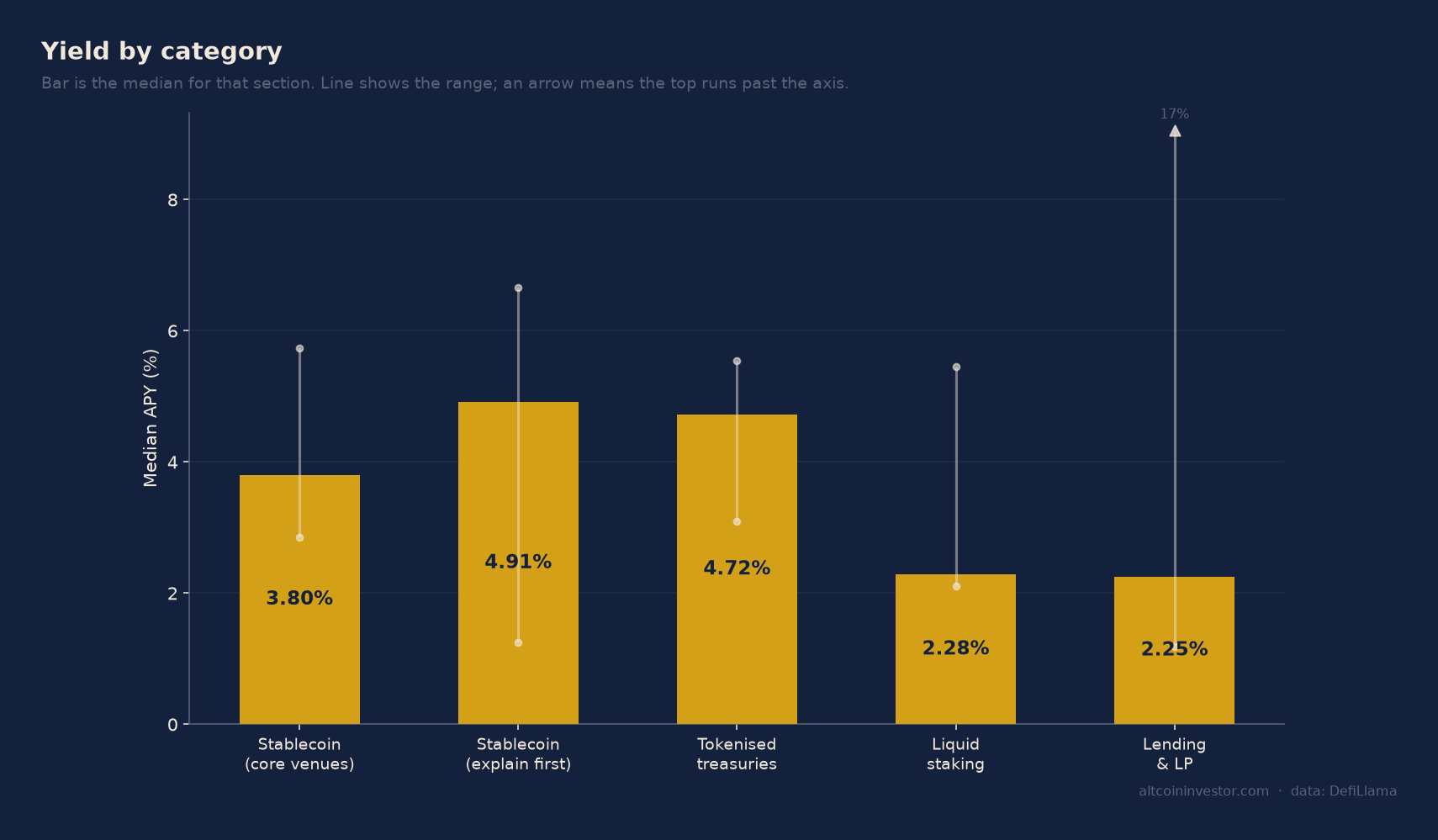
The fourth signal is comparative. When transparent DeFi protocols with visible on-chain revenue pay 4% to 6% on stablecoins, and a custodial platform or subsidized protocol offers 15% or more, the difference is the risk premium or the unsustainable subsidy. In 2026, reputable DeFi lending venues like Aave, Morpho, and Compound pay between 3.57% and 6% on USDC and USDT. The Maker Dai Savings Rate offers 5% to 8% on DAI. Ethena's sUSDe pays approximately 3.6% as of May 2026, derived from basis trade funding rates and staking rewards.
When a protocol advertises 15% or higher, the question is not whether the rate is attractive. The question is what structural difference justifies the premium, and whether that difference will persist when market conditions change. In every historical case, the answer was no.
What Current Market Conditions Reveal About Sustainability
The stablecoin yield environment of 2026 is instructive precisely because it is so much lower than 2021. Aave v3 pays 3.57% on Ethereum and 3.65% on Base for USDC deposits. Compound v3 offers 4.51% on Ethereum. The Dai Savings Rate has compressed from 11% in early 2024 to between 5% and 8% in 2026. These are not exciting numbers, but they are sustainable because they derive from borrower interest, protocol fees, and real economic activity.
The lesson from the 2021-2022 collapses is that sustainable yield originates from identifiable revenue: borrower interest, trading fees, funding rate arbitrage, or protocol take rates. When the source of yield is opaque, or when the advertised rate exceeds what transparent protocols pay by a factor of two or more, the difference is either custodial risk or structural unsustainability.
The U.S. GENIUS Act, signed into law in July 2025, prohibits payment stablecoin issuers from paying yield directly to holders. This regulatory shift has pushed yield generation into a separate layer - lending protocols, DeFi venues, and custodial platforms that are not themselves stablecoin issuers. The result is that yield transparency has improved slightly, because platforms must now disclose what they do with deposits in order to generate returns. But custodial risk remains, and the platforms offering the highest rates are still the ones taking the most counterparty exposure or deploying the most leverage.
The Risk Screening Framework That Would Have Identified All Three Failures
A simple four-question framework would have surfaced the structural risk in Anchor, Celsius, and BlockFi 60 to 90 days before collapse. The questions are: where does the yield actually come from, can you verify the source on-chain or in audited financial statements, what is the deposit-to-borrow ratio or equivalent metric, and what is the liquidity profile if 20% of depositors withdraw in a single week?
For Anchor, the first question revealed that yield came from a depleting reserve, not from borrower interest. The third question showed deposits outstripping borrows by a factor of ten or more. The fourth question had no satisfactory answer, because the protocol had no mechanism to fund mass withdrawals once the reserve emptied. All three signals were public and on-chain in early 2022.
For Celsius and BlockFi, the first question had no public answer. Neither platform disclosed where depositor funds were deployed, which counterparties held loans, or how collateral was managed. The absence of transparency was itself the warning. The fourth question - liquidity under withdrawal pressure - became acute in June 2022 when both platforms began issuing reassurances and negotiating rescue credit lines. Depositors who asked the questions in April 2022 would have had 60 days to withdraw before the freezes.
In 2026, the same framework applies. Protocols that pay 15% or more without clear revenue sources are either subsidizing yield from treasuries that will deplete, stacking leverage that will unwind, or relying on new deposits to fund old withdrawals. The historical precedent is unambiguous. High yields do not persist when the mechanism producing them depends on conditions that cannot hold.
When Yield Reflects Risk, Not Return
The eurozone sovereign debt crisis taught European bond investors a lesson that crypto depositors learned in 2022: when a yield exceeds the risk-free rate by a wide margin, the excess is compensation for the probability of loss, not a gift. Greek government bonds offered 20% yields in 2011 because the market assigned a high probability to default. The yields were not returns. They were warnings, priced in basis points.
Stablecoin yields above 15% function the same way. They are not income opportunities. They are risk premiums, and the risk is that the mechanism producing the yield will fail before you withdraw. Anchor's 19.45% reflected the market's assessment that the protocol could not sustain the payout. Celsius's 17% reflected undisclosed counterparty exposure and leverage. BlockFi's 8% - lower than the others, but still double what transparent DeFi protocols offered - reflected custodial risk and dependence on perpetually rising collateral values.
The difference between 2022 and 2026 is that the market has already run the experiment. The protocols offering 15% or more today are not doing anything structurally different from Anchor, Celsius, or BlockFi. They are either subsidizing yield, stacking leverage, or obscuring the source of return. The warning signs are the same: opaque disclosures, deposit-to-borrow imbalances, burn rates that exceed reserve capacity, and reassurances issued when liquidity comes under pressure.
For depositors evaluating stablecoin yield opportunities in 2026, the relevant comparison is not the headline APY. It is the difference between the advertised rate and what transparent DeFi protocols with visible on-chain revenue are paying on the same stablecoins. That difference is the risk premium, and history suggests it compensates for the probability of total loss within 12 months.
The Takeaway
Every stablecoin yield above 15% that has been advertised in the last four years has either collapsed or compressed to single digits within 18 months. The mechanisms are identifiable: unsustainable subsidies that deplete visible reserves, leverage stacking that depends on rising collateral values, and Ponzi-style recycling where new deposits fund old withdrawals. The warning signs surface 60 to 90 days before failure, and they are visible in on-chain data, deposit-to-borrow ratios, reserve burn rates, and liquidity reassurances issued by platforms under stress. The lesson from Anchor, Celsius, and BlockFi is not that high yields are inherently fraudulent. It is that high yields reflect high risk, and the risk is structural collapse when the market conditions that sustain the mechanism change. In 2026, sustainable stablecoin yields range from 3.5% to 9%, sourced from borrower interest, protocol fees, and funding rate arbitrage. Anything meaningfully above that range is compensation for counterparty risk, leverage risk, or the probability that the yield will disappear before you withdraw. The question that matters is not whether today's 15% looks attractive. It is whether the mechanism producing it has already failed twice, and whether you will recognize the warning signs before the third collapse.
Frequently Asked Questions
What caused Anchor Protocol's 19.45% yield to collapse?
Anchor paid 19.45% by subsidizing depositor interest from an on-chain reserve of UST. Borrower interest could not cover the payouts. At peak deposits of $14 billion, the protocol needed to pay $2.5 billion annually but faced an $1.8 billion shortfall. By January 2022, the reserve held only $34 million against $13.3 billion in deposits. The burn rate reached $6 million daily by April 2022. When the reserve depleted and confidence broke in May 2022, the protocol collapsed within days.
How do you identify an unsustainable stablecoin yield before it collapses?
Ask four questions: where does the yield actually come from, can you verify the source on-chain or in audited statements, what is the deposit-to-borrow ratio, and what happens if 20% of depositors withdraw in one week. If the yield comes from a depleting reserve, deposits exceed borrows by 3x or more, or the platform cannot answer the liquidity question, those are 60-90 day warning signs. Compare the advertised rate to what transparent DeFi protocols pay. Differences above 2x the transparent rate reflect either custodial risk or structural unsustainability.
Why did Celsius and BlockFi fail when their yields were lower than Anchor's?
Celsius offered 8-17% and BlockFi paid 8% by taking custody of deposits and lending to counterparties at higher rates. Both platforms stacked leverage and had undisclosed exposure to Three Arrows Capital, which defaulted in June 2022. When crypto asset prices fell, collateral values declined faster than liquidation could respond. Both depended on rising asset prices to remain solvent. Celsius froze withdrawals June 12, 2022. BlockFi filed for bankruptcy November 28, 2022, days after FTX collapsed. The failure mode was counterparty exposure and liquidity crisis, not reserve depletion.
What stablecoin yields are sustainable in 2026?
Sustainable stablecoin yields in 2026 range from 3.5% to 9% APY. Aave v3 pays 3.57% on Ethereum and 3.65% on Base for USDC. Compound v3 offers 4.51%. The Maker Dai Savings Rate provides 5-8% on DAI. Ethena sUSDe pays approximately 3.6% from basis trade funding rates and staking rewards. These yields derive from borrower interest, protocol fees, and real economic activity. Rates above 10% in 2026 either carry custodial risk premiums or depend on mechanisms that have failed historically.
What is the European monetary parallel to stablecoin yield collapses?
The eurozone sovereign debt crisis of 2011-2013 offers the closest parallel. Greek, Portuguese, and Irish government bonds offered yields exceeding 10% and in some cases 20%. Those yields were not returns but market-priced estimates of default probability. When sovereign credibility broke, bonds defaulted and advertised yields became losses. Anchor's 19.45%, Celsius's 17%, and BlockFi's 8% functioned the same way: high rates reflected the probability of mechanism failure, not sustainable income. Both cases demonstrate that yields meaningfully above risk-free rates compensate for structural risk, not opportunity.
You have just examined three collapse mechanisms and the 60-90 day warning signs that surfaced before Anchor, Celsius, and BlockFi failed. Those mechanisms are being tested again in 2026.
Every Thursday: where crypto yield actually is - stablecoins, liquid staking and DeFi lending, with the risk named next to the rate and what changed since last week.
Get it free every ThursdayFree. No trade calls, no allocations, no hype. Unsubscribe in one click.