Aave's Tokenized Stock Collateral Misses the Income Story
Aave V4 now accepts tokenized stocks as collateral for USDC loans, but the structure excludes the users who need dollar credit most - those in high-inflation economies.
Real crypto income, honestly assessed: stablecoin yield, staking, and DeFi lending. What earns, what breaks and how to verify before you deposit.
Aave V4 now accepts tokenized stocks as collateral for USDC loans, but the structure excludes the users who need dollar credit most - those in high-inflation economies.
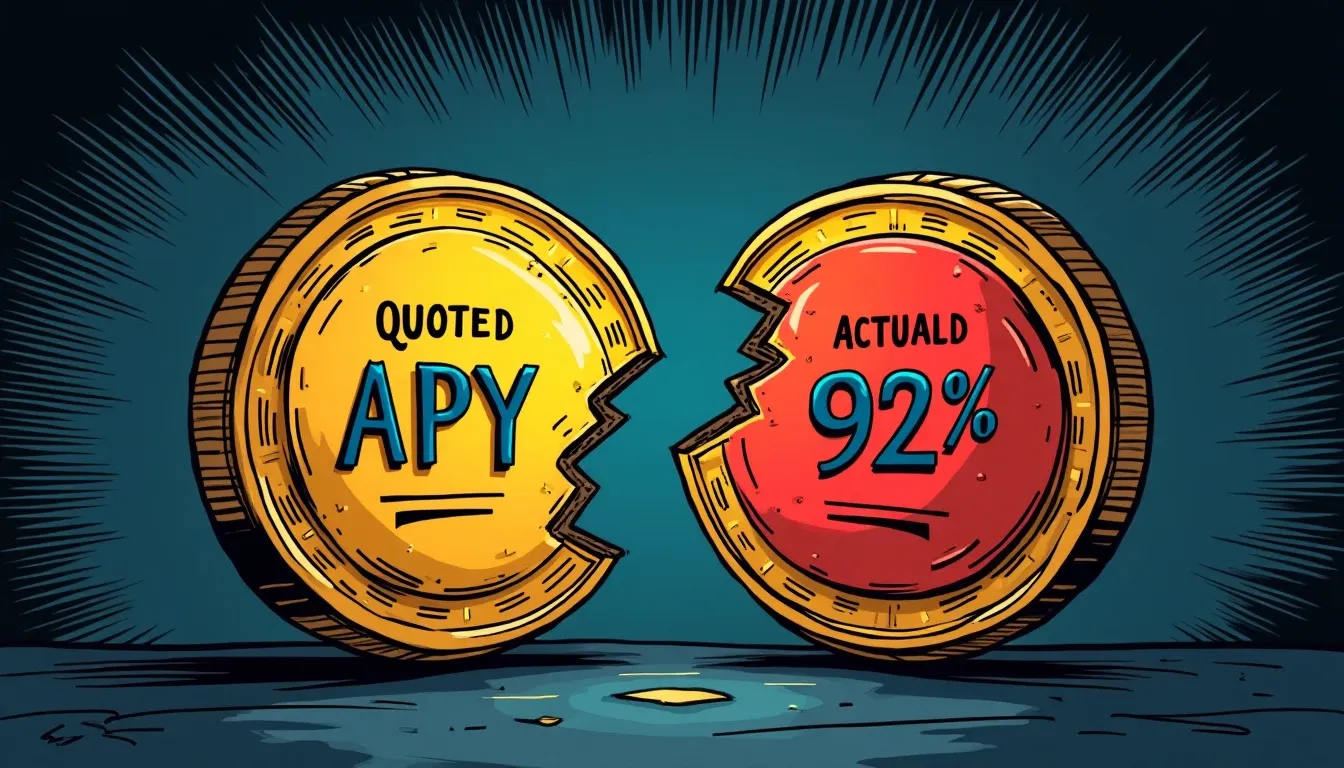
Most DeFi positions return 3-7 percentage points below quoted APY. Here is the five-component formula for measuring what a yield position actually nets.
A repeatable process for comparing equivalent-risk positions across protocols: matching collateral requirements, lock periods, audit scores, and TVL, then isolating the net rate difference.

APY drift, TVL drops, failed governance proposals, remediated audit findings, and social media panic often mean nothing. Here is how to tell noise from signal.
Rate is what a protocol advertises. TVL is what people do. When the two disagree, the second one is usually right. Here is how to read the signal.

Five on-chain signals visible 72 hours before the 5.36% to 3.29% Compound V3 USDC rate collapse. Monitor utilization curves, borrow trends, and governance to exit before yield crashes.
When your yield position vanishes from DefiLlama or RWA.xyz, you have six hours to distinguish data lag from liquidity freeze. Here's the exact checklist.

Most monitoring advice is a list of everything that could be checked. This is a list of what is worth checking and explicitly what is not.
sUSDe pays 7.1%, sUSDS pays 3.6%, sFRAX pays 4.1%, USDY pays 4.65%. Four yield-bearing stablecoins with entirely different risk stacks. Here's how to deploy under $1,000.

KelpDAO filed a lawsuit against LayerZero over the April 18 exploit that drained 116,500 rsETH worth $292 million, alleging the protocol endorsed the vulnerable configuration.
Anchor's 19.45% APY, Celsius's 17%, and BlockFi's 8% all went to zero within months. Three mechanisms explain why yields above 15% collapse predictably.

Where stablecoin and money market yields actually come from, what can break each, and which delivers better risk-adjusted returns when you account for collateral quality and failure modes.
DeFi protocols change fees, collateral factors, and emissions after you deposit. Governance votes on these changes days before they execute, if you know where to look.
Most people have more idle capital than they think. Stablecoins on exchanges, unwrapped tokens, dust across chains, unclaimed rewards. Here is the checklist.
RLUSD launched on Aave V3 at 4.98% APY with $133M TVL. Here is the repeatable 72-hour risk checklist for new stablecoin listings before you commit capital.

Bitget confirmed a $351.6M hot wallet breach via spoofed backend transfer data. Withdrawals remain frozen. Here's the counterparty risk exposure for DeFi users.